CF-105 Arrow vs F-104 Starfighter
CF-105 Arrow vs F-104 Starfighter at a glance — top speed 2,103 vs 2,500 km/h, range 483 vs 2,623 km, max takeoff weight 31,120 vs 13,170 kg, built 5 vs 2,578 units.
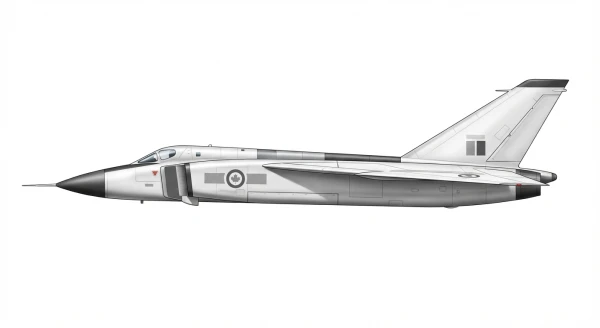
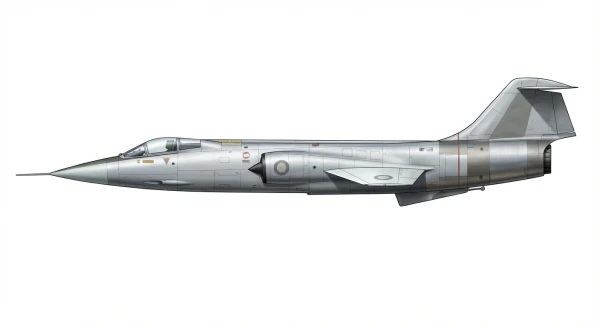
| CF-105 Arrow | F-104 Starfighter | |
|---|---|---|
| Origin country | 🇨🇦 Canada | 🇺🇸 United States |
| Category | Combat Aircraft | Combat Aircraft |
| Manufacturer | Avro | Lockheed |
| First flight | 25 March 1958 | 4 March 1954 |
| Year introduced | -- | 1958 |
| Number produced | 5 units | 2578 units |
| Average unit price | $3 million | $1.4 million |
| Wing area | 113.8 m² | 18.2 m² |
| Wingspan | 15.0 m | 6.4 m |
| Height | 6.3 m | 4.1 m |
| Length | 23.7 m | 16.7 m |
| Maximum speed | 2103 km/h | 2500 km/h |
| Operational range | 483 km | 2,623 km |
| Service ceiling | 16,154 m | 15,240 m |
| Max. takeoff weight | 31,120 kg | 13,170 kg |
| Empty weight | 22,245 kg | 6,350 kg |
| Total thrust | 2 x 10,659 kgf | 1 x 7,076 kgf |
Detailed Comparison
The CF-105 Arrow was a large, twin-engine interceptor designed to counter Soviet bombers over Canada's vast territory, while the F-104 Starfighter was a smaller, single-engine point-defense fighter born from the demand for pure speed and climb performance. The Arrow was a technologically ambitious project cancelled before entering service, with only five test aircraft built. In contrast, the Starfighter became a prolific Cold War asset, with over 2,500 units produced and serving in 15 air forces worldwide, evolving from an interceptor to a multi-role fighter-bomber.
Development and Design
The design philosophies behind the two aircraft were fundamentally different. The Arrow was a large delta-wing platform intended for long-range, high-altitude interception, incorporating advanced features for its time such as a rudimentary fly-by-wire system, extensive use of titanium, and a large internal weapons bay. Its development was a high-risk, high-cost national project intended to go directly to production. The Starfighter, conceived by Lockheed's Kelly Johnson, was a minimalist design focused on maximizing performance with existing technology. Its defining features were a small, thin, trapezoidal wing and a long, slender fuselage. This design optimized for supersonic speed and climb rate but presented significant handling challenges, especially at low speeds, which necessitated a boundary layer control system.
Specifications and Performances
The Arrow was a significantly larger and heavier aircraft, with an empty weight of 22,245 kg, over three times that of the Starfighter's 6,350 kg. This size was necessary for its intended role, requiring two powerful Pratt & Whitney J75 engines. While both aircraft were capable of Mach 2, their performance characteristics diverged sharply in other areas. The Starfighter's primary design goal was reflected in its exceptional climb rate of 244.0 m/s, nearly three times the Arrow's 84.0 m/s, making it a superior quick-reaction interceptor. The Arrow's larger delta wing (113.8 m² vs. the F-104's 18.22 m²) and planned Orenda Iroquois engines in the Mk 2 version were intended to provide superior performance at very high altitudes, with a projected service ceiling of over 70,000 ft for later variants.
Deployment and usage
Operational histories starkly divide the two aircraft. The CF-105 Arrow never entered military service. The program was cancelled on February 20, 1959, due to escalating costs and a strategic shift from bomber threats to intercontinental ballistic missiles (ICBMs). The five completed prototypes were destroyed, leaving the aircraft as a subject of historical debate. Conversely, the F-104 Starfighter had a long and widespread service life, beginning in 1958. It was used by the USAF in the Vietnam War and served as a deterrent during the Taiwan Strait and Berlin crises. Its greatest impact was through export, becoming a primary fighter for many NATO allies, including Germany, Italy, and Canada. Its adaptation into the F-104G multi-role fighter-bomber demonstrated its versatility, though its demanding flight characteristics resulted in a high accident rate in some air forces.
Conclusion
The CF-105 Arrow represents a case of immense but unrealized technological potential, a highly specialized solution whose strategic relevance evaporated before it could mature. Its cancellation underscores the risks of high-cost, single-purpose defense projects. The F-104 Starfighter, while flawed, was a successful design due to its focused performance, adaptability, and lower cost. It became a ubiquitous Cold War fighter that fulfilled a variety of roles for numerous nations, demonstrating that a less ambitious but more flexible and affordable platform can have a far greater strategic impact than a technologically superior but operationally non-existent one.