Atlas Cheetah vs MiG-21 Fishbed
Atlas Cheetah vs MiG-21 Fishbed at a glance — top speed 2,338 vs 2,125 km/h, range 2,600 vs 660 km, max takeoff weight 16,500 vs 8,625 kg, built 38 vs 11,496 units.
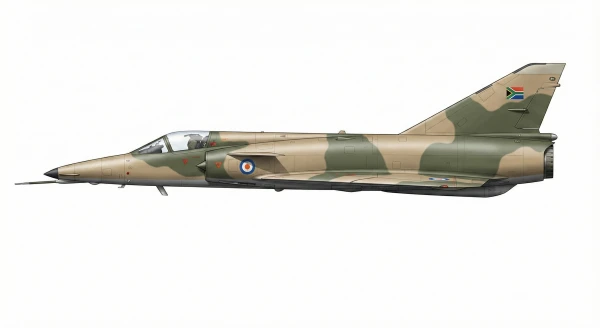
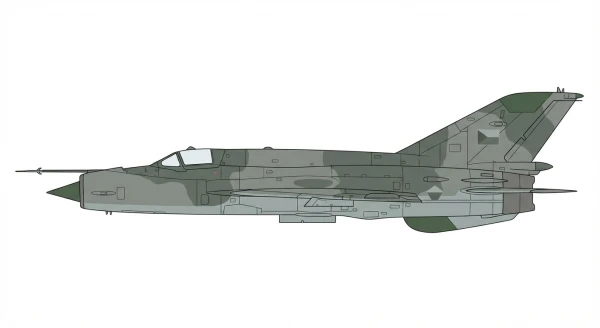
| Atlas Cheetah | MiG-21 Fishbed | |
|---|---|---|
| Origin country | 🇿🇦 South Africa | 🇷🇺 Ex-USSR |
| Category | Combat Aircraft | Combat Aircraft |
| Manufacturer | Atlas | Mikoyan-Gurevich |
| First flight | 16 July 1986 | 16 June 1955 |
| Year introduced | 1986 | 1958 |
| Number produced | 38 units | 11496 units |
| Average unit price | -- | $2 million |
| Wing area | 34.8 m² | 23.0 m² |
| Wingspan | 8.2 m | 7.2 m |
| Height | 4.6 m | 4.1 m |
| Length | 15.7 m | 13.5 m |
| Maximum speed | 2338 km/h | 2125 km/h |
| Operational range | 2,600 km | 660 km |
| Service ceiling | 17,000 m | 19,000 m |
| Max. takeoff weight | 16,500 kg | 8,625 kg |
| Empty weight | 7,400 kg | 4,871 kg |
| Total thrust | -- | 1 x 4,689 kgf |
Detailed Comparison
The Atlas Cheetah represents a deep modernization of the Mirage III airframe engineered specifically to counter Soviet-supplied air power in Southern Africa, whereas the Mikoyan-Gurevich MiG-21 Fishbed defines the Soviet standard of the Cold War era. While the MiG-21 was designed as a lightweight, mass-produced point-defense interceptor, the Cheetah was developed under sanctions as a sophisticated multi-role platform, integrating fourth-generation avionics into a third-generation airframe to maintain air superiority against advanced threats like the MiG-23.
Development and Design
The MiG-21, introduced in the late 1950s, prioritized speed and simplicity. Its design features a "pencil" fuselage and a tailed delta wing configuration, optimized for high-speed interception and ease of maintenance. Conversely, the Cheetah, entering service in 1986, was an evolutionary necessity born from the South African Border War. Unable to procure new aircraft, Atlas Aviation—likely with Israeli assistance—heavily modified existing Mirage III airframes.
The Cheetah's design introduced significant aerodynamic alterations, including non-moving canards, nose strakes, and "drooping" leading edges to improve high angle-of-attack handling, a known weakness of pure delta wings like the MiG-21. While the MiG-21 utilized relatively simple analog systems for much of its service life, the Cheetah C variant featured a glass cockpit, a Helmet-Mounted Sight (HMS), and a sophisticated Electronic Warfare (EW) suite, placing its situational awareness capabilities well ahead of standard MiG-21 variants.
Specifications and Performance
Performance metrics reveal distinct operational doctrines. Both aircraft are Mach 2 capable, with the Cheetah reaching 2,338 km/h and the MiG-21 achieving 2,125 km/h. However, the MiG-21 is severely limited by its small airframe, resulting in a short operational range of roughly 660 km. The Cheetah, designed for the vast distances of the African theater, boasts a range of 1,300 km and is equipped with an aerial refueling probe, a capability absent in most MiG-21 models.
Payload capacity further differentiates the two. The Cheetah can carry approximately 4,000 kg of ordnance across five hardpoints, double the typical load of a MiG-21. Furthermore, the Cheetah C was powered by the Atar 9K50 engine, providing superior thrust-to-weight performance compared to the MiG-21's Tumansky R-11, particularly when the Cheetah was carrying heavy air-to-ground loads.
Deployment and usage
The MiG-21 saw global deployment as the primary interceptor for the Eastern Bloc and allied nations, serving in Vietnam, the Middle East, and Africa. Its usage was often characterized by "swarm" tactics and ground-controlled interception. In contrast, the Cheetah was a high-value asset used by the South African Air Force (SAAF) for specific strike and air superiority missions.
The Cheetah C possessed genuine Beyond Visual Range (BVR) capabilities with V4 R-Darter missiles and could deliver Precision-Guided Munitions (PGMs), such as laser-guided bombs. The standard MiG-21 was largely restricted to visual-range combat with IR-guided missiles (Atoll/Aphid) and unguided ground ordnance. While the MiG-21 has been retired by many major powers, modernized variants (like the Indian Bison) continue to fly. The Cheetah was retired by the SAAF in the 2000s, though former SAAF airframes are now utilized by Draken International as aggressor aircraft for US military training.
Conclusion
The comparison highlights the difference between a mass-produced single-role platform and a highly specialized modernization program. The MiG-21 was a cost-effective solution for basic air defense, relying on numbers and speed. The Cheetah demonstrated that extensive aerodynamic and avionic upgrades could elevate an older airframe to near-peer status with fourth-generation fighters. Ultimately, the Cheetah C was a far more capable multi-role combatant than the standard MiG-21, offering superior range, payload, and electronic warfare capabilities essential for modern aerial warfare.