Be-200 vs CL-415 Super Scooper
Be-200 vs CL-415 Super Scooper at a glance — top speed 700 vs 359 km/h, range 3,300 vs 2,427 km, max takeoff weight 41,000 vs 19,890 kg, built 19 vs 95 units.
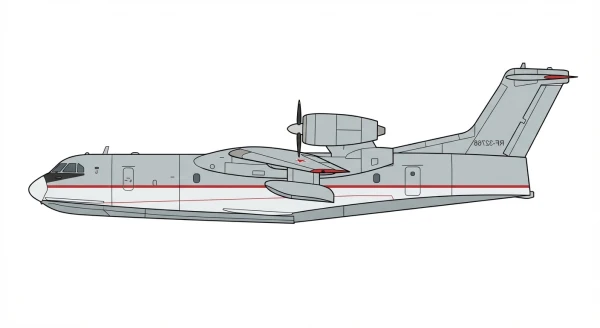
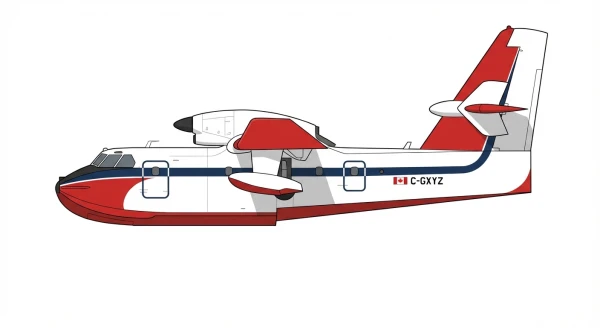
| Be-200 | CL-415 Super Scooper | |
|---|---|---|
| Origin country | 🇷🇺 Russia | 🇨🇦 Canada |
| Category | Military Transport Aircraft | Military Transport Aircraft |
| Manufacturer | Beriev | Viking Air |
| First flight | 24 September 1998 | 6 December 1993 |
| Year introduced | 2003 | 1994 |
| Number produced | 19 units | 95 units |
| Average unit price | $67 million | $37 million |
| Wing area | 117.4 m² | 100.0 m² |
| Wingspan | 32.8 m | 28.4 m |
| Height | 8.9 m | 8.9 m |
| Length | 31.4 m | 20.0 m |
| Maximum speed | 700 km/h | 359 km/h |
| Operational range | 3,300 km | 2,427 km |
| Service ceiling | 8,000 m | 4,481 m |
| Max. takeoff weight | 41,000 kg | 19,890 kg |
| Empty weight | 27,600 kg | 12,882 kg |
| Total thrust | 2 x 7,500 kgf | 2 x 1,775 kW |
Detailed Comparison
The Beriev Be-200 and Canadair CL-415 occupy the same narrow procurement niche for amphibious water bombers, yet their engineering reflects completely divergent operational concepts. The Russian airframe relies on turbofan-powered speed and heavy payload capacity, while the Canadian platform prioritizes low-speed maneuverability, high sortie generation, and short-field performance.
Development and Design
Beriev derived the Be-200 from the military A-40 Albatross anti-submarine flying boat, scaling the airframe down by half. To prevent water ingestion, engineers mounted two D-436TP turbofans above the wing root. The airframe includes a pressurized cabin, enabling high-altitude transit and multirole operations, including transporting up to 72 passengers or 7,500 kg of cargo. Canadair (now Viking Air/De Havilland) built the CL-415 strictly as an evolution of the unpressurized, purpose-built CL-215. The CL-415 integrates two Pratt & Whitney Canada PW123AF turboprops, winglets, and finlets to stabilize the airframe during low-altitude water scooping.
Specifications and Performances
The Be-200 roughly doubles the CL-415’s payload, holding 12,000 kg of water compared to the Canadian aircraft's 6,140 liters. Jet propulsion translates to a 700 km/h maximum speed, nearly twice the CL-415’s 359 km/h. However, this speed exacts a severe operational penalty:
- The Be-200 requires 1,800 m of takeoff distance, restricting the lakes and bays it can safely use.
- The CL-415 requires only 838 m, exponentially increasing available scoop sites in constrained geographic environments.
At $37 million, the CL-415 is nearly half the $67 million unit cost of the Be-200, allowing operators to procure multiple airframes for continuous rotational drops over a target.
Deployment and usage
The CL-415 dominates the Western market with 95 units built, serving as the primary aerial firefighting asset for Canada, France, Spain, Italy, and Greece. It routinely operates in dense smoke and tight mountain valleys, utilizing its turboprop torque for rapid climb-outs. Beriev has produced 19 Be-200s, primarily for Russia’s Ministry of Emergency Situations (EMERCOM) and Azerbaijan. Russia deploys the Be-200 abroad for disaster relief diplomacy, flying missions in Indonesia, Greece, and Israel. The Be-200's export viability effectively ended after its European certification was revoked in March 2022 following the invasion of Ukraine.
Conclusion
For dedicated aerial firefighting, the CL-415 is the superior aircraft. Its turboprop engines respond faster to throttle adjustments in low-altitude turbulence, and its 838 m takeoff requirement allows it to scoop water closer to the fireline, generating a much higher drop frequency. The Be-200 wins only in strategic disaster response. Its jet engines and pressurized cabin allow it to self-deploy across continents in hours rather than days, functioning as a heavy cargo or troop transport when fires are not burning. However, in narrow valleys and constrained water sources, its wide turning radius and long scoop distance limit its tactical utility.