DHC-6 Twin Otter vs Let L-410
DHC-6 Twin Otter vs Let L-410 at a glance — top speed 315 vs 365 km/h, range 1,480 vs 1,500 km, max takeoff weight 5,670 vs 5,800 kg, built 985 vs 1,200 units.
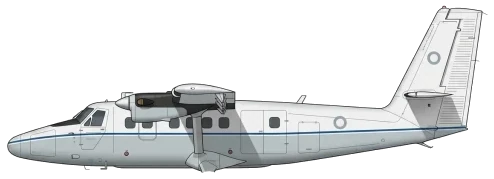
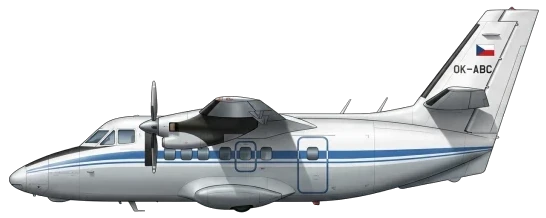
| DHC-6 Twin Otter | Let L-410 | |
|---|---|---|
| Origin country | 🇨🇦 Canada | 🇨🇿 Czechia |
| Category | Military Transport Aircraft | Military Transport Aircraft |
| Manufacturer | De Havilland Canada | Let |
| First flight | 20 May 1965 | 16 April 1969 |
| Year introduced | 1966 | 1970 |
| Number produced | 985 units | 1200 units |
| Average unit price | $7 million | -- |
| Wing area | 39.0 m² | 35.2 m² |
| Wingspan | 20.0 m | 19.5 m |
| Height | 6.0 m | 5.8 m |
| Length | 15.8 m | 14.5 m |
| Maximum speed | 315 km/h | 365 km/h |
| Operational range | 1,480 km | 1,500 km |
| Service ceiling | 7,620 m | 7,000 m |
| Max. takeoff weight | 5,670 kg | 5,800 kg |
| Empty weight | 3,175 kg | 3,800 kg |
| Total thrust | 2 x 410 kW | 2 x 575 kW |
Detailed Comparison
The DHC-6 Twin Otter and Let L-410 Turbolet are both high-wing, twin-turboprop utility aircraft, but they originate from different operational doctrines. The Canadian DHC-6 was conceived from the outset as an exceptional Short Take-Off and Landing (STOL) platform, building on De Havilland Canada's legacy of "bush planes." Conversely, the Czech L-410 was developed to fulfill a Soviet-era requirement for a rugged and reliable replacement for the Antonov An-2, emphasizing durability and general performance over specialized STOL capabilities, which were incorporated in later variants.
Development and Design
The Twin Otter's design is dominated by its STOL requirements. Its development in 1964 was a direct evolution of the single-engine DHC-3, leveraging the new, lightweight Pratt & Whitney Canada PT6A-20 turboprop. Its most significant design feature is a large wing with double-slotted trailing-edge flaps and ailerons that work in unison, generating immense lift at low speeds. This, combined with its fixed tricycle landing gear (also adaptable to skis or floats), prioritizes simplicity and performance from unprepared surfaces. Production has seen several series, with the modern DHC-6 Series 400 and Classic 300-G incorporating glass cockpits and modernized systems, attesting to the airframe's enduring viability.
The L-410's development began with a focus on creating a robust commuter and cargo aircraft. Initial prototypes were ironically powered by the same PT6A engines as the Twin Otter due to delays with the indigenous Walter M601 engine. The L-410 features a more conventional design with a retractable undercarriage for better cruise performance. Its STOL capabilities were significantly enhanced only with the later L-410UVP variant, which introduced a longer wingspan and higher tailplane. The aircraft's all-metal construction and dual hydraulic circuits were engineered for reliability in the demanding operational environment of the Soviet Union. The latest L 410 NG variant represents a major redesign with new engines and avionics.
Specifications and Performances
A comparison of specifications reveals the aircrafts' differing priorities. The Twin Otter's larger wing area (39.0 m² vs. 35.2 m²) relative to its lower maximum takeoff weight (5,670 kg vs. 5,800 kg for the L-410 base model) is a key factor in its superior short-field performance. This STOL focus, however, comes at the cost of speed; the L-410 is significantly faster (365 km/h max speed vs. 315 km/h) due to its more powerful Walter M601 engines (575 kW each vs. the Otter's 410 kW PT6A-27s). The Otter possesses a slightly higher service ceiling (7,620 m vs 7,000 m), an advantage for operations in mountainous terrain. The L-410's retractable gear offers reduced drag in cruise, while the Otter's fixed gear is simpler, more robust, and better suited for rough-field operations.
Deployment and usage
The Twin Otter's military and paramilitary usage is defined by its ability to access extreme and remote locations. It is a critical asset for nations operating in polar regions, such as the United States Antarctic Program and the British Antarctic Survey, as well as for forces requiring access to jungle or mountain landing strips. Its adaptability to floats and skis makes it invaluable for special operations, search and rescue, and logistical support where no traditional runway exists.
The L-410 served as a workhorse transport throughout the Soviet Union and its client states, with over 1,200 built. It was a ubiquitous light transport for troops, cargo, and paratrooper training, connecting remote garrisons and operating from semi-prepared airfields. While the UVP variant is STOL-capable, its primary role has been as a general utility and short-haul transport, valued for its robust construction and payload capacity rather than the extreme field performance of the Otter.
Conclusion
Both aircraft are highly successful and respected designs that have proven their worth over decades of service. The DHC-6 Twin Otter is a specialized tool, offering unparalleled STOL performance that makes it the default choice for operations in the world's most inaccessible environments. Its design is a pure expression of function over form. The L-410 Turbolet is a more conventional but exceptionally durable utility transport. It offers greater speed and was produced in larger numbers, serving as a resilient multi-purpose airlifter. The selection between the two hinges entirely on mission requirements: for extreme short-field access, the Twin Otter is superior; for general utility transport with a balance of speed and ruggedness, the L-410 is a proven and capable alternative.