Il-62 Classic
Soviet long-range narrow-body jetliner, developed in the 1960s and operated extensively for intercontinental passenger and head-of-state transport. Key figures: top speed 900 km/h, range 10,000 km, service ceiling 12,000 m, max takeoff weight 165,000 kg, built 292.
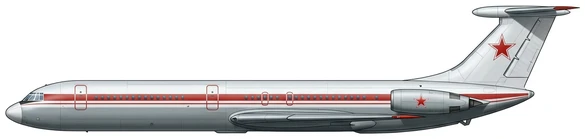
| Crew | 3–5 |
| Length | 53.1 m (174.3 ft) |
| Wingspan | 43.2 m (141.7 ft) |
| Height | 12.4 m (40.5 ft) |
| Wing area | 279.6 m² (3009.0 sqft) |
| Empty weight | 71,600 kg (157,851 lbs) |
| Max. takeoff weight | 165,000 kg (363,762 lbs) |
| Powerplant | 4 × turbofans Soloviev D-30KU 108 kN each |
| Maximum speed | 900 km/h (559 mph) |
| Operational range | 10,000 km (6,214 mi) |
| Service ceiling | 12,000 m (39,370 ft) |
| Climb rate | 18.0 m/s (59.1 ft/s) |
Description
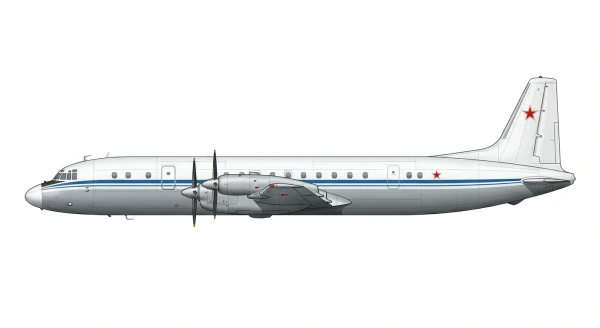
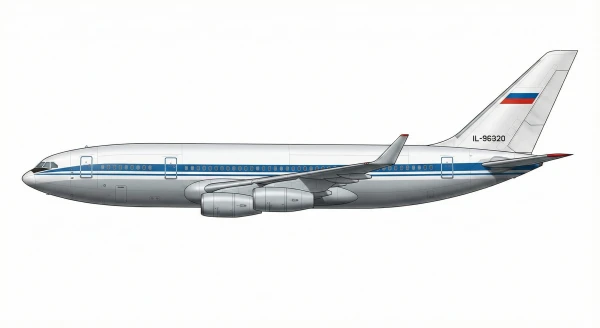
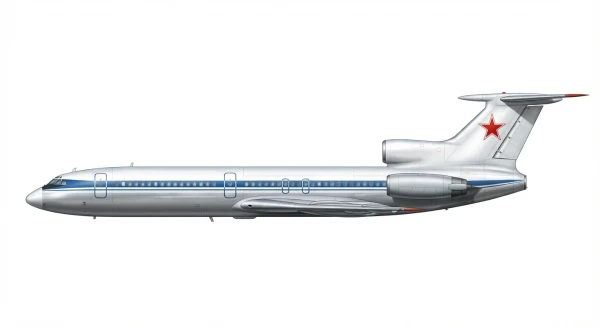
The Ilyushin Il-62 (NATO reporting name: Classic) is a Soviet long-range narrow-body jetliner designed by the Ilyushin Design Bureau. Developed as a successor to the turboprop Il-18, the aircraft entered Aeroflot civilian service on 15 September 1967. It served as a long-range passenger transport, head-of-state aircraft, and military transport. When it first flew in 1963, the Il-62 was the world's largest jet airliner and the first long-range quad-jet operated by the Soviet Union.
Development
Ilyushin submitted the initial long-range jetliner proposal in February 1960, receiving official authorization on 18 June 1960. TsAGI, the Soviet aerospace agency, specified the paired rear-engine and T-tail layout to allow an aerodynamically clean wing design. Fitted temporarily with Lyulka AL-7PB turbojet engines, the prototype first flew on 3 January 1963, later crashing during maximum-weight testing. The first aircraft equipped with the intended Kuznetsov NK-8 engines flew in 1964. The improved Il-62M variant, powered by Soloviev D-30KU engines, made its first flight in 1971 and entered service in 1973. Total production reached 292 aircraft, comprising 5 prototypes, 94 original Il-62s, and 193 Il-62Ms.
Design
The Il-62 is an all-metal low-wing monoplane featuring a fail-safe, riveted semi-monocoque structure. The aircraft utilizes unpowered, all-manual flight controls linked via steel cables, rods, and trim tabs. To prevent the empty aircraft from tipping onto its tail while parked, an extendable lightweight strut is installed at the rear of the fuselage. The wing leading edge incorporates a distinctive saw-tooth design that creates vortices to maintain stability at high angles of attack. Avionics feature the Polyot-1 automatic flight control system, Doppler navigation radar (later replaced by triplex inertial systems), and a TA-6 auxiliary power unit housed in the tailcone.
Operational History
Aeroflot inaugurated passenger service with an Il-62 flight from Moscow to Montreal in 1967, eventually operating up to 165 examples by 1989. Over 30 nations operated the type, including foreign civil carriers such as Interflug, CSA, Cubana, and LOT Polish Airlines. Special VIP salon conversions served as head-of-state transports for 14 countries, while an airborne command post variant operated with the Russian EMERCOM emergency agency. Starting in late 2015, Russian Aerospace Forces Il-62M aircraft provided military transport capabilities during the intervention in the Syrian Civil War, conducting personnel and material flights through Khmeimim Air Base in Latakia.
Variants
-
Il-62: Initial production variant powered by four Kuznetsov NK-8 turbofans with seating for up to 174 passengers.
-
Il-62M: Upgraded version introduced in 1973 featuring Soloviev D-30KU engines, modified wing spoilers, a fin fuel tank, and containerized baggage systems.
-
Il-62MK: Medium-range modification developed in 1978 with strengthened wings and landing gear to support higher gross weights and up to 198 passengers.
-
Il-62MGr: Dedicated freighter conversion of the Il-62M capable of transporting up to 40,000 kg of cargo over a 5,500 km range.
Frequently Asked Questions
What type of aircraft is the Il-62 Classic?
What is the maximum speed of the Il-62 Classic?
What is the range of the Il-62 Classic?
When did the Il-62 Classic first fly?
How many Il-62 Classic have been built?
What is the service ceiling of the Il-62 Classic?
- AUG 62026 Created Page created: Il-62 Classic