DHC-3 Otter
Canadian utility aircraft, noted for its use in bush flying and rugged environments during the mid-20th century. Key figures: top speed 257 km/h, range 1,540 km, service ceiling 5,730 m, max takeoff weight 3,629 kg, unit price $0.6M, built 466. In service with 1 air force as of 2026 — United States (1).
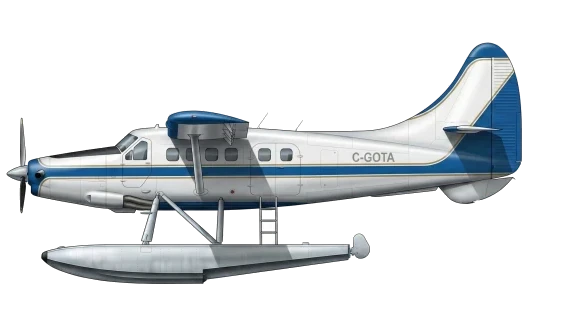
| Crew | 1 |
| Length | 12.8 m (42.0 ft) |
| Wingspan | 18 m (59.1 ft) |
| Height | 3.8 m (12.6 ft) |
| Wing area | 35 m² (376.7 sqft) |
| Empty weight | 2,010 kg (4,431 lbs) |
| Max. takeoff weight | 3,629 kg (8,001 lbs) |
| Powerplant | 1 × radial engine Pratt & Whitney R-1340-S1H1-G Wasp 447 kW each |
| Maximum speed | 257 km/h (160 mph) |
| Operational range | 1,540 km (957 mi) |
| Service ceiling | 5,730 m (18,799 ft) |
| Climb rate | 4.3 m/s (14.1 ft/s) |

Description
The de Havilland Canada DHC-3 Otter is a single-engined, high-wing, propeller-driven STOL utility transport built in Canada by de Havilland Canada. Certified in November 1952, it was designed as an enlarged development of the DHC-2 Beaver for bush operations, light transport and search and rescue, and served with the Royal Canadian Air Force, the United States Army as the U-1A, and numerous civil bush operators. The type certificate is now held by the De Havilland Canada company founded in 2019.
Development
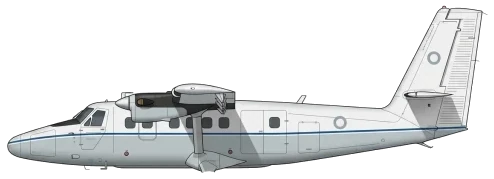
The Otter was conceived in January 1951 as a larger, more powerful version of the DHC-2 Beaver, and was designated the "King Beaver" during design work. It retained the Beaver's overall configuration but added a longer fuselage, a greater-span wing and a cruciform tail, with main cabin seating increased from six to 10 or 11. Canadian certification followed in November 1952 and production began shortly afterwards; 466 aircraft were built. The Otter formed the basis of the DHC-6 Twin Otter, powered by two wing-mounted Pratt & Whitney Canada PT6 turboprops.
Design
Power was supplied by a 600 hp (450 kW) Pratt & Whitney R-1340 Wasp nine-cylinder air-cooled radial driving a three-bladed Hamilton Standard constant-speed propeller of 10 ft 10 in diameter; the engine was geared for lower propeller revolutions and consequently lower airspeed. The electrical system was 28 volts DC. Wingspan is 58 ft 0 in, length 41 ft 10 in and gross weight 8,000 lb, with maximum speed 160 mph at 5,000 ft and range 960 miles on 178 imp gal of internal fuel. The aircraft can be fitted with skis or EDO floats, the latter available with wheels for amphibious operation. RCAF Otter 3682 was used for STOL research, receiving oversized 45-degree droop flaps (the "Batwing Otter"), a four-wheel undercarriage and enlarged fin, later a J85 turbojet for reverse thrust, and finally twin PT6 turboprops in May 1963 — the first twin-PT6 fixed-wing installation to fly. Stolairus Aviation offers a STOL kit with contoured leading edge and drooped wingtips, and a 400 lb upgross kit raising float gross weight to 8,367 lb.
Operational History
The RCAF and Canadian Forces operated the type as the CSR-123 and CC-123 until 1980 in search and rescue and light transport roles, including parachute and low-level supply drops for the Canadian Army. In early 1957 HMCS Magnificent carried four Otters from Halifax to Port Said for the United Nations Emergency Force, all four flying off unassisted at anchor — the only occasion RCAF fixed-wing aircraft operated from a Canadian warship. An Otter crossed the South Pole in 1957 during the Commonwealth Trans-Antarctic Expedition. The US Army was the largest operator with 184 U-1As; other military users included Australia, India, Ghana, Norway, Chile and the Khmer Republic. Qantas operated Otters in Papua New Guinea from 1958 to 1960, transferring them to Trans Australian Airlines until withdrawal in 1966. As of June 2019, 119 accidents had caused 242 deaths.
Variants
- DHC-3 Otter: Single-engined STOL utility transport, the baseline production version.
- CSR-123 Otter: Royal Canadian Air Force search and rescue and utility transport variant.
- U-1A Otter: US Army utility transport, preceded by six YU-1 test and evaluation aircraft.
- UC-1 Otter: US Navy transport, redesignated U-1B in 1962.
- DHC-3-T Turbo-Otter: Conversion with Pratt & Whitney Canada PT6A-27 or PT6A-34 turboprop.
Frequently Asked Questions
What type of aircraft is the DHC-3 Otter?
What is the maximum speed of the DHC-3 Otter?
What is the range of the DHC-3 Otter?
When did the DHC-3 Otter first fly?
How many DHC-3 Otter have been built?
Which countries operate the DHC-3 Otter?
How much does a DHC-3 Otter cost?
What is the service ceiling of the DHC-3 Otter?
- AUG 302026 Updated Description updated
- JUL 232026 Updated Sources and cross-references refreshed
- APR 72026 Updated Picture credits updated in a site-wide editorial pass
- JAN 122026 Updated Range updated in a site-wide editorial pass