F-5E Tiger II vs Mirage III / 5 / 50
F-5E Tiger II vs Mirage III / 5 / 50 at a glance — top speed 1,700 vs 2,350 km/h, range 3,723 vs 3,335 km, max takeoff weight 11,187 vs 12,000 kg, built 1,399 vs 1,422 units.
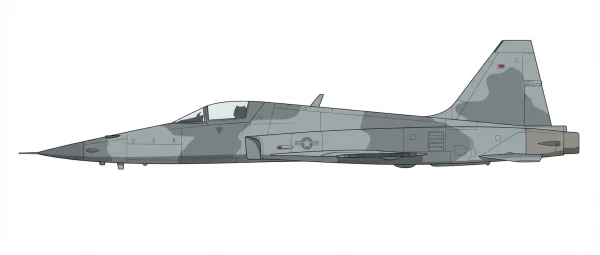
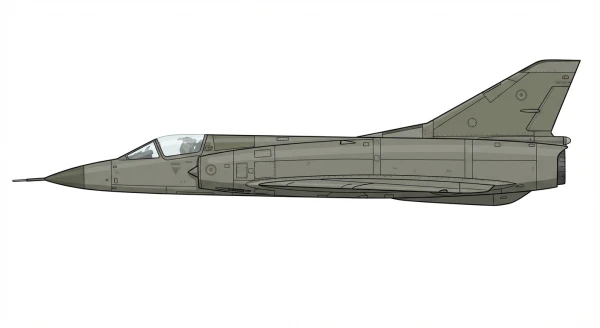
| F-5E Tiger II | Mirage III / 5 / 50 | |
|---|---|---|
| Origin country | 🇺🇸 United States | 🇫🇷 France |
| Category | Combat Aircraft | Combat Aircraft |
| Manufacturer | Northrop | Dassault |
| First flight | 11 August 1972 | 17 November 1956 |
| Year introduced | 1976 | 1961 |
| Number produced | 1399 units | 1422 units |
| Average unit price | $2.1 million | $5 million |
| Wing area | 17.3 m² | 34.8 m² |
| Wingspan | 8.1 m | 8.2 m |
| Height | 4.1 m | 4.5 m |
| Length | 14.5 m | 15.3 m |
| Maximum speed | 1700 km/h | 2350 km/h |
| Operational range | 3,723 km | 3,335 km |
| Service ceiling | 15,789 m | 17,000 m |
| Max. takeoff weight | 11,187 kg | 12,000 kg |
| Empty weight | 4,349 kg | 6,740 kg |
| Total thrust | 2 x 3,176 kgf | 1 x 6,200 kgf |
Detailed Comparison
The Northrop F-5E Tiger II and Dassault Mirage III illustrate diverging tactical priorities during the Cold War. While the F-5E was engineered as a low-cost, maintainable lightweight fighter for U.S. allies, the Mirage III was a high-performance interceptor designed to break the Mach 2 barrier. Both platforms successfully capitalized on the export market, yet they served different strategic needs: the F-5E emphasized agility and sustainability, whereas the Mirage prioritized raw speed and heavy-hitting interception capabilities.
Development and Design
The F-5E Tiger II evolved from Northrop’s specific intent to produce an affordable, modular fighter. Utilizing a conventional aerodynamic layout and twin General Electric J85-GE-21 turbojets, it prioritized ease of maintenance in austere environments, making it ideal for nations lacking extensive support infrastructure. In contrast, the Mirage III featured a tailless delta-wing configuration. This design choice, powered by a single SNECMA Atar turbojet, provided exceptional high-speed stability and internal fuel volume but required higher landing speeds. While the F-5E focused on agility through a lightweight structure, the Mirage platform evolved through variants like the simplified, ground-attack-focused Mirage 5 and the modernized Mirage 50, which integrated canards and advanced avionics to mitigate the inherent low-speed handling limitations of the delta wing.
Specifications and Performances
Performance metrics highlight the Mirage III's dominance in interception roles. It achieves a maximum speed of 2,350 km/h (Mach 2.2) and a service ceiling of 17,000 m, significantly outperforming the F-5E’s 1,700 km/h top speed and lower ceiling of 15,789 m. The Mirage also boasts a superior range of 2,400 km compared to the F-5E’s 891 km, reflecting its larger internal fuel capacity. However, the F-5E is considerably lighter with an empty weight of 4,349 kg against the Mirage's 6,740 kg, contributing to superior sustained turn rates in close-range engagements. In terms of organic firepower, the F-5E utilizes two 20mm M39A2 cannons, whereas the Mirage packs a heavier punch with dual 30mm DEFA cannons.
Deployment and usage
The F-5E found extensive use as an "Aggressor" aircraft for the USAF, mimicking Soviet MiG-21 performance characteristics for pilot training. Combat deployments included the Vietnam War and the Iran-Iraq War, proving its utility in both air-to-air and ground-attack roles using munitions like the AGM-65 Maverick. The Mirage III earned its reputation primarily through the Israeli Air Force, notably during the Six-Day War, where it was instrumental in Operation Focus and achieved high kill ratios in air combat. While the Mirage proved effective in the Middle East, Argentine usage during the Falklands War exposed the platform's limitations when operating at the edge of its combat radius against modern naval air defenses.
Conclusion
Ultimately, the F-5E Tiger II and Mirage III exemplify successful but distinct export strategies. The F-5E succeeded as a sustainable solution for nations requiring competent multi-role capabilities without the logistical burden of complex systems. The Mirage III, however, offered nations a high-end interceptor capability that could challenge superpowers' aircraft. While the Mirage defined the era with speed and high-profile victories, the F-5E’s legacy lies in its unparalleled operational availability and adaptability.