F-5E Tiger II vs MiG-21 Fishbed
F-5E Tiger II vs MiG-21 Fishbed at a glance — top speed 1,700 vs 2,125 km/h, range 3,723 vs 660 km, max takeoff weight 11,187 vs 8,625 kg, built 1,399 vs 11,496 units.
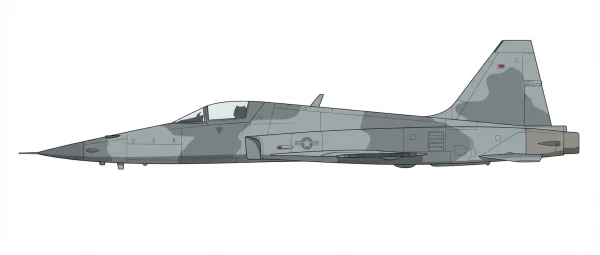
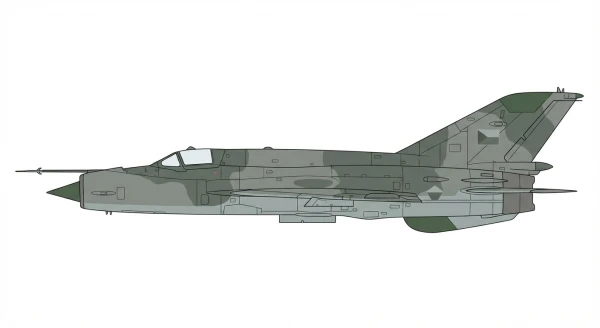
| F-5E Tiger II | MiG-21 Fishbed | |
|---|---|---|
| Origin country | 🇺🇸 United States | 🇷🇺 Ex-USSR |
| Category | Combat Aircraft | Combat Aircraft |
| Manufacturer | Northrop | Mikoyan-Gurevich |
| First flight | 11 August 1972 | 16 June 1955 |
| Year introduced | 1976 | 1958 |
| Number produced | 1399 units | 11496 units |
| Average unit price | $2.1 million | $2 million |
| Wing area | 17.3 m² | 23.0 m² |
| Wingspan | 8.1 m | 7.2 m |
| Height | 4.1 m | 4.1 m |
| Length | 14.5 m | 13.5 m |
| Maximum speed | 1700 km/h | 2125 km/h |
| Operational range | 3,723 km | 660 km |
| Service ceiling | 15,789 m | 19,000 m |
| Max. takeoff weight | 11,187 kg | 8,625 kg |
| Empty weight | 4,349 kg | 4,871 kg |
| Total thrust | 2 x 3,176 kgf | 1 x 4,689 kgf |
Detailed Comparison
The Northrop F-5E Tiger II and the Mikoyan-Gurevich MiG-21 Fishbed stand as the preeminent lightweight export fighters of the Cold War. While both prioritized low acquisition costs and ease of maintenance to equip allied nations, they diverged significantly in aerodynamic philosophy and intended tactical application. The F-5E focused on agility and multi-role versatility for U.S. partners, whereas the MiG-21 was designed as a high-speed interceptor to counter Western strike aircraft.
Development and Design
Northrop developed the F-5E as an evolution of the Freedom Fighter, incorporating more powerful J85-GE-21 engines and improved aerodynamics to create an affordable, modular platform. Its design emphasized modular construction, allowing nations with limited infrastructure to swap components easily. Conversely, the MiG-21 emerged from a requirement to intercept supersonic Western bombers. Its defining feature is the tailed delta wing configuration, optimized for high-speed dashes. While the F-5E utilized a twin-engine layout for survivability and sustained turn performance, the MiG-21 relied on a single, powerful Tumansky turbojet within a minimum-drag fuselage, accepting compromises in range and cockpit visibility to achieve raw speed.
Specifications and Performances
The performance metrics illustrate the doctrinal split: the MiG-21 possesses superior kinematic performance in the vertical plane, while the F-5E excels in horizontal maneuvering. The MiG-21 achieves a maximum speed of 2125 km/h and a service ceiling of 19,000 m, significantly outclassing the F-5E’s 1700 km/h and 15,789 m ceiling. However, the Soviet design suffers from limited endurance, with a range of only 660 km compared to the F-5E's 891 km. The F-5E’s wing design and twin-engine configuration provide better handling at subsonic speeds, whereas the MiG-21’s delta wing bleeds energy rapidly during hard turns, making it difficult to handle during takeoff, landing, and sustained dogfights.
Deployment and usage
Both aircraft saw extensive export success, with the MiG-21 serving over 60 nations and the F-5E over 30. In the Vietnam War, the MiG-21 proved effective using "hit-and-run" interceptor tactics against American strike packages. The F-5E, arriving later, served the South Vietnamese Air Force and later became a staple of the Iran-Iraq War, where it clashed directly with MiG-21s. A testament to the F-5E’s maneuverability is its long-standing use by U.S. Air Force "Aggressor" squadrons to simulate the size and performance of Soviet fighters like the MiG-21 in dissimilar air combat training. The MiG-21 remains in service through heavy modernization programs like the Indian "Bison," while the F-5E continues to serve via upgrades like the Brazilian F-5EM, leveraging its 7,000-pound ordnance capacity for ground attack roles.
Conclusion
The MiG-21 was a superior interceptor, built to scramble, climb fast, and engage bombers. The F-5E was a more balanced, pilot-friendly fighter-bomber. While the MiG-21 holds the advantage in raw speed and production numbers (over 11,000 units), the F-5E offered superior avionics integration, maintainability, and sustained dogfighting capability. In modern asymmetrical warfare, the F-5E's versatile air-to-ground platform often proves more utilitarian than the MiG-21's dedicated interceptor profile, though highly upgraded variants of both airframes continue to defy their age in active service.