F-16 Fighting Falcon vs F-5E Tiger II
F-16 Fighting Falcon vs F-5E Tiger II at a glance — top speed 2,178 vs 1,700 km/h, range 4,217 vs 3,723 km, max takeoff weight 19,200 vs 11,187 kg, built 4,604 vs 1,399 units.
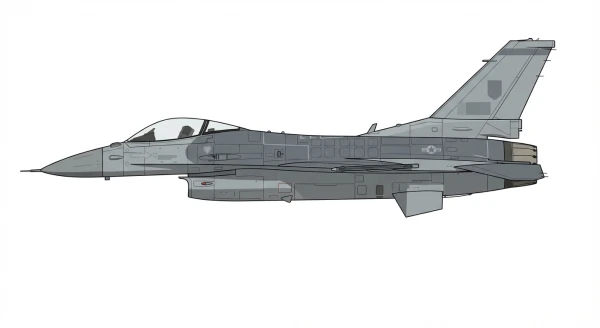
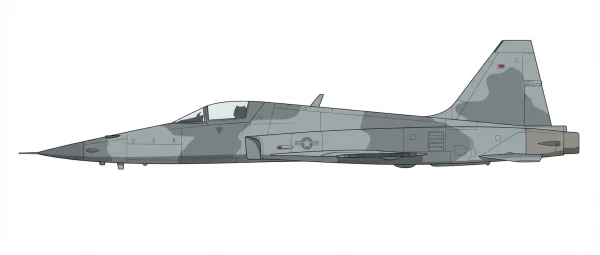
| F-16 Fighting Falcon | F-5E Tiger II | |
|---|---|---|
| Origin country | 🇺🇸 United States | 🇺🇸 United States |
| Category | Combat Aircraft | Combat Aircraft |
| Manufacturer | General Dynamics | Northrop |
| First flight | 2 February 1974 | 11 August 1972 |
| Year introduced | 1979 | 1976 |
| Number produced | 4604 units | 1399 units |
| Average unit price | $18.8 million | $2.1 million |
| Wing area | 27.9 m² | 17.3 m² |
| Wingspan | 10.0 m | 8.1 m |
| Height | 4.9 m | 4.1 m |
| Length | 15.1 m | 14.5 m |
| Maximum speed | 2178 km/h | 1700 km/h |
| Operational range | 4,217 km | 3,723 km |
| Service ceiling | 15,240 m | 15,789 m |
| Max. takeoff weight | 19,200 kg | 11,187 kg |
| Empty weight | 8,570 kg | 4,349 kg |
| Total thrust | 1 x 12,701 kgf | 2 x 3,176 kgf |
Detailed Comparison
The General Dynamics F-16 Fighting Falcon and the Northrop F-5E Tiger II both stem from the lightweight fighter concept but represent different technological generations and strategic objectives. While the F-5E was optimized for export as a cost-effective, low-maintenance solution for allies during the Cold War, the F-16 evolved from a daytime air superiority fighter into a highly complex, all-weather multirole platform that became the backbone of the USAF and NATO airpower.
Development and Design
Northrop designed the F-5E Tiger II as an evolution of the Freedom Fighter, prioritizing modular construction and operational simplicity. It features a twin-engine layout using small J85 turbojets, aimed at nations lacking extensive maintenance infrastructure. Conversely, the F-16 emerged from the Lightweight Fighter Program with revolutionary aerodynamics. It introduced relaxed static stability controlled by a fly-by-wire system, allowing for maneuvering limits that physically exceed the pilot's tolerance before the airframe's. The F-16's single-engine design houses a massive turbofan, contrasting with the F-5E's reliance on twin, smaller turbojets, while its frameless bubble canopy offers superior situational awareness compared to the more traditional cockpit of the Tiger II.
Specifications and Performances
The performance gap illustrates the technological leap between the two airframes. The F-16 achieves a maximum speed of 2,410 km/h and a service ceiling of 18,288 m, significantly outperforming the F-5E’s 1,700 km/h top speed and 15,789 m ceiling. Propulsion is the differentiating factor; the F-16's single F110 engine generates 7,777 kgf of dry thrust, more than double the combined output of the F-5E’s two J85s (approx. 3,176 kgf total). This power advantage allows the F-16 to carry a maximum takeoff weight of 19,200 kg, nearly double the F-5E’s 11,187 kg. While the F-5E is capable of deploying AGM-65 Mavericks and AIM-9 Sidewinders, the F-16's payload capacity supports a broader array of heavy ordnance, including anti-ship missiles, heavy laser-guided bombs, and nuclear weapons.
Deployment and usage
The F-16 serves as a frontline combatant for the USAF and over 25 other nations, executing complex mission profiles including Suppression of Enemy Air Defenses (SEAD) and precision deep strikes. It demonstrated these capabilities extensively in Operation Desert Storm, destroying over 30 Iraqi aircraft, and in the Balkans. The F-5E found its niche primarily in export markets and asymmetric conflicts, utilized by the South Vietnamese Air Force and extensively during the Iran-Iraq War. Notably, the F-5E’s flight characteristics, which resemble Soviet platforms like the MiG-21, led to its widespread use in Aggressor squadrons for dissimilar air combat training (DACT) by western forces, rather than as a frontline air superiority fighter in major power conflicts.
Conclusion
Ultimately, the F-5E Tiger II succeeded as a logistical solution, providing credible air defense to nations requiring low operating costs and high sortie generation rates. However, the F-16 Fighting Falcon represents a paradigm shift in kinematic performance and avionics integration. While the Tiger II remains relevant through modernization programs in countries like Brazil and Chile, the F-16 defines the standard for modern multirole capability, balancing raw power with the adaptability to integrate cutting-edge weaponry and sensors decades after its introduction.