F-84 Thunderjet vs MiG-15 Fagot
F-84 Thunderjet vs MiG-15 Fagot at a glance — top speed 1,001 vs 1,075 km/h, range 3,218 vs 2,520 km, max takeoff weight 10,590 vs 6,105 kg, built 7,524 vs 17,310 units.
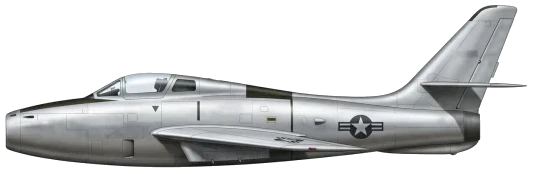
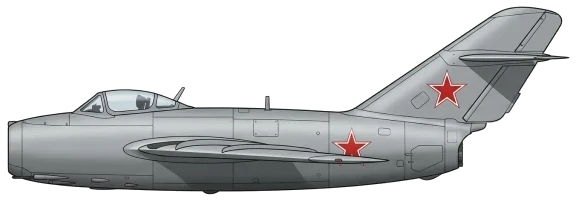
| F-84 Thunderjet | MiG-15 Fagot | |
|---|---|---|
| Origin country | 🇺🇸 United States | 🇷🇺 Ex-USSR |
| Category | Combat Aircraft | Combat Aircraft |
| Manufacturer | Republic | Mikoyan-Gurevich |
| First flight | 28 February 1946 | 19 December 1947 |
| Year introduced | 1950 | 1949 |
| Number produced | 7524 units | 17310 units |
| Average unit price | $1.4 million | $200K |
| Wing area | 24.0 m² | 20.6 m² |
| Wingspan | 11.1 m | 10.1 m |
| Height | 3.8 m | 3.7 m |
| Length | 11.6 m | 10.1 m |
| Maximum speed | 1001 km/h | 1075 km/h |
| Operational range | 3,218 km | 2,520 km |
| Service ceiling | 12,344 m | 15,500 m |
| Max. takeoff weight | 10,590 kg | 6,105 kg |
| Empty weight | 5,200 kg | 3,580 kg |
| Total thrust | 1 x 2,522 kgf | 1 x 2,700 kgf |
Detailed Comparison
The Republic F-84 Thunderjet served as a robust, straight-wing ground attack platform derived from World War II design principles, whereas the Mikoyan-Gurevich MiG-15 represented a generational leap in interceptor capability through swept-wing technology. While the F-84 struggled with aerodynamic limitations inherent to early jet designs, the MiG-15 effectively exploited captured German research to challenge Western air superiority, forcing a rapid tactical evolution during the Korean War.
Development and Design
Designed by Alexander Kartveli, the F-84 retained a traditional straight-wing configuration using a laminar flow airfoil. Republic prioritized housing an axial compressor turbojet within a slim fuselage, placing fuel tanks in the thick wings. This conservative approach resulted in early longitudinal instability and skin buckling. In contrast, the Soviet MiG-15 utilized advanced swept-wing geometry to approach Mach 1. Constructed with aluminum alloys and powered by the Klimov VK-1 (a reverse-engineered Rolls-Royce Nene), the MiG prioritized high-altitude interception with heavy-caliber armament—one 37mm and two 23mm cannons—over the F-84’s six .50 caliber machine guns.
Specifications and Performance
The performance gap illustrates the sharp divergence in operational roles. The MiG-15 holds a distinct kinetic advantage, utilizing a lighter airframe (6,105 kg Max Takeoff Weight) and higher thrust (2,700 kgf) to achieve a climb rate of 50.0 m/s, more than double the F-84’s 19.1 m/s. The Soviet fighter also dominates in the vertical domain with a service ceiling of 15,500 m compared to the Thunderjet's 12,344 m. While the F-84 falls short in interception metrics, its heavier construction allows it to operate at a significantly higher weight (10,590 kg), facilitating a payload capacity for rockets and bombs that the lighter MiG cannot match. The MiG-15 is faster, with a max speed of 1075 km/h against the F-84's 1001 km/h, but the Thunderjet offers greater versatility as a weapons truck.
Deployment and Usage
Operationally, the F-84 found its niche as the USAF's primary strike aircraft during the Korean War, flying 86,408 sorties and destroying an estimated 60% of ground targets. Its robust airframe supported heavy ordnance loads, including 32 HVAR rockets or 4,000 lbs of bombs; the F-84G even became the first single-seat fighter capable of delivering the Mark 7 nuclear bomb. Conversely, the MiG-15 functioned strictly as an air superiority fighter. It dominated "MiG Alley," forcing UN forces to transition from straight-wing jets like the F-80 and F-84 to the F-86 Sabre. While the F-84 pioneered operational techniques like aerial refueling, the MiG-15's impact was geopolitical, signaling Soviet parity in jet technology.
Conclusion
The F-84 Thunderjet proved to be a highly effective strike platform that became obsolete as an air-to-air fighter the moment swept-wing adversaries appeared. It excelled in payload delivery and endurance but lacked the energy maneuverability for dogfighting. The MiG-15 was a purebred interceptor that altered air combat doctrine through raw performance, despite primitive avionics. The Thunderjet represents the effective culmination of straight-wing tactical bombing, while the MiG-15 marks the definitive entry into the trans-sonic era of air superiority.
-
 Belgium
-
 Denmark
-
 Ex-Yugoslavia
- All 15 former operators →
