G-2 Galeb vs G.91 Gina
G-2 Galeb vs G.91 Gina at a glance — top speed 812 vs 1,075 km/h, range 669 vs 1,150 km, max takeoff weight 4,300 vs 5,500 kg, built 248 vs 770 units.
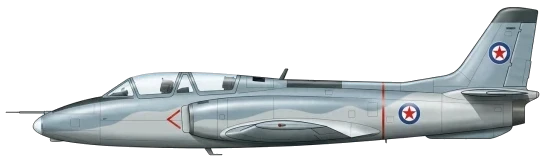
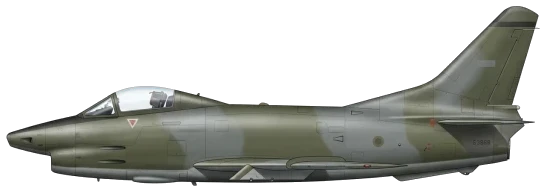
| G-2 Galeb | G.91 Gina | |
|---|---|---|
| Origin country | 🇷🇸 Ex-Yugoslavia | 🇮🇹 Italy |
| Category | Military Training Aircraft | Combat Aircraft |
| Manufacturer | Soko | Fiat |
| First flight | 31 July 1961 | 9 August 1956 |
| Year introduced | 1965 | 1959 |
| Number produced | 248 units | 770 units |
| Average unit price | $180K | $1.6 million |
| Wing area | 19.4 m² | 16.4 m² |
| Wingspan | 11.6 m | 8.6 m |
| Height | 3.3 m | 4.0 m |
| Length | 10.3 m | 10.3 m |
| Maximum speed | 812 km/h | 1075 km/h |
| Operational range | 669 km | 1,150 km |
| Service ceiling | 12,000 m | 13,106 m |
| Max. takeoff weight | 4,300 kg | 5,500 kg |
| Empty weight | 2,620 kg | 3,100 kg |
| Total thrust | 1 x 1,134 kgf | 1 x 2,268 kgf |
Detailed Comparison
The SOKO G-2 Galeb and Fiat G.91 Gina originate from the same Cold War era but were conceived for fundamentally different purposes. The Galeb was developed as a versatile jet trainer for the Yugoslav Air Force with a secondary light attack capability, while the G.91 was a purpose-built light tactical strike fighter, born from a specific NATO requirement for an affordable, austere-field combat aircraft. This core distinction in mission shaped every aspect of their design, performance, and operational history.
Development and Design
The G-2 Galeb's design was a pragmatic national project for Yugoslavia, intended to replace the T-33 trainer. Its development relied heavily on British collaboration, notably for its Armstrong Siddeley Viper engine and ejection seats. The resulting aircraft is a conventional, straight-wing trainer with a tandem two-seat cockpit, prioritizing forgiving flight characteristics, ease of maintenance, and reliability for student pilots. Its construction is a standard stressed-skin all-metal airframe, reflecting its primary role as an instructional platform.
In contrast, the Fiat G.91 was the winner of the 1953 NATO NBMR-1 competition. Its design was dictated by stringent military requirements: short-field takeoff from semi-prepared surfaces, high subsonic speed, and robust ground attack capabilities. This led to a more compact, rugged airframe with low-pressure tires, a single-seat armored cockpit, and a significantly more powerful Bristol Siddeley Orpheus engine. The G.91 was designed from the outset as a weapon system, with an integrated armament bay and superior payload capacity.
Specifications and Performances
The performance gap between the two aircraft directly reflects their design philosophies. The G.91 is a dedicated combat aircraft and significantly outperforms the Galeb.
- Power and Speed: The G.91's Orpheus engine produces nearly double the thrust of the Galeb's Viper (2268 kgf vs. 1134 kgf), enabling a much higher maximum speed (1075 km/h vs. 812 km/h) and a superior climb rate (30 m/s vs. 22.8 m/s).
- Payload: The G.91’s primary role is evident in its armament. It could carry a heavier and more diverse ordnance load of up to 680 kg on four hardpoints, including cannons, rockets, and missiles. The Galeb was limited to two 12.7 mm machine guns and a 300 kg capacity on its four hardpoints, suitable for weapons training rather than sustained combat.
- Airframe: The Galeb’s larger wingspan and wing area (11.62 m and 19.43 m²) compared to the G.91 (8.56 m and 16.4 m²) contribute to its stable, trainer-like handling, whereas the G.91’s configuration prioritized agility and speed.
Deployment and usage
The Galeb served primarily as the standard jet trainer for the Yugoslav Air Force, where it proved highly successful and reliable. Its combat use was limited and largely opportunistic, seeing action in the Bosnian War and with Libyan forces. It was a school-combat aircraft, not a frontline striker. The G.91, however, was a core asset for the Italian, West German, and Portuguese air forces. Portugal in particular used the G.91 extensively in a combat role during its colonial wars in Africa, where the aircraft's ruggedness and close air support capabilities were thoroughly tested.
Conclusion
Ultimately, the G-2 Galeb was a successful national achievement for Yugoslavia, producing a reliable and effective jet trainer that served its intended purpose well. The Fiat G.91 was a product of a multinational military requirement, resulting in a more capable, potent, and expensive light strike fighter that saw significant frontline combat service. While both are single-engine subsonic jets from the same period, the Galeb was an aircraft designed to teach pilots, while the G.91 was an aircraft designed for them to fight in.


