E-2 Hawkeye vs GlobalEye
E-2 Hawkeye vs GlobalEye at a glance — top speed 648 vs 1,110 km/h, range 2,708 vs 11,000 km, max takeoff weight 57,500 vs 45,100 kg, built 313 vs 5 units.
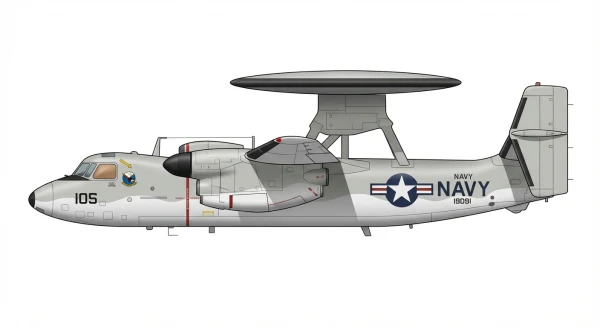
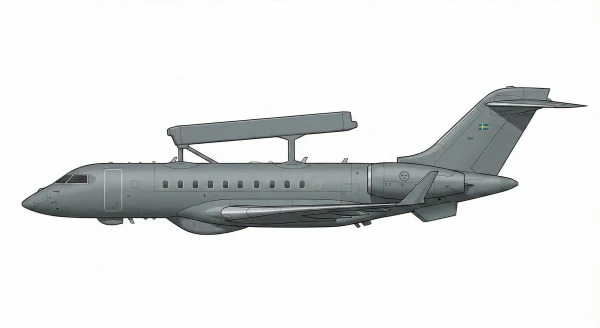
| E-2 Hawkeye | GlobalEye | |
|---|---|---|
| Origin country | 🇺🇸 United States | 🇨🇦 Canada🇸🇪 Sweden |
| Category | Military Special Mission Aircraft | Military Special Mission Aircraft |
| Manufacturer | Grumman | Saab |
| First flight | 21 October 1960 | 14 March 2018 |
| Year introduced | 1964 | 2020 |
| Number produced | 313 units | 5 units |
| Average unit price | $232 million | $350 million |
| Wing area | 65.0 m² | 94.9 m² |
| Wingspan | 24.6 m | 29.0 m |
| Height | 5.6 m | 7.8 m |
| Length | 17.6 m | 30.3 m |
| Maximum speed | 648 km/h | 1110 km/h |
| Operational range | 2,708 km | 11,000 km |
| Service ceiling | 10,577 m | 16,000 m |
| Max. takeoff weight | 57,500 kg | 45,100 kg |
| Empty weight | 19,536 kg | 23,690 kg |
| Total thrust | 2 x 3,803 kW | 2 x 6,690 kgf |
Detailed Comparison
The Saab GlobalEye and Grumman E-2 Hawkeye are both airborne early warning and control (AEW&C) platforms, but they originate from fundamentally different operational doctrines. The GlobalEye is a 21st-century, multi-domain strategic asset based on a commercial business jet, while the E-2 Hawkeye is a legacy, purpose-built tactical system designed specifically for carrier-based naval operations. This distinction in origin and intended role dictates every aspect of their design, performance, and sensor integration.
Development and Design
The GlobalEye's design leverages the performance of a Bombardier Global 6500 business jet, a recent development launched in 2016. Saab extensively modifies the airframe to support its primary sensor, the fixed Erieye ER (Extended Range) Active Electronically Scanned Array (AESA) radar. This non-rotating, dorsal-mounted "skibox" radar, combined with maritime and electro-optical sensors, reflects a modern philosophy of integrated, multi-domain surveillance. In contrast, the E-2 Hawkeye was designed in the late 1950s for the specific, restrictive environment of aircraft carriers. Its defining feature is the 24-foot diameter rotating radome (rotodome), a design that provides continuous 360-degree coverage. Its development has been evolutionary, with the current E-2D Advanced Hawkeye incorporating a modern AESA radar (the AN/APY-9) within the legacy rotodome and airframe, which includes features like a tail hook and folding wings essential for naval service.
Specifications and Performances
The GlobalEye's business jet platform provides significant performance advantages. It flies higher (16,000 m vs. 10,577 m), faster (1110 km/h vs. 648 km/h), and possesses a vastly greater unrefueled range and endurance (11,000 km and 11 hours vs. the E-2's ~2,500 km and ~6-8 hours). This allows the GlobalEye to cover larger areas from a single strategic base. The E-2's performance is constrained by its turboprop engines and robust airframe built for CATOBAR operations. While its platform metrics are lower, its AN/APY-9 radar is a highly advanced UHF-band system optimized for detecting low-observable threats in cluttered littoral environments. The GlobalEye's Erieye ER uses Gallium Nitride technology for its enhanced range of 550 km, but its fixed, side-looking arrays have specific fields of view, unlike the E-2's mechanically rotated 360-degree scan.
Deployment and usage
The E-2 Hawkeye has been the cornerstone of U.S. Navy carrier strike group air defense for six decades, with a combat record spanning from Vietnam to Operation Desert Storm. Its primary role is to act as the "eyes of the fleet," detecting incoming threats and directing fighter intercepts. It is a tactical command-and-control node indispensable for sea control and power projection. The GlobalEye is a much newer system with no combat history. Its first operator, the UAE, employs it as a strategic "Swing Role Surveillance System" for simultaneous air, sea, and land monitoring, a broader mission set than the E-2's traditional focus. It is operated from land bases as a national-level asset, a role reflected by its adoption by Sweden and France for strategic surveillance.
Conclusion
The GlobalEye and E-2 Hawkeye are not direct competitors; they are optimized for different environments. The GlobalEye represents the state-of-the-art in land-based, multi-domain strategic AEW&C, offering superior platform performance and sensor fusion for national-level surveillance. The E-2D Advanced Hawkeye, while based on an older airframe, remains the unparalleled solution for carrier-based operations. Its design is a testament to the unique demands of naval aviation, and its integration within the naval command structure makes it a critical tactical asset for maritime power projection. The choice between them is dictated entirely by a nation's strategic posture: land-based strategic awareness versus sea-based tactical control.