F-5 Freedom Fighter vs Azarakhsh
F-5 Freedom Fighter vs Azarakhsh at a glance — built 1,204 vs 6 units.
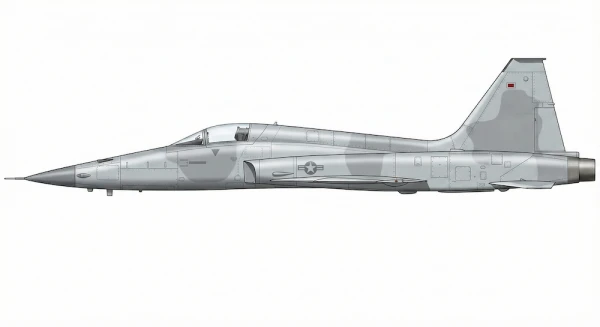
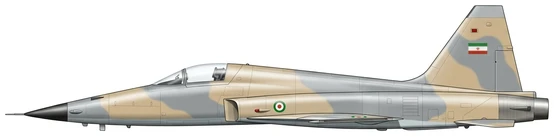
| F-5 Freedom Fighter | Azarakhsh | |
|---|---|---|
| Origin country | 🇺🇸 United States | 🇮🇷 Iran |
| Category | Combat Aircraft | Combat Aircraft |
| Manufacturer | Northrop | HESA |
| First flight | 30 July 1959 | 1 April 1997 |
| Year introduced | 1965 | 2001 |
| Number produced | 1204 units | 6 units |
| Average unit price | $2 million | -- |
| Wing area | 17.3 m² | -- m² |
| Wingspan | 8.1 m | -- m |
| Height | 4.1 m | -- m |
| Length | 14.5 m | -- m |
| Maximum speed | 1700 km/h | -- km/h |
| Operational range | 3,723 km | -- km |
| Service ceiling | 15,789 m | -- m |
| Max. takeoff weight | 11,187 kg | -- kg |
| Empty weight | 4,349 kg | -- kg |
| Total thrust | 2 x 3,176 kgf | -- |
Detailed Comparison
Northrop’s F-5 series is a lightweight, widely exported American tactical fighter that shaped Cold War lower-tier air defense and aggressor training, while the HESA Azarakhsh is a localized derivative built by Iran to sustain its aging F-5 fleet under embargo. Comparing the two is less an evaluation of competing designs than an examination of the original platform's longevity against one isolated nation's attempt to domestically replicate it.
Development and Design
Edgar Schmued designed the F-5 to counter the 1950s trend of increasingly heavy fighters. Using two compact General Electric J85 turbojets originally meant for the ADM-20 Quail decoy, Northrop prioritized aerodynamic efficiency, high sortie-generation rates, and low unit cost ($2.0 million). The Azarakhsh emerged decades later from Iran's mandate to bypass Western arms embargoes. First flown in 1997, the Azarakhsh was classified by HESA as an indigenous design. However, visual and structural analysis indicates it is a rebuilt F-5E Tiger II, utilizing the exact aerodynamic planform and internal layout, engineered through domestic overhaul and parts substitution rather than original aeronautical development.
Specifications and Performances
Performance metrics for the Azarakhsh mirror those of the F-5E Tiger II, as the airframes are aerodynamically identical. The F-5 operates at a maximum takeoff weight of 11,187 kg, powered by twin J85-GE-21B engines producing 3,176 kgf thrust. This yields a maximum speed of 1,700 km/h and a service ceiling of 15,789 meters. The platform's strict limitation is its low fuel fraction, restricting its unrefueled combat radius (891 km range) against heavier contemporaries. The baseline F-5 handles a 3,200 kg payload, specifically:
- Two internal 20 mm M39A2 revolver cannons
- Wingtip AIM-9 Sidewinder air-to-air missiles
- Mark 80 series unguided bombs and rocket pods for ground attack
While acceleration is marginal, the F-5E's enlarged wing area (17.28 m²) and modified leading-edge extensions generate high sustained turn rates.
Deployment and usage
The F-5 proliferated globally, seeing direct combat in Vietnam during the USAF Skoshi Tiger evaluation, executing ground-attack missions but requiring frequent aerial refueling. In the 1977 Ogaden War, Ethiopian F-5s systematically defeated Somali MiG-21s in air-to-air engagements due to maneuverability and pilot training advantages. The USAF institutionalized the F-5 as an aggressor aircraft; its radar cross-section and kinematic profile accurately simulated Soviet MiG-21s. Conversely, the Azarakhsh lacks a combat history. With only six units confirmed in service by 2001, its deployment is restricted to sustaining Iranian frontline fighter numbers.
Conclusion
The F-5 holds the definitive edge across all tactical and logistical scenarios because it is the baseline platform. The Azarakhsh operates as a localized life-extension program masquerading as an independent combat aircraft. While HESA's effort to reverse-engineer the F-5 demonstrates mechanical competence under strict embargoes, an overhauled 1970s airframe cannot compete with globally supported F-5 fleets utilizing upgraded avionics, integrated BVR munitions like the AIM-120 AMRAAM, and original equipment manufacturer supply chains.