F-5 Freedom Fighter vs MiG-21 Fishbed
F-5 Freedom Fighter vs MiG-21 Fishbed at a glance — top speed 1,700 vs 2,125 km/h, range 2,806 vs 660 km, max takeoff weight 11,187 vs 8,625 kg, built 1,204 vs 11,496 units.
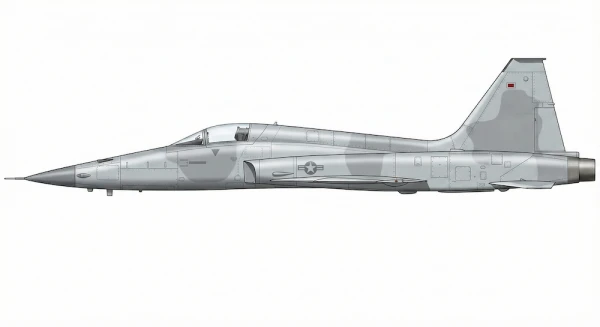
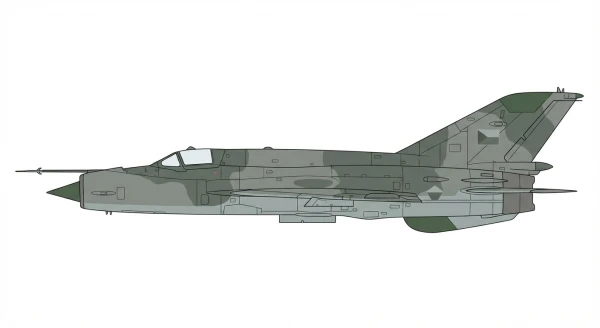
| F-5 Freedom Fighter | MiG-21 Fishbed | |
|---|---|---|
| Origin country | 🇺🇸 United States | 🇷🇺 Ex-USSR |
| Category | Combat Aircraft | Combat Aircraft |
| Manufacturer | Northrop | Mikoyan-Gurevich |
| First flight | 30 July 1959 | 16 June 1955 |
| Year introduced | 1965 | 1958 |
| Number produced | 1204 units | 11496 units |
| Average unit price | $2 million | $2 million |
| Wing area | 17.3 m² | 23.0 m² |
| Wingspan | 8.1 m | 7.2 m |
| Height | 4.1 m | 4.1 m |
| Length | 14.5 m | 13.5 m |
| Maximum speed | 1700 km/h | 2125 km/h |
| Operational range | 2,806 km | 660 km |
| Service ceiling | 15,789 m | 19,000 m |
| Max. takeoff weight | 11,187 kg | 8,625 kg |
| Empty weight | 4,349 kg | 4,871 kg |
| Total thrust | 2 x 3,176 kgf | 1 x 4,689 kgf |
Detailed Comparison
The Northrop F-5 Freedom Fighter and the Mikoyan-Gurevitch MiG-21 Fishbed served as the primary lightweight export fighters for the Western and Eastern blocs during the Cold War. While both platforms prioritized affordability, simplicity, and ease of maintenance to equip allied nations, they represent divergent engineering philosophies: the F-5 emphasized aerodynamic refinement and multi-role utility, whereas the MiG-21 focused on high-speed interception and raw thrust-to-weight performance.
Development and Design
Northrop developed the F-5 as a privately funded reversal of the trend toward heavier, complex fighters, utilizing two compact General Electric J85 turbojets. This resulted in a highly aerodynamic area-ruled fuselage optimized for maneuverability and operations from austere airfields. The design prioritized pilot visibility and handling, eventually incorporating a two-position nose gear to reduce takeoff distances.
Conversely, the MiG-21 was the Soviet response to Western Mach 2 interceptors like the F-104. Built around a single, powerful Tumansky R-11 turbojet and a distinct delta wing configuration, the Fishbed was designed for high-altitude speed and rapid climbing. While efficient at supersonic speeds, the MiG-21's delta wing compromised low-speed handling, making landings demanding and restricting pilot visibility compared to the F-5.
Specifications and Performances
Performance metrics highlight the intended strategic roles of each airframe. The MiG-21 offers superior kinematic performance, with a maximum speed of 2,125 km/h and a service ceiling of 19,000 m, significantly outclassing the F-5's 1,700 km/h top speed and 15,789 m ceiling. This aligns with the Soviet doctrine of ground-controlled point defense interception.
However, the F-5 offers greater operational flexibility and endurance. Its combat range of 891 km exceeds the MiG-21's 660 km, addressing the Soviet jet's notable fuel limitations. Furthermore, the F-5 features seven hardpoints capable of carrying 3,200 kg of ordnance, compared to the MiG-21’s five hardpoints. While the MiG-21 relied on varying internal cannon configurations (often the GSh-23), the F-5 standardizes on two M39A2 20mm cannons, providing consistent close-range firepower.
Deployment and usage
Both aircraft saw extensive combat in the Vietnam War, acting as direct adversaries. The USAF "Skoshi Tiger" evaluation proved the F-5's efficacy in ground attack, while North Vietnamese MiG-21s utilized "hit-and-run" missile tactics against heavier US fighters. The F-5 found a specific niche in the US as an "aggressor" aircraft, valued for its ability to simulate the MiG-21's size and flight characteristics in training.
Globally, the MiG-21 became the most produced combat aircraft in history (over 11,000 units), seeing heavy use in the Middle East, India, and Africa. It often served as a disposable frontline interceptor. The F-5, while produced in smaller numbers (1,204 units), became a mainstay for nations requiring a reliable multi-role platform, seeing action in the Ogaden War and serving with over 30 air forces.
Conclusion
The MiG-21 Fishbed utilizes brute force to achieve specific air superiority parameters, offering high speed and altitude at the cost of range, situational awareness, and loiter time. The F-5 Freedom Fighter represents a more balanced approach, sacrificing raw kinematic performance for superior avionics, payload flexibility, and handling qualities. While the MiG-21 arguably had a higher strategic impact due to sheer production volume, the F-5’s design philosophy yielded a more versatile platform that proved exceptionally survivable and adaptable in diverse combat environments.