F-16 Fighting Falcon vs JAS 39 Gripen
F-16 Fighting Falcon vs JAS 39 Gripen at a glance — top speed 2,178 vs 2,100 km/h, range 4,217 vs 4,000 km, max takeoff weight 19,200 vs 14,000 kg, built 4,604 vs 300 units.
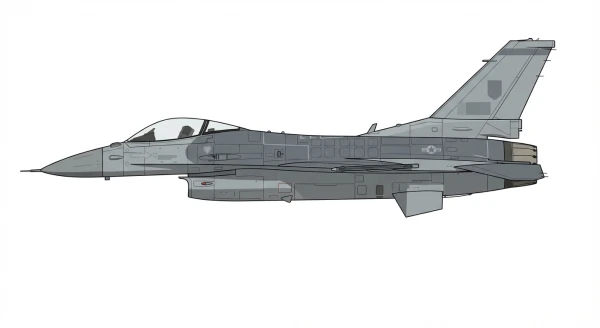
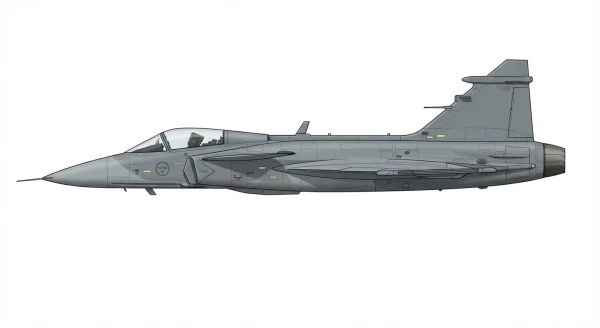
| F-16 Fighting Falcon | JAS 39 Gripen | |
|---|---|---|
| Origin country | 🇺🇸 United States | 🇸🇪 Sweden |
| Category | Combat Aircraft | Combat Aircraft |
| Manufacturer | General Dynamics | Saab |
| First flight | 2 February 1974 | 9 December 1988 |
| Year introduced | 1979 | 1996 |
| Number produced | 4604 units | 300 units |
| Average unit price | $18.8 million | $30 million |
| Wing area | 27.9 m² | 30.0 m² |
| Wingspan | 10.0 m | 8.4 m |
| Height | 4.9 m | 4.5 m |
| Length | 15.1 m | 14.9 m |
| Maximum speed | 2178 km/h | 2100 km/h |
| Operational range | 4,217 km | 4,000 km |
| Service ceiling | 15,240 m | 15,240 m |
| Max. takeoff weight | 19,200 kg | 14,000 kg |
| Empty weight | 8,570 kg | 6,800 kg |
| Total thrust | 1 x 12,701 kgf | 1 x 8,209 kgf |
Detailed Comparison
The JAS 39 Gripen and F-16 Fighting Falcon are single-engine multirole fighters stemming from different design philosophies. The F-16, a product of the 1970s, became a global standard through its combat-proven adaptability and massive production run. The Gripen emerged a decade later as a purpose-built multirole platform, emphasizing advanced avionics, low operational costs, and high sortie rates from austere bases, tailored to Sweden's strategic doctrine.
Development and Design
The F-16 pioneered a fly-by-wire control system, side-stick controller, and bubble canopy, evolving from a simple daytime fighter into a formidable all-weather weapon system through continuous block upgrades. Its success is validated by over 4,600 units built. The Gripen was conceived from the start as a versatile "JAS" (Air-to-Air, Air-to-Surface, Reconnaissance) platform. Its delta-canard configuration provides exceptional agility and short-field performance. A core design principle is its modular architecture, enabling simplified maintenance and cost-effective upgrades to critical systems like its engine and avionics, which significantly lowers life-cycle costs.
Specifications and Performances
The F-16 is the larger aircraft, with a max takeoff weight of 19,200 kg to the Gripen's 14,000 kg. This allows the F-16 to carry a heavier weapon and fuel load, translating to greater range and persistence. In contrast, the Gripen’s significantly lower empty weight (5,700 kg vs. 8,570 kg) and more modern aerodynamic design result in superior fuel efficiency and reduced maintenance needs. A key operational distinction is the Gripen’s integration of the MBDA Meteor long-range missile, which provides a significant beyond-visual-range (BVR) advantage over most F-16s equipped with the AIM-120 AMRAAM. Newer Gripen E/F variants further close the performance gap with AESA radar and a more powerful engine.
Deployment and usage
The F-16 possesses an unparalleled combat record, serving as a frontline asset for the U.S. and over 25 allied nations in numerous conflicts since the 1980s. This battle-proven status and widespread interoperability make it a low-risk, dependable choice. The Gripen’s operational history is more limited, primarily consisting of reconnaissance missions over Libya and Baltic Air Policing duties. However, its performance in complex international exercises is consistently well-regarded. Its design for rapid turnaround with minimal ground crew has proven to be a distinct advantage, allowing for high mission availability even in demanding operational tempos.
Conclusion
The F-16 Fighting Falcon is a mature, powerful, and battle-hardened workhorse with an extensive global support network. Its continuous upgrades maintain its relevance, but its older design results in a larger operational footprint. The JAS 39 Gripen, particularly the E/F variant, embodies a more modern systems-based approach, prioritizing information superiority, network-centric capabilities, and life-cycle affordability. It packages advanced sensors and superior weaponry like the Meteor into a platform designed for high readiness and low support demands, making it a compelling alternative for air forces focused on cost-effective deterrence.