M-346 Master vs T-50 Golden Eagle
M-346 Master vs T-50 Golden Eagle at a glance — top speed 1,092 vs 1,840 km/h, range 1,925 vs 1,851 km, max takeoff weight 9,500 vs 13,472 kg, built 92 vs 200 units.
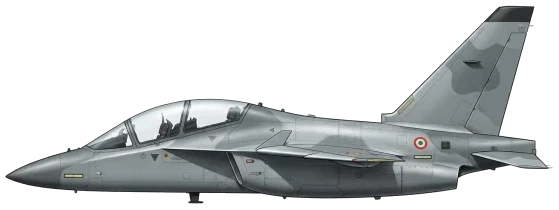
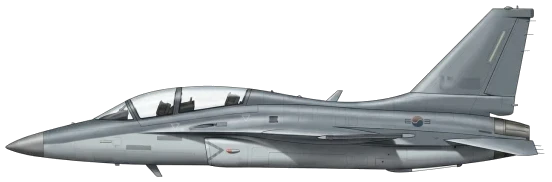
| M-346 Master | T-50 Golden Eagle | |
|---|---|---|
| Origin country | 🇮🇹 Italy | 🇰🇷 South Korea |
| Category | Military Training Aircraft | Military Training Aircraft |
| Manufacturer | Aermacchi | KAI |
| First flight | 15 July 2004 | 20 August 2002 |
| Year introduced | 2015 | 2005 |
| Number produced | 92 units | 200 units |
| Average unit price | $40 million | $25 million |
| Wing area | 23.5 m² | 23.7 m² |
| Wingspan | 9.7 m | 9.2 m |
| Height | 4.8 m | 4.8 m |
| Length | 11.5 m | 13.0 m |
| Maximum speed | 1092 km/h | 1840 km/h |
| Operational range | 1,925 km | 1,851 km |
| Service ceiling | 13,716 m | 16,764 m |
| Max. takeoff weight | 9,500 kg | 13,472 kg |
| Empty weight | 4,610 kg | 6,441 kg |
| Total thrust | 2 x 2,835 kgf | 1 x 5,409 kgf |
Detailed Comparison
The Italian M-346 Master and the South Korean T-50 Golden Eagle are leading advanced jet trainers, but they originate from different operational philosophies. The M-346 is a twin-engine, transonic aircraft optimized as a pure Lead-In Fighter Trainer (LIFT) with a secondary light attack capability. In contrast, the T-50 is a single-engine, supersonic platform designed from its inception for a dual role as both an advanced trainer and a capable light combat aircraft. This core difference in design intent dictates their respective performance, capabilities, and operational use.
Development and Design
The M-346’s design emphasizes training fidelity and cost-effectiveness. Evolving from a partnership with Yakovlev, Leonardo developed it independently with Western systems, including twin Honeywell F124 non-afterburning engines and a sophisticated quadruplex fly-by-wire system. This configuration provides high reliability and exceptional handling at high angles of attack (over 30°), mimicking the agility of modern fighters. Its most significant feature is the Embedded Tactical Training System (ETTS), which simulates radar, weapons, and electronic warfare systems, allowing for complex combat training without live ordnance.
The T-50 Golden Eagle, a collaboration between Korea Aerospace Industries (KAI) and Lockheed Martin, leverages design elements from the F-16. It is built around a single, powerful General Electric F404 afterburning engine, which provides supersonic performance (up to Mach 1.5). This makes it a more direct stepping stone for pilots transitioning to high-performance supersonic fighters. While also equipped with a digital fly-by-wire system, its design prioritizes speed and raw performance over the M-346's specific focus on high-AoA maneuverability. The T-50 platform was conceived with a clear path to a combat variant, the FA-50.
Specifications and Performances
A comparison of specifications reveals the T-50 as the larger and more powerful aircraft. Its single F404 engine produces nearly double the dry thrust (5,409 kgf) of the M-346's two F124s combined (5,670 kgf total) and offers a significant increase with its afterburner (8,029 kgf). This power advantage grants the T-50 a higher service ceiling (16,764 m vs. 13,716 m) and supersonic speed, whereas the M-346 is limited to transonic flight (1,092 km/h). Consequently, the T-50 has a substantially higher maximum takeoff weight (13,472 kg vs. 9,500 kg), allowing for a greater fuel and weapons load. The M-346's strengths are not in raw performance but in its efficiency and specialized flight envelope for training complex aerial maneuvers.
Deployment and Usage
Both aircraft have achieved significant export success. The M-346 serves primarily as a trainer for air forces including Italy, Israel, Singapore, and Poland, where its advanced simulation capabilities are highly valued. Its combat variant, the M-346FA, adds a multi-mode radar and expanded weapons capability but the aircraft's primary role remains training. The T-50 platform serves a distinct dual role. The Republic of Korea Air Force operates both the T-50 trainer and the FA-50 light combat aircraft. Crucially, the Philippine Air Force has used its FA-50PH variant in actual combat during the Battle of Marawi, proving its effectiveness in an operational attack role. This combat record gives the T-50 family a distinction the M-346 currently lacks.
Conclusion
The choice between the M-346 and T-50 depends on an air force's specific requirements. The M-346 Master is an exemplary training system, offering a safe, cost-effective, and highly realistic environment to prepare pilots for 5th-generation fighters. Its focus is on skill development through advanced simulation and high-AoA handling. The T-50 Golden Eagle is a more versatile platform that serves as both a high-performance trainer and a credible light combat aircraft. For nations seeking a single airframe to fulfill advanced training needs and supplement their combat fleet with a supersonic, combat-proven asset, the T-50 family presents a compelling solution.


-
 South Korea
103
South Korea
103
-
 Iraq
24
Iraq
24
-
 Indonesia
19
Indonesia
19
- All 4 operators →