F-86 Sabre vs MD-450 Ouragan
F-86 Sabre vs MD-450 Ouragan at a glance — top speed 1,127 vs 940 km/h, range 2,454 vs 920 km, max takeoff weight 9,621 vs 7,900 kg, built 9,860 vs 567 units.
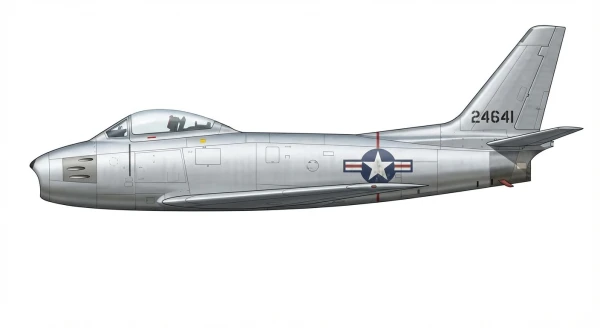
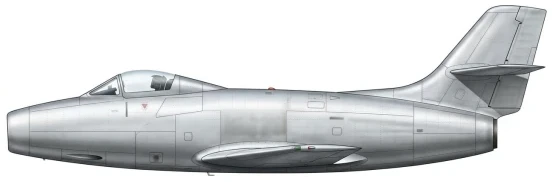
| F-86 Sabre | MD-450 Ouragan | |
|---|---|---|
| Origin country | 🇺🇸 United States | 🇫🇷 France |
| Category | Combat Aircraft | Combat Aircraft |
| Manufacturer | North American | Dassault |
| First flight | 1 October 1947 | 28 February 1949 |
| Year introduced | 1949 | 1952 |
| Number produced | 9860 units | 567 units |
| Average unit price | $1.2 million | $1 million |
| Wing area | 28.1 m² | 23.8 m² |
| Wingspan | 11.3 m | 13.2 m |
| Height | 4.4 m | 4.1 m |
| Length | 11.4 m | 10.7 m |
| Maximum speed | 1127 km/h | 940 km/h |
| Operational range | 2,454 km | 920 km |
| Service ceiling | 15,850 m | 13,000 m |
| Max. takeoff weight | 9,621 kg | 7,900 kg |
| Empty weight | 5,443 kg | 4,142 kg |
| Total thrust | 1 x 3,402 kgf | 1 x 2,263 kgf |
Detailed Comparison
The North American F-86 Sabre and the Dassault MD-450 Ouragan illustrate the divergence in postwar aviation capabilities between the United States and France. While the Sabre incorporated advanced German aerodynamic data to achieve transonic speeds, the Ouragan represented a pragmatic, private venture to revitalize the French aerospace industry using established technology. Consequently, the F-86 defined the cutting edge of air superiority, while the Ouragan served as a foundational platform for future French development.
Development and Design
The design philosophies of these aircraft were dictated by available research and industrial capacity. North American Aviation delayed the XP-86 prototype to incorporate a 35° swept-back wing and automatic leading-edge slats derived from German Me 262 data. This decision was critical for delaying compressibility issues at high Mach numbers. The F-86 also integrated an "all-flying tail" in later variants to maintain control authority during transonic flight.
In contrast, Marcel Bloch (Dassault) designed the MD-450 Ouragan to be simple and robust. It featured a relatively conventional layout with a nose intake, thin but essentially straight tapered wings, and a swept tailplane. While the F-86 utilized axial-flow turbojets (and later the Rolls-Royce Avon), the Ouragan relied on the reliable but older centrifugal-flow Rolls-Royce Nene, license-produced by Hispano-Suiza. The Ouragan prioritized rapid availability and industrial independence over aerodynamic novelty.
Specifications and Performance
The aerodynamic advantages of the Sabre are evident in the performance data. The F-86 achieves a maximum speed of 1127 km/h, significantly outpacing the Ouragan’s 940 km/h. The disparity in vertical performance is equally pronounced, with the Sabre offering a climb rate of 61.0 m/s compared to the Ouragan's 38.0 m/s. This kinematic superiority allowed the F-86 to dictate engagement terms in air-to-air combat.
- Thrust: The provided Sabre specifications list a thrust of 3402 kgf (Avon engine), whereas the Ouragan produces 2263 kgf.
- Ceiling: The Sabre operates effectively up to 15,850 m, offering a 2,850 m advantage over the Ouragan's 13,000 m ceiling.
- Armament: The Ouragan mounted four 20mm Hispano cannons, offering greater destructive power per hit than the Sabre’s standard six 0.50 caliber machine guns. However, the Sabre eventually integrated AIM-9 Sidewinder missiles, marking a transition to the missile age that the original Ouragan design did not initially support.
Deployment and Usage
The F-86 Sabre served as the primary U.S. air superiority fighter during the Korean War, tasked with countering the Soviet MiG-15. Its high-speed agility allowed it to secure air dominance, and it saw extensive export to allied nations including Pakistan and Taiwan, seeing combat in the Indo-Pakistani wars and the Taiwan Strait.
The Ouragan entered service later (1952) and was quickly superseded in the interceptor role by the Mystère IV. Consequently, it found its niche in ground attack and secondary roles. It saw combat with the Israeli Air Force during the Suez Crisis and Six-Day War, and with the Indian Air Force (as the Toofani) against Portuguese and Pakistani forces. Its robust landing gear and stability made it an effective platform for rough-field operations, a capability formalized in the Barougan variant.
Conclusion
The F-86 Sabre was a technologically superior aircraft that set the standard for jet-to-jet combat, benefiting from superior aerodynamics and engine technology. It was a dedicated air superiority machine adaptable to other roles. The MD-450 Ouragan, while outclassed in pure kinematics, succeeded in its primary objective: re-establishing French indigenous fighter production. It proved to be a rugged, reliable strike aircraft and the necessary precursor to the successful Mirage lineage.