F-84F Thunderstreak vs MiG-15 Fagot
F-84F Thunderstreak vs MiG-15 Fagot at a glance — top speed 1,060 vs 1,075 km/h, range 1,304 vs 2,520 km, max takeoff weight 12,247 vs 6,105 kg, built 3,428 vs 17,310 units.
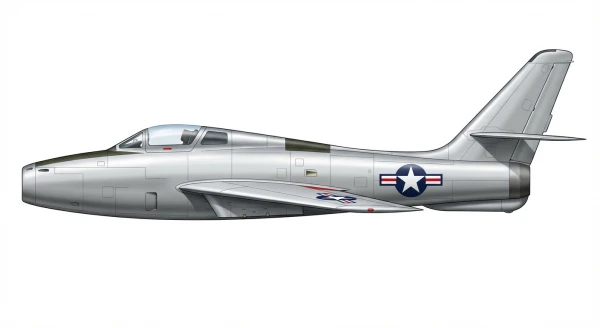
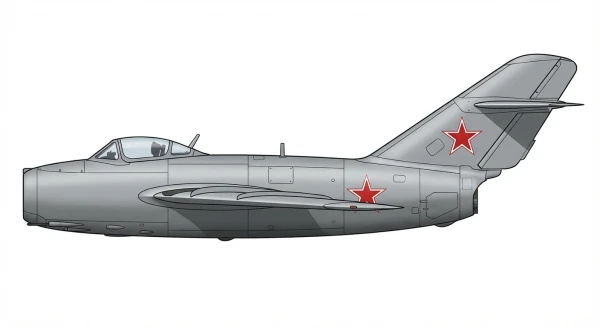
| F-84F Thunderstreak | MiG-15 Fagot | |
|---|---|---|
| Origin country | 🇺🇸 United States | 🇷🇺 Ex-USSR |
| Category | Combat Aircraft | Combat Aircraft |
| Manufacturer | Republic | Mikoyan-Gurevich |
| First flight | 3 June 1950 | 19 December 1947 |
| Year introduced | 1954 | 1949 |
| Number produced | 3428 units | 17310 units |
| Average unit price | $1.6 million | $200K |
| Wing area | 30.2 m² | 20.6 m² |
| Wingspan | 10.2 m | 10.1 m |
| Height | 4.6 m | 3.7 m |
| Length | 13.2 m | 10.1 m |
| Maximum speed | 1060 km/h | 1075 km/h |
| Operational range | 1,304 km | 2,520 km |
| Service ceiling | 12,000 m | 15,500 m |
| Max. takeoff weight | 12,247 kg | 6,105 kg |
| Empty weight | 6,789 kg | 3,580 kg |
| Total thrust | 1 x 3,275 kgf | 1 x 2,700 kgf |
Detailed Comparison
The Republic F-84F Thunderstreak was a swept-wing evolution of an existing ground-attack platform designed for tactical nuclear delivery and strike missions, whereas the Mikoyan-Gurevich MiG-15 was a purpose-built high-altitude interceptor optimized for destroying heavy bombers. While both aircraft utilized swept-wing technology to approach transonic speeds, their engineering lineages diverged significantly: the F-84F struggled with weight and engine integration as a modified airframe, while the MiG-15 benefited from a lighter, agile design philosophy centered on the Nene-derivative VK-1 engine.
Development and Design
Development of the F-84F involved a complex redesign of the straight-wing Thunderjet, eventually retaining only 15% tool commonality. The integration of the Wright J65 engine (a license-built Armstrong Siddeley Sapphire) necessitated a vertically stretched fuselage and oval intake. The use of heavy press-forged wing spars and ribs contributed to a robust but heavy structure. Conversely, the MiG-15 leveraged captured German aerodynamic research and the reverse-engineered Rolls-Royce Nene engine (Klimov VK-1). The Soviet design emphasized simplicity and mass production, using extensive aluminum alloys. The F-84F faced severe teething issues, including stability problems (pitch-up) and engine flameouts in heavy precipitation, requiring the retrofitting of a hydraulically powered stabilator in later blocks. The MiG-15's design prioritized high-altitude performance, though it suffered from primitive avionics compared to Western standards.
Specifications and Performances
Performance metrics highlight the distinct operational roles of these aircraft. The MiG-15 possesses a superior thrust-to-weight ratio, with a MTOW of only 6,105 kg compared to the F-84F's massive 12,247 kg. This weight disparity grants the MiG-15 a significant advantage in vertical maneuverability, achieving a service ceiling of 15,500 m and a climb rate of 50.0 m/s, substantially outperforming the Thunderstreak’s 12,000 m ceiling and 42.0 m/s climb. While maximum speeds are comparable (approx. 1060-1075 km/h), the F-84F was designed for payload rather than agility. It could carry 6,000 lb of external stores, including the Mark 7 nuclear bomb, whereas the MiG-15 relied on heavy cannon armament (37 mm and 23 mm) specifically for air-to-air engagements against bombers.
Deployment and usage
The MiG-15 defined the air war over Korea, shocking UN forces in "MiG Alley" and forcing the deployment of the F-86 Sabre. Its deployment focused on air superiority and interception, with production reaching 17,310 units. In contrast, the F-84F served primarily as a tactical strike aircraft for NATO. Equipped with the Low-Altitude Bombing System (LABS), it provided a nuclear deterrent capability in Europe. Operational readiness for the Thunderstreak was plagued by maintenance issues, including corrosion and engine failures, leading to early USAF retirement by 1958, though it saw reactivation during the 1961 Berlin Crisis. The F-84F saw limited air-to-air combat, with one recorded engagement where Turkish units downed Iraqi Il-28 bombers.
Conclusion
Ultimately, the MiG-15 proved to be a seminal air superiority fighter that altered the trajectory of aerial warfare, leveraging lightweight design for vertical dominance. The F-84F Thunderstreak, while aerodynamically advanced, was hampered by excessive weight and mechanical unreliability. It found its niche not as a dogfighter, but as a rugged, high-speed delivery platform for conventional and nuclear ordnance, serving as a transitional asset for NATO air forces until the arrival of the Century Series fighters.