F-84F Thunderstreak vs F-86 Sabre
F-84F Thunderstreak vs F-86 Sabre at a glance — top speed 1,060 vs 1,127 km/h, range 1,304 vs 2,454 km, max takeoff weight 12,247 vs 9,621 kg, built 3,428 vs 9,860 units.
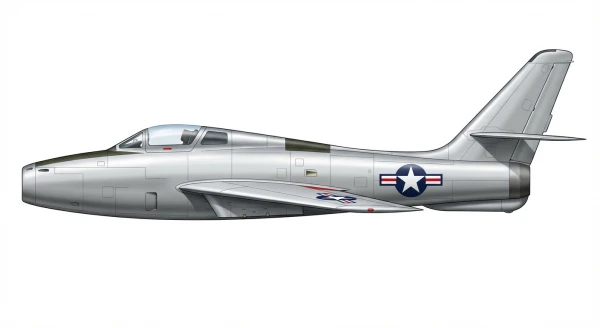
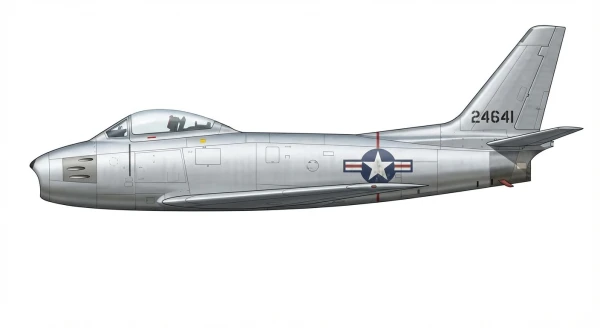
| F-84F Thunderstreak | F-86 Sabre | |
|---|---|---|
| Origin country | 🇺🇸 United States | 🇺🇸 United States |
| Category | Combat Aircraft | Combat Aircraft |
| Manufacturer | Republic | North American |
| First flight | 3 June 1950 | 1 October 1947 |
| Year introduced | 1954 | 1949 |
| Number produced | 3428 units | 9860 units |
| Average unit price | $1.6 million | $1.2 million |
| Wing area | 30.2 m² | 28.1 m² |
| Wingspan | 10.2 m | 11.3 m |
| Height | 4.6 m | 4.4 m |
| Length | 13.2 m | 11.4 m |
| Maximum speed | 1060 km/h | 1127 km/h |
| Operational range | 1,304 km | 2,454 km |
| Service ceiling | 12,000 m | 15,850 m |
| Max. takeoff weight | 12,247 kg | 9,621 kg |
| Empty weight | 6,789 kg | 5,443 kg |
| Total thrust | 1 x 3,275 kgf | 1 x 3,402 kgf |
Detailed Comparison
The Republic F-84F Thunderstreak and North American F-86 Sabre emerged as contemporary swept-wing jet fighters, yet they filled diverging tactical roles within the United States Air Force and NATO. While both utilized captured German aerodynamic research regarding swept-wing planforms to delay drag rise, the F-86 was optimized for agility and high-altitude interception, whereas the F-84F evolved into a heavier, low-altitude nuclear strike and ground attack platform.
Development and Design
The F-86 Sabre represented a "clean sheet" approach, incorporating a 35-degree swept wing and automatic leading-edge slats inspired by the Me 262 to maintain low-speed stability. It featured an "all-flying" tail on later variants, granting superior controllability in the transonic regime. Conversely, the F-84F began as a swept-wing modification of the straight-wing F-84 Thunderjet. However, the requirement to install the larger Wright J65 engine (a licensed Armstrong Siddeley Sapphire) necessitated a vertically stretched fuselage and an oval air intake. This resulted in only 15% tooling commonality with its predecessor. The F-84F faced significant production hurdles, including competition for press-forged wing spars with the B-47 Stratojet and persistent stability issues like accelerated stall pitch-up, which were only rectified in later production blocks.
Specifications and Performance
The F-86 Sabre demonstrates superior kinematic performance suitable for air-to-air combat, boasting a maximum speed of 1127 km/h and a service ceiling of 15,850 m, significantly outclassing the F-84F's 1060 km/h top speed and 12,000 m ceiling. The Sabre’s climb rate of 61.0 m/s is nearly 50% greater than the Thunderstreak's 42.0 m/s.
The F-84F, however, was built for load-carrying. It is a substantially heavier machine, with a Maximum Takeoff Weight (MTOW) of 12,247 kg compared to the Sabre's 9,621 kg. This structural mass supported a heavy external payload of up to 6,000 lb (2,727 kg), compared to the standard fighter-bomber loadout of the Sabre. While the F-86 utilized machine guns and eventually AIM-9 Sidewinders, the F-84F was specifically configured for the delivery of the Mark 7 nuclear bomb.
Deployment and Usage
The F-86 defined air combat during the Korean War, serving as the primary counter to the MiG-15 and achieving a notable kill ratio. It saw extensive export success, with the Republic of China Air Force notably deploying AIM-9s in combat against the PRC.
The F-84F missed the Korean War due to development delays and was not declared operational until 1954. Its service life was plagued by the J65 engine's susceptibility to flameouts in heavy rain and fleet-wide corrosion issues. Despite these flaws, it served a critical role in NATO as a tactical nuclear deterrent. Equipped with the Low-Altitude Bombing System (LABS), the Thunderstreak provided the primary strike capability for tactical air forces in Europe during the mid-1950s until replaced by the F-100 and F-105.
Conclusion
The F-86 Sabre is rightfully categorized as a premier air superiority fighter, distinguished by its reliability, handling, and combat effectiveness. The F-84F Thunderstreak, while a robust platform for nuclear and conventional strike missions, represents a compromised design hampered by mechanical deficiencies and restricted maneuverability. The Sabre achieved tactical dominance; the Thunderstreak fulfilled a strategic necessity.