IA 58 Pucará vs OV-10 Bronco
IA 58 Pucará vs OV-10 Bronco at a glance — top speed 500 vs 452 km/h, range 3,710 vs 2,222 km, max takeoff weight 6,800 vs 6,552 kg, built 110 vs 360 units.
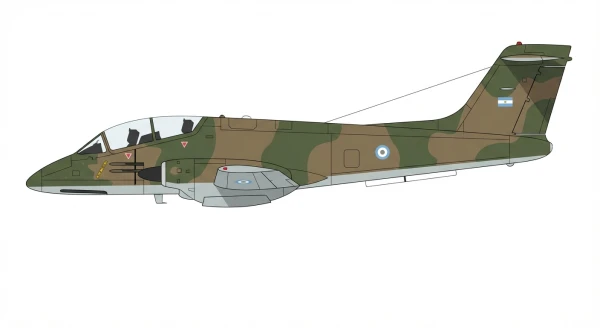
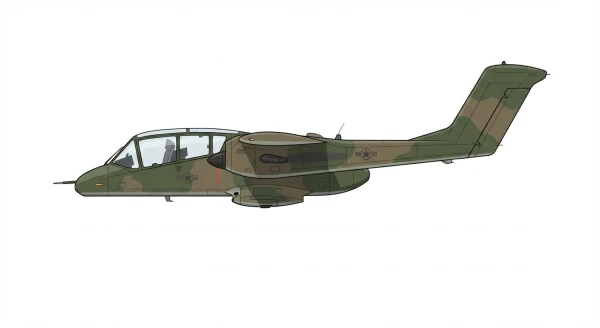
| IA 58 Pucará | OV-10 Bronco | |
|---|---|---|
| Origin country | 🇦🇷 Argentina | 🇺🇸 United States |
| Category | Combat Aircraft | Combat Aircraft |
| Manufacturer | FMA | North American |
| First flight | 8 November 1974 | 16 July 1965 |
| Year introduced | 1976 | 1967 |
| Number produced | 110 units | 360 units |
| Average unit price | $2 million | $1 million |
| Wing area | 30.3 m² | 88.7 m² |
| Wingspan | 14.5 m | 12.2 m |
| Height | 5.4 m | 4.6 m |
| Length | 14.3 m | 12.7 m |
| Maximum speed | 500 km/h | 452 km/h |
| Operational range | 3,710 km | 2,222 km |
| Service ceiling | 10,000 m | 8,780 m |
| Max. takeoff weight | 6,800 kg | 6,552 kg |
| Empty weight | 4,020 kg | 3,261 kg |
| Total thrust | 2 x 729 kW | 2 x 776 kW |
Detailed Comparison
The FMA IA 58 Pucará and the North American OV-10 Bronco are twin-turboprop combat aircraft developed for similar counter-insurgency (COIN) and light attack roles, yet they originate from distinct operational philosophies. The Pucará, developed nationally by Argentina, is a dedicated ground-attack platform built around a heavy fixed armament. The Bronco, a product of a US tri-service requirement for a Light Armed Reconnaissance Aircraft (LARA), was designed as a multi-role observation and forward air control (FAC) platform with secondary attack capabilities.
Development and Design
The Pucará's design reflects its intended use in COIN operations from unprepared airstrips. Its conventional, all-metal monoplane structure with a slender fuselage prioritizes robustness and protection, incorporating armor for the crew and engines. A key feature is its powerful integrated armament of two 20mm cannons and four 7.62mm machine guns. In contrast, the Bronco's unique twin-boom configuration with a central nacelle was driven by the LARA specification's demand for exceptional crew visibility, short-field performance, and mission flexibility. This layout provides a rear cargo bay that can accommodate paratroopers or medical litters, a capability the Pucará lacks. The Bronco's standard armament of four machine guns is lighter, relying more heavily on its seven external hardpoints for mission-specific ordnance.
Specifications and Performances
While both are twin-turboprops, their performance metrics reflect their design priorities. The Pucará is physically larger and heavier, with a max takeoff weight of 6800 kg compared to the Bronco's 6552 kg. Its more powerful 729 kW Turbomeca Astazou engines give it a higher maximum speed of 500 km/h. The Bronco, with its 533 kW Garrett T76 engines, is slower at 452 km/h but was optimized for loiter time and short takeoff and landing (STOL) from austere locations, a core LARA requirement. The Pucará's higher service ceiling (10,000 m vs. 8,780 m) is a notable advantage, though its lack of an oxygen system in early models limited its practical use at altitude. The Bronco's design emphasized payload flexibility, with a slightly lower external load of 1,450 kg but greater modularity.
Deployment and usage
Both aircraft have extensive combat records. The Pucará was used by the Argentine Air Force in domestic COIN operations and, most notably, during the Falklands War. Its ability to operate from short, grass airstrips was an asset, but it proved vulnerable to air defenses, with losses to Sea Harriers and Stinger missiles. It did, however, achieve a confirmed air-to-air victory against a Royal Marines Scout helicopter. The Bronco saw widespread service with the US Marine Corps, Air Force, and Navy in Vietnam, primarily as an effective FAC and light-attack aircraft. Its versatility and long endurance were highly valued. Various export versions have been used in conflicts by Colombia, the Philippines, and Morocco, underscoring its utility in COIN and surveillance roles.
Conclusion
The IA 58 Pucará is a purpose-built, rugged light attack aircraft, defined by its formidable internal cannon armament and robust construction for austere environments. The OV-10 Bronco is a more versatile system, designed from the outset as an observation, FAC, and light support platform. Its unique twin-boom design afforded it superior visibility and cargo-carrying flexibility not present in the Pucará. While the Pucará is arguably a more potent gun platform, the Bronco's multi-role adaptability made it a more widely exported and enduring design in the LARA category. Subsequent upgrades to both airframes, such as the Pucará Fénix and OV-10D, have focused on enhancing surveillance capabilities, reflecting a modern shift from pure COIN to intelligence, surveillance, and reconnaissance (ISR) roles.