Pilatus PC-21 vs Pilatus PC-9
Pilatus PC-21 vs Pilatus PC-9 at a glance — top speed 685 vs 593 km/h, range 1,333 vs 1,537 km, max takeoff weight 4,250 vs 3,200 kg, built 211 vs 265 units.
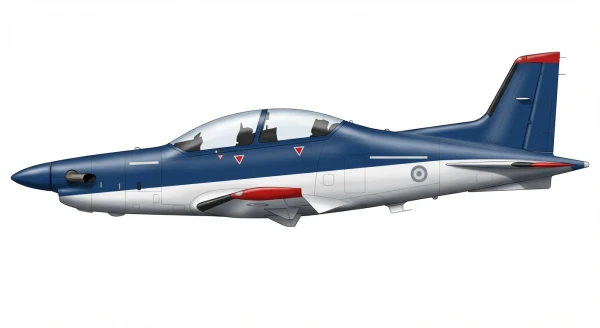
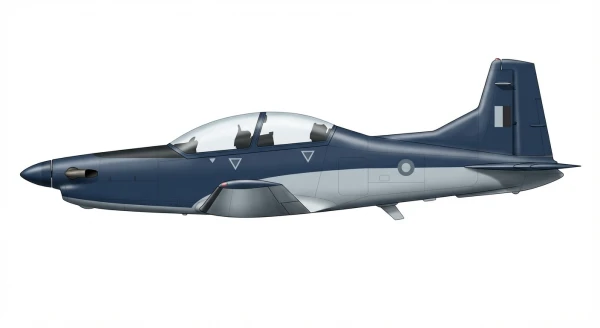
| Pilatus PC-21 | Pilatus PC-9 | |
|---|---|---|
| Origin country | 🇨🇭 Switzerland | 🇨🇭 Switzerland |
| Category | Military Training Aircraft | Military Training Aircraft |
| Manufacturer | Pilatus | Pilatus |
| First flight | 1 July 2002 | 7 May 1984 |
| Year introduced | 2008 | 1987 |
| Number produced | 211 units | 265 units |
| Average unit price | $9 million | -- |
| Wing area | 15.2 m² | 16.3 m² |
| Wingspan | 9.1 m | 10.2 m |
| Height | 3.8 m | 3.3 m |
| Length | 11.2 m | 10.2 m |
| Maximum speed | 685 km/h | 593 km/h |
| Operational range | 1,333 km | 1,537 km |
| Service ceiling | 11,580 m | 11,600 m |
| Max. takeoff weight | 4,250 kg | 3,200 kg |
| Empty weight | 2,270 kg | 1,781 kg |
| Total thrust | 1 x 1,193 kW | 1 x 708 kW |
Detailed Comparison
The Pilatus PC-9 and PC-21 trace the shift in Western military flight training from basic flying platforms to integrated systems designed to bypass intermediate jet trainers. The PC-9 emerged in the 1980s as a high-performance ab initio and advanced trainer. Twenty years later, Pilatus engineered the PC-21 with a different mandate: downloading fast-jet syllabus hours into a turboprop airframe to reduce training costs.
Development and Design
The PC-9 was derived from the PC-7, adding nearly 300 kg of mass, a lengthened fuselage, stepped ejection seats, and a ventral airbrake. Its basic architecture birthed the Beechcraft T-6 Texan II, which won the US JPATS competition. In contrast, Pilatus built the PC-21 around an embedded simulation suite, digital power management, and automatic yaw compensation to mimic jet handling. The cockpit utilizes three large color LCDs and HOTAS controls that emulate front-line fighters. This allows air forces to train pilots in radar operation, weapons deployment, and electronic warfare entirely through software, without actual RF emissions or external stores.
Specifications and Performances
The PC-21 demands a much heavier footprint, with a 4,250 kg maximum takeoff weight compared to the PC-9’s 3,200 kg. To offset this mass and emulate jet speeds, the PC-21 relies on specific hardware upgrades:
- A 1,193 kW Pratt & Whitney PT6A-68B turboprop, generating 68% more power than the PC-9’s 708 kW PT6A-62
- An aerodynamic profile enabling a 685 km/h top speed, a 92 km/h advantage over the older airframe
- A reinforced wing structure rated for +8g maneuvers, suited for combat maneuvering drills
The PC-9 retains a range advantage of 1,537 km versus the PC-21’s 1,333 km, reflecting the 1980s aircraft's lighter frame and lower fuel burn rates.
Deployment and usage
The PC-9 proliferated widely as a standard trainer and aerobatic platform, flying with the Australian Roulettes and Thai Blue Phoenix. It also saw combat operations; Chad armed its PC-9s for strike missions against rebel columns in 2008, triggering Swiss export control disputes. The PC-21, conversely, secures contracts with modern air forces—including Singapore, Qatar, and France—specifically to replace legacy jet trainers like the Alpha Jet. The Royal Australian Air Force explicitly phased out its PC-9 fleet in 2019 to transition to the PC-21, utilizing the newer aircraft to offload F-35 conversion training hours to a turboprop.
Conclusion
The PC-9 is an effective stick-and-rudder trainer, but it is obsolete for operators of 4.5 and 5th-generation combat aircraft. The PC-21 holds the definitive edge in advanced military training. By replicating fast-jet avionics and sensor management within a $9.0 million turboprop airframe, the PC-21 eliminates the need for a dedicated lead-in fighter trainer (LIFT) jet. For air forces attempting to control pilot production costs without degrading syllabus quality, the PC-21 is the strictly superior procurement choice.