Pilatus PC-21 vs T-6 Texan II
Pilatus PC-21 vs T-6 Texan II at a glance — top speed 685 vs 585 km/h, range 1,333 vs 1,700 km, max takeoff weight 4,250 vs 2,948 kg, built 211 vs 1,000 units.
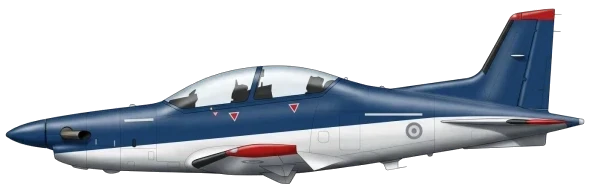
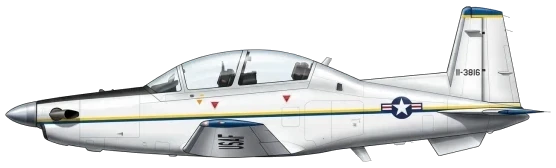
| Pilatus PC-21 | T-6 Texan II | |
|---|---|---|
| Origin country | 🇨🇭 Switzerland | 🇺🇸 United States |
| Category | Military Training Aircraft | Military Training Aircraft |
| Manufacturer | Pilatus | Beechcraft |
| First flight | 1 July 2002 | 23 December 1992 |
| Year introduced | 2008 | 2001 |
| Number produced | 211 units | 1000 units |
| Average unit price | $9 million | $4.3 million |
| Wing area | 15.2 m² | 16.3 m² |
| Wingspan | 9.1 m | 10.2 m |
| Height | 3.8 m | 3.3 m |
| Length | 11.2 m | 10.2 m |
| Maximum speed | 685 km/h | 585 km/h |
| Operational range | 1,333 km | 1,700 km |
| Service ceiling | 11,580 m | 9,449 m |
| Max. takeoff weight | 4,250 kg | 2,948 kg |
| Empty weight | 2,270 kg | 2,135 kg |
| Total thrust | 1 x 1,193 kW | 1 x 820 kW |
Detailed Comparison
The Swiss Pilatus PC-21 is a high-performance turboprop trainer designed to replicate the flight characteristics and systems of modern jet fighters, while the American Beechcraft T-6 Texan II serves as a foundational primary trainer for a broad user base. This distinction is evident in their core performance metrics; the PC-21’s more powerful 1,193 kW engine provides a higher maximum speed (624 km/h vs. 585 km/h) and service ceiling (11,580 m vs. 9,449 m) compared to the T-6. This performance gap is a direct result of their differing design philosophies and intended roles within a pilot training syllabus.
Development and Design
The PC-21 was developed from the outset as a comprehensive training system intended to cover the majority of a pilot's training, reducing reliance on expensive jet trainers. Its design incorporates advanced features like hydraulically-assisted ailerons, an anti-g system, and a pressurized cabin for high-altitude operations. A key innovation is its embedded simulation and training suite, which can emulate radar, electronic warfare, and weapons employment directly in the cockpit. In contrast, the T-6 Texan II originated from the US Joint Primary Aircraft Training System (JPATS) requirement to replace legacy trainers. Based on the Pilatus PC-9, its design focuses on providing a reliable, cost-effective platform to transition students to modern glass cockpit environments. At a price of $4.3 million, the T-6 is significantly less expensive than the $9.0 million PC-21, reflecting the latter's more advanced systems and performance.
Specifications and Performances
The PC-21's performance envelope is substantially larger than the T-6's. Its higher climb rate (20.32 m/s vs. 16.0 m/s) and speed allow it to better simulate the mission profiles of front-line combat aircraft. A critical differentiator is its structural strength and payload capacity. The PC-21 has a much higher maximum takeoff weight (4,250 kg vs. 2,858 kg) and is designed to carry up to 1,150 kg of external stores on five hardpoints. This gives it a credible light attack and counter-insurgency capability inherent in its standard configuration. While the T-6 platform has a light-attack variant (the AT-6 Wolverine), the standard T-6A/B trainers lack this built-in weapons capability.
Deployment and usage
The T-6 Texan II is the standard primary trainer for the U.S. Air Force and Navy and has been widely exported, with over 850 units built. Its primary role is in the initial phases of pilot instruction. Operational history has been broadly successful, though it has included challenges such as unexplained physiological episodes. The PC-21 is operated by a smaller, more select group of air forces, often as part of a holistic training package that includes ground-based simulators and logistical support. Its deployment by nations like Saudi Arabia and Qatar is intended to streamline the path to advanced jets like the Eurofighter Typhoon and Rafale. The French Air Force's use of the PC-21 for surveillance during the 2024 Olympics demonstrates a versatility derived from its higher performance and payload options.
Conclusion
The T-6 Texan II is a proven, economical, and widely adopted primary trainer that effectively introduces pilots to modern flight systems. The Pilatus PC-21 occupies a different segment of the market as a more capable and expensive advanced trainer. It serves as a "turboprop jet," designed to download significant training hours from operational conversion units, offering potential long-term cost savings for air forces that operate complex and expensive fighter fleets. The choice between the two aircraft reflects a fundamental divergence in training doctrine: the T-6 provides a solid, widespread foundation, while the PC-21 offers a high-fidelity, specialized path to high-performance combat aircraft.
-
 Saudi Arabia
55
Saudi Arabia
55
-
 Australia
49
Australia
49
-
 Spain
40
Spain
40
- All 10 operators →
-
 United States
740
United States
740
-
 Mexico
69
Mexico
69
-
 Greece
45
Greece
45
- All 15 operators →