Pilatus PC-9 vs T-6 Texan II
Pilatus PC-9 vs T-6 Texan II at a glance — top speed 593 vs 585 km/h, range 1,537 vs 1,700 km, max takeoff weight 3,200 vs 2,948 kg, built 265 vs 1,000 units.
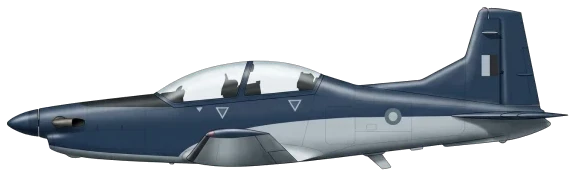
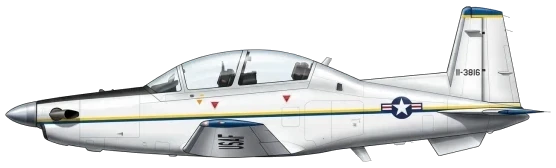
| Pilatus PC-9 | T-6 Texan II | |
|---|---|---|
| Origin country | 🇨🇭 Switzerland | 🇺🇸 United States |
| Category | Military Training Aircraft | Military Training Aircraft |
| Manufacturer | Pilatus | Beechcraft |
| First flight | 7 May 1984 | 23 December 1992 |
| Year introduced | 1987 | 2001 |
| Number produced | 265 units | 1000 units |
| Average unit price | -- | $4.3 million |
| Wing area | 16.3 m² | 16.3 m² |
| Wingspan | 10.2 m | 10.2 m |
| Height | 3.3 m | 3.3 m |
| Length | 10.2 m | 10.2 m |
| Maximum speed | 593 km/h | 585 km/h |
| Operational range | 1,537 km | 1,700 km |
| Service ceiling | 11,600 m | 9,449 m |
| Max. takeoff weight | 3,200 kg | 2,948 kg |
| Empty weight | 1,781 kg | 2,135 kg |
| Total thrust | 1 x 708 kW | 1 x 820 kW |
Detailed Comparison
The T-6 Texan II is a direct, heavily modified derivative of the Pilatus PC-9, developed to meet the specific requirements of the U.S. Joint Primary Aircraft Training System (JPATS). While the Swiss PC-9 was conceived as a versatile advanced trainer with inherent light-attack potential, the American T-6 was tailored as a primary trainer, emphasizing a modern cockpit environment and durability for high-G maneuvers to prepare pilots for subsequent jet aircraft.
Development and Design
The PC-9 evolved from the earlier PC-7, incorporating a more powerful engine, a lengthened fuselage, and a stepped tandem cockpit with Martin-Baker ejection seats to improve instructor visibility. Its design philosophy maintained a multi-role capability, featuring seven hardpoints for external stores. In contrast, the T-6’s development as the "Beech Pilatus PC-9 Mk.2" focused on winning the JPATS contract. This necessitated significant re-engineering, including a strengthened airframe to handle sustained high-G forces (+7 to -3.5 G), a pressurized cockpit, and the integration of a full "glass cockpit" with a Head-Up Display (HUD) as standard. The T-6 design prioritized mimicking the complex operational environment of modern combat aircraft from the earliest stage of training.
Specifications and Performances
A comparison of performance metrics reveals the trade-offs in their respective designs. Despite its more powerful Pratt & Whitney Canada PT6A-68 engine (932 kW vs. the PC-9's 708 kW PT6A-62), the T-6 has a slightly lower maximum speed (585 km/h vs. the PC-9's 593 km/h), a significantly lower service ceiling (9,449 m vs. 11,600 m), and a slower climb rate (16.0 m/s vs. 19.7 m/s). This performance difference is primarily attributable to the T-6's substantially heavier empty weight (2,135 kg vs. 1,781 kg), a direct result of its reinforced airframe and more complex avionics. The PC-9's higher maximum takeoff weight (3,200 kg vs. the T-6's 2,858 kg) also gives it a greater useful load, underscoring its utility for carrying external fuel or armament.
Deployment and usage
The PC-9 has seen wide service as an advanced trainer and has been used by multiple national aerobatic teams. Its seven standard hardpoints have enabled its use in light attack and surveillance roles, as evidenced by its operational history with nations like Chad and a combat loss over Iraq in 1991. The T-6, by contrast, is almost exclusively a primary flight trainer, serving as the foundational aircraft for U.S. Air Force and Navy student pilots. Its variants reflect this training focus:
- T-6A: Standard USAF primary trainer.
- T-6B: U.S. Navy variant with an enhanced digital cockpit.
- T-6C: Export version with hardpoints for weapons training. The dedicated AT-6 Wolverine light attack aircraft is a separate, more extensive modification of the airframe, whereas a light combat capability was more inherent to the original PC-9 design.
Conclusion
The Pilatus PC-9 is a versatile and high-performing turboprop trainer with a design that accommodates multiple roles, reflected in its superior flight performance and payload capacity. The T-6 Texan II is a specialized evolution, sacrificing some of that raw performance for a more robust airframe and an integrated digital cockpit specifically designed to streamline the U.S. military's training pipeline for advanced combat aircraft. The decision by some former PC-9 operators, such as the Royal Thai Air Force, to replace them with the T-6 indicates a preference for a more modern, integrated training system, even at the cost of the broader mission flexibility offered by the original Swiss design.


-
 United States
740
United States
740
-
 Mexico
69
Mexico
69
-
 Greece
45
Greece
45
- All 15 operators →