AW101 vs S-92 Superhawk
AW101 vs S-92 Superhawk at a glance — top speed 309 vs 306 km/h, range 1,389 vs 850 km, built 137 vs 300 units.
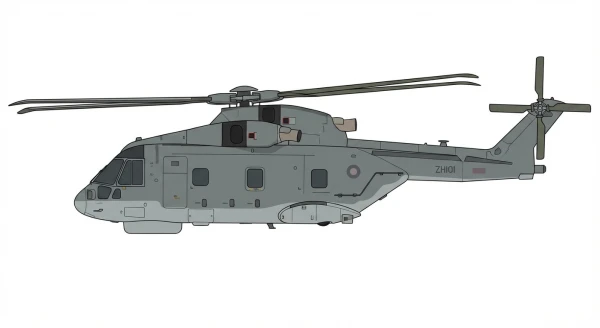
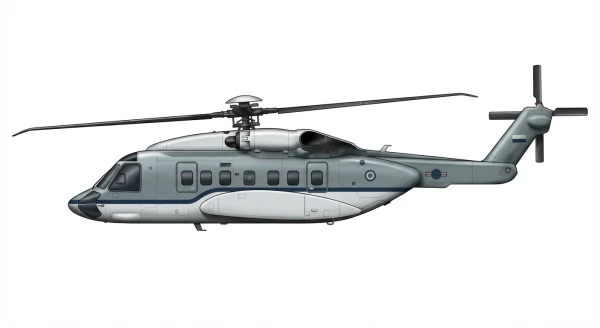
| AW101 | S-92 Superhawk | |
|---|---|---|
| Origin country | 🇬🇧 United Kingdom🇮🇹 Italy | 🇺🇸 United States |
| Category | Military Helicopters | Military Helicopters |
| Manufacturer | AgustaWestland | Sikorsky |
| First flight | 19 October 1964 | 23 December 1998 |
| Year introduced | 1999 | 2004 |
| Number produced | 137 units | 300 units |
| Average unit price | $70 million | $32 million |
| Wingspan | 18.6 m | 17.2 m |
| Height | 6.6 m | -- m |
| Length | 20.4 m | -- m |
| Maximum speed | 309 km/h | 306 km/h |
| Operational range | 1,389 km | 850 km |
| Service ceiling | 2,600 m | 4,267 m |
| Max. takeoff weight | 12,900 kg | -- kg |
| Empty weight | 6,850 kg | 7,031 kg |
| Total thrust | 3 x 1,044 kW | -- |
Detailed Comparison
The AgustaWestland (now Leonardo) AW101 and the Sikorsky S-92 represent the divergence between clean-sheet military procurement and the commercial-off-the-shelf (COTS) militarization trend. While the AW101 emerged from a specific Cold War requirement to hunt Soviet submarines, the S-92 began as a bus for the offshore energy sector, attempting to wear a uniform later in its life cycle.
Development and Design
The AW101 is defined by its three-engine configuration, a requirement driven by the Royal Navy and Italian Navy for safe loitering during sonar dipping operations. This architecture provides a One Engine Inoperative (OEI) safety margin that twin-engine helicopters cannot match. Its design integrates active vibration control and armored crew seats from the outset, reflecting a philosophy prioritizing survivability and sensor stability over economy.
Conversely, the S-92 utilizes dynamic components from the S-70/Black Hawk lineage but pairs them with a high-volume, commercial airframe. Sikorsky's approach focused on economics and cabin volume for the oil and gas market. The difficulties in militarizing this platform are best illustrated by Canada’s CH-148 Cyclone program, where transforming the S-92 into a naval asset resulted in over a decade of delays and massive cost overruns. The S-92 lacks the AW101's bespoke military DNA, relying instead on retrofitting mission systems into a civilian shell.
Specifications and Performance
Performance metrics favor the European platform for blue-water and heavy-lift operations. The AW101’s range of nearly 1,400 km dwarfs the S-92’s 850 km, a direct result of the triple-turbine architecture and larger fuel fraction. This range advantage allows the AW101 to conduct long-range SAR or ASW screens without the immediate refueling tether required by the S-92.
While the S-92 is theoretically cheaper at $32 million compared to the AW101's $70 million, this delta evaporates when the S-92 is militarized (the VH-92 and CH-148 are significantly more expensive than the base airframe). The AW101 offers a higher Maximum Takeoff Weight (14,600 kg on newer variants vs roughly 12,000 kg for S-92), translating to superior payload capacity for torpedoes, anti-ship missiles, or troop contingents.
Deployment and Usage
The AW101 possesses a combat record the S-92 cannot claim. RAF Merlin HC3s saw heavy utilization in Iraq (Operation Telic) and Afghanistan (Operation Herrick). These aircraft were often outfitted with heavy armor and defensive aid suites, earning a reputation for taking punishment and bringing crews home. The platform functions effectively as both a tactical transport and a high-end ASW hunter.
The S-92’s military service is largely limited to VIP transport (the US Marine Corps VH-92 "Marine One") and the troubled Canadian maritime patrol role. It has found success in civilian and para-public SAR (UK Coastguard, Irish Coast Guard), replacing aging Sea Kings and S-61s. However, the operational history is marred by the 2009 Cougar Helicopters crash off Newfoundland, which exposed vulnerabilities in the main gearbox mounting studs—a catastrophic failure mode for a helicopter marketed on safety.
Conclusion
For naval commanders and combat operators, the AW101 is the superior machine. Its three-engine redundancy, range, and purpose-built fuselage justify its high acquisition cost and maintenance demands. It is a warfighter's airframe. The S-92 remains a commercial design forced into a military role; while competent for VIP lift or benign environment SAR, it lacks the kinetic resilience and raw performance required for high-intensity conflict.