Cougar
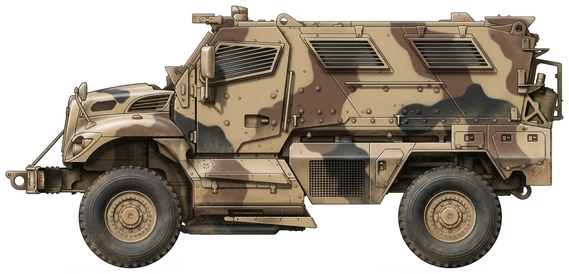
Introduced in 2002, the American Cougar is a Mine-Resistant Ambush Protected troop transport vehicle featuring a V-shaped hull designed to deflect underbody explosive blasts. Key figures: weight 14.5 t, top speed 105 km/h, range 966 km, unit cost $0.73M, built 7,000. In service with 6 armies — United Kingdom (583), Poland (300), Uzbekistan (100) and 3 others.
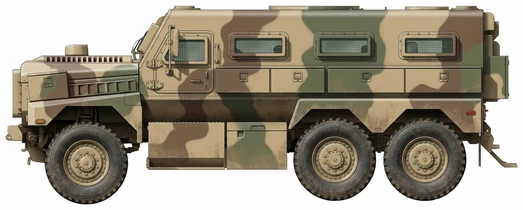
| Sub-type | Mine-resistant ambush-protected (MRAP) and infantry mobility vehicle |
| Crew | 6 (2 crew + 4 passengers) personnels |
| Range | 966 km |
| Mass | 14.5 tons |
| Height | 2.64 m (8.7 ft) |
| Width | 2.74 m (9.0 ft) |
| Length | 5.91 m (19.4 ft) |
| Max. speed | 105 km/h (65 mph) |
| Engine | Caterpillar C-7 diesel I6, 330 hp (243 kW) |
| Weapon 1 | Optional remote weapon station (CROWS II) |
| Weapon 2 | Optional firing ports |
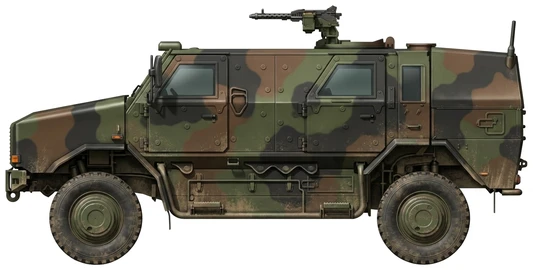
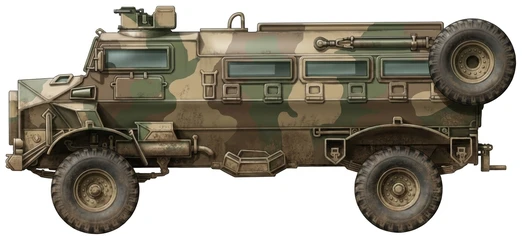
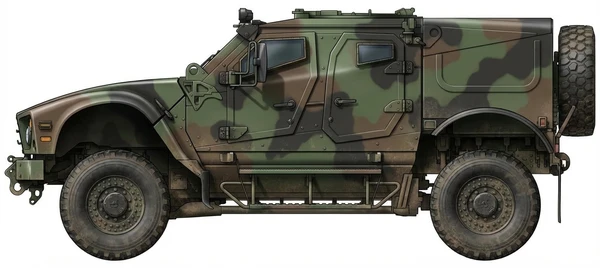
Description
Force Protection Inc. developed the Cougar mine-resistant ambush-protected (MRAP) and infantry mobility vehicle, with vehicle integration performed by Spartan Motors. Development began in early 2004 following a United States Marine Corps (USMC) requirement for a mine-protected vehicle for operations in Iraq. Force Protection designed and delivered the initial vehicles in October 2004. Derived in part from earlier South African mine-resistant vehicle concepts, the design incorporated a continuous single-hull bottom plate, heavier axles, and design standards conforming to US Military Standards, UK Defstans, and NATO STANAGs. Built in 4×4 and 6×6 configurations, the 6×6 version offered larger payload capacity for roles such as carrying explosive ordnance disposal robots. Originally designated the Hardened Engineer Vehicle (HEV), the project became the Joint Explosive Ordnance Disposal Rapid Response Vehicle (JERRV) before adoption into the broader US military MRAP program.
The Cougar features a monocoque V-shaped hull extending to the engine bay to direct underbody blast forces away from the vehicle. The hull structure surrounding the commander and driver is reinforced for torsional stiffness. The armor provides protection against small arms, landmines, and improvised explosive devices (IEDs), withstanding blast forces of at least 14 kg TNT under a wheel and 7 kg TNT under the belly. The vehicle accepts add-on armor systems, including ceramic belly plates and British Chobham-type armor. Dual air-conditioning units maintain interior temperatures in high-ambient environments.
Variants include the Cougar ISS with independent suspension, the Iraqi Light Armored Vehicle (Badger ILAV), and British derivatives comprising the Mastiff 6×6 and Ridgback 4×4 Protected Patrol Vehicles. British variants feature heavy vertical side armor plates over the vision blocks and weapon ports, mounting armament such as 7.62 mm general-purpose machine guns, 12.7 mm heavy machine guns, or 40 mm automatic grenade launchers. Other specialized models include the Mastiff 2 'Protected Eyes' counter-IED vehicle, the Wolfhound logistics support vehicle, Djibouti's Fire Support Cougar fitted with a Panhard AML-90 turret, and the US Air Force RADBO variant equipped with a directed-energy weapon for airfield unexploded ordnance clearance.
The Cougar is operated by several military forces, including the United States, United Kingdom, Canada, Poland, Iraq, and Ukraine. USMC and US Army forces deployed Cougars to Iraq starting in 2004, where vehicles sustained multiple IED attacks. Canadian forces deployed the Cougar to Afghanistan in 2007, while the British Army operated Mastiff, Ridgback, and Wolfhound variants in Iraq and Afghanistan. Polish forces utilized lent Cougar H vehicles armed with 7.62 mm PK machine guns in Afghanistan from 2008. The United Kingdom transferred Mastiff vehicles to Ukraine in 2022 following the Russian invasion.
Frequently Asked Questions
What type of vehicle is the Cougar?
What is the weight of the Cougar?
What is the maximum speed of the Cougar?
What is the operational range of the Cougar?
How many crew members does the Cougar require?
How many Cougar have been built?
What weapons does the Cougar carry?
- AUG 292026 Updated Re-filed as a protected mobility vehicle (was Light)
- AUG 22026 Created Page created: Cougar