SR-71 Blackbird vs U-2 Dragon Lady
SR-71 Blackbird vs U-2 Dragon Lady at a glance — top speed 3,541 vs 805 km/h, range 5,230 vs 11,280 km, max takeoff weight 78,018 vs 18,144 kg, built 32 vs 104 units.

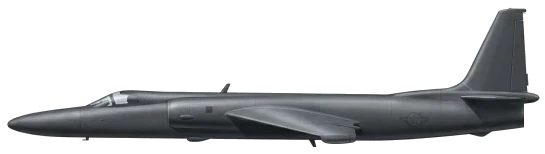
| SR-71 Blackbird | U-2 Dragon Lady | |
|---|---|---|
| Origin country | 🇺🇸 United States | 🇺🇸 United States |
| Category | Military Special Mission Aircraft | Military Special Mission Aircraft |
| Manufacturer | Lockheed | Lockheed |
| First flight | 22 December 1964 | 1 August 1955 |
| Year introduced | 1966 | 1956 |
| Number produced | 32 units | 104 units |
| Average unit price | $185 million | $50 million |
| Wing area | 167.0 m² | 93.0 m² |
| Wingspan | 17.0 m | 31.0 m |
| Height | 5.7 m | 4.9 m |
| Length | 32.8 m | 19.0 m |
| Maximum speed | 3541 km/h | 805 km/h |
| Operational range | 5,230 km | 11,280 km |
| Service ceiling | 25,908 m | 21,336 m |
| Max. takeoff weight | 78,018 kg | 18,144 kg |
| Empty weight | 30,617 kg | 6,486 kg |
| Total thrust | 2 x 15,422 kgf | 1 x 7,711 kgf |
Detailed Comparison
The SR-71 Blackbird and U-2 Dragon Lady, both developed by Lockheed's Skunk Works for high-altitude reconnaissance, pursued fundamentally different survival strategies. The SR-71 relied on unprecedented speed and altitude to outrun threats, while the U-2 leveraged extreme altitude and endurance for persistent surveillance. This core difference in philosophy dictated their design, operational employment, and ultimately, their service longevity.
Development and Design
The SR-71 was an exercise in overcoming the physical limits of flight. Its design was driven by the need to survive in an environment of extreme heat and speed. Key innovations included:
- A fuselage and wing structure built primarily from titanium alloys to withstand skin temperatures exceeding 480°C (900°F) at its operational speed of Mach 3+.
- Two Pratt & Whitney J58 engines, which were hybrid turbo-ramjets, operating as conventional turbojets at lower speeds and as ramjets at high altitude and speed.
- Early stealth characteristics, including chines along the fuselage and radar-absorbent materials, to reduce its radar cross-section.
The U-2 was engineered for maximum altitude and loiter time, resulting in a design resembling a high-performance glider.
- Its defining feature is an exceptionally long, high-aspect-ratio wing (31m wingspan vs. 19m length) that provides immense lift in the thin air above 70,000 feet.
- This design makes the aircraft notoriously difficult to fly, with a very narrow margin between its maximum speed and stall speed at altitude, a region known as the "coffin corner."
- Unlike the SR-71's static design, the U-2 has undergone continuous evolution, from the original U-2A to the larger, more powerful U-2R/S models, allowing it to integrate modern sensor payloads.
Specifications and Performances
A performance comparison reveals two distinct operational envelopes. The SR-71's maximum speed of 3,541 km/h and service ceiling of 25,908 m made it untouchable by any interceptor or surface-to-air missile of its era. It could cross a continent in a fraction of the time of other aircraft. The U-2 operates at a subsonic 805 km/h and a lower, though still significant, ceiling of 21,336 m. While its range is comparable to the SR-71 on paper, its low speed translates into much longer mission endurance, allowing it to remain over a target area for hours. The SR-71 was a massive, heavy aircraft with a max takeoff weight of 78,018 kg, requiring two powerful engines. The U-2 is a lightweight, single-engine platform (18,144 kg MTOW), prioritizing efficiency over raw power.
Deployment and usage
The SR-71 was a strategic asset used for time-critical reconnaissance over the most heavily defended territories, such as the Soviet Union and North Vietnam. Its mission was a rapid "fly-over," gathering imagery and signals intelligence before a defense could react. Its high operational cost and complexity, however, limited its deployment. The U-2, in contrast, has served as a more flexible and persistent intelligence, surveillance, and reconnaissance (ISR) platform. It provides direct, real-time support to theater commanders, capable of carrying a wide array of modular sensor payloads for imagery (IMINT), signals (SIGINT), and measurement intelligence (MASINT). Its lower operational cost and adaptability have seen it deployed in every major US conflict since the Cold War.
Conclusion
The SR-71 Blackbird represented a pinnacle of aeronautical engineering, a specialized solution that achieved survivability through sheer performance. However, its high cost and narrow mission profile led to its retirement as satellite reconnaissance capabilities advanced. The U-2 Dragon Lady, through its more modest but highly efficient and adaptable design, has proven to be the more enduring platform. By continuously integrating new technologies onto a proven airframe, the U-2 has remained a relevant and cost-effective ISR asset for over six decades, demonstrating that adaptability and operational flexibility are as crucial as ultimate performance.
