U-2 Dragon Lady
American high-altitude reconnaissance aircraft, known for extensive Cold War era operations and various military applications worldwide. Key figures: top speed 805 km/h, range 11,280 km, service ceiling 21,336 m, max takeoff weight 18,144 kg, unit price $50M, built 104. In service with 1 air force as of 2026 — United States (31).
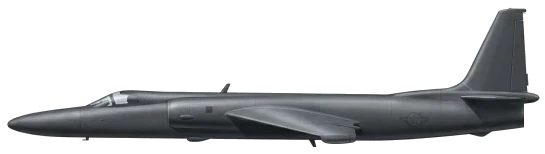
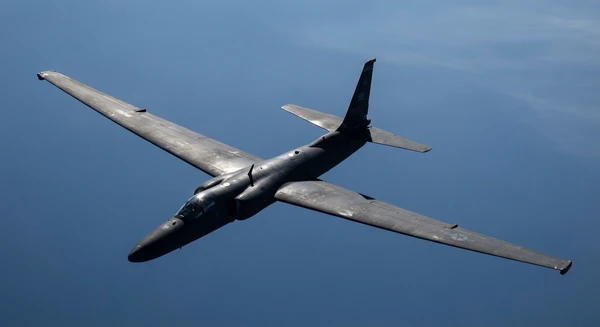
| Crew | 1 |
| Length | 19 m (62.3 ft) |
| Wingspan | 31 m (101.7 ft) |
| Height | 4.9 m (16.0 ft) |
| Wing area | 93 m² (1001.0 sqft) |
| Empty weight | 6,486 kg (14,299 lbs) |
| Max. takeoff weight | 18,144 kg (40,001 lbs) |
| Powerplant | 1 × turbofan General Electric F118-GE-101 7,711 kgf each |
| Maximum speed | 805 km/h (500 mph) |
| Operational range | 11,280 km (7,009 mi) |
| Endurance | 12 hours |
| Service ceiling | 21,336 m (70,000 ft) |
| Climb rate | 45.7 m/s (149.9 ft/s) |


Description
The U-2 is a high-altitude, long-range reconnaissance and surveillance aircraft that originated from the Cold War era. It gathers real-time strategic data, day and night, in all weather conditions, and can be deployed worldwide. Developed in less than a year in Lockheed's secretive "Skunk Works" workshops, its existence was only revealed 4 years after it was introduced into service when a U-2 was shot down over Soviet territory on May 1, 1960.
Design
To enable it to fly at high altitudes, the design of the U-2 is highly unique, with long wings and a slender fuselage, which give it the appearance of a glider. Its piloting is particularly delicate due to the very low pressures experienced at high altitude, as well as during the landing phase. In the early U-2A and U-2C models, the stall speed and maximum speed were extremely close: 90% of the flight time was spent just 5 knots above the stall speed. The pilot is equipped with a pressurized suit, which provides liquid oxygen and protects them in case of cabin depressurization. The U-2's multiple sensors allow for simultaneous collection of signal emissions, photographic, infrared, electro-optical, and radar imagery, as well as other types of data (atmospheric, topographical, etc.).
Variants
Several versions of the U-2, nicknamed "Dragon Lady," were developed after the U-2A. The most significant is the U-2R, which made its first flight in 1967: it has larger dimensions and incorporates a more powerful engine. In 1979, after a 12-year production halt, the TR-1 was designed, optimized for surveillance of Eastern Europe. A total of 35 units were built, including 4 two-seater training aircraft. The US Air Force plans to keep the U-2 in service until 2020.
Frequently Asked Questions
What type of aircraft is the U-2 Dragon Lady?
What is the maximum speed of the U-2 Dragon Lady?
What is the range of the U-2 Dragon Lady?
When did the U-2 Dragon Lady first fly?
How many U-2 Dragon Lady have been built?
Which countries operate the U-2 Dragon Lady?
How much does a U-2 Dragon Lady cost?
What is the service ceiling of the U-2 Dragon Lady?
- AUG 142026 Updated Per-engine thrust corrected against the engine variant the entry names
- AUG 52026 Updated Climb rate added; powerplant updated
- JUL 232026 Updated Sources and cross-references refreshed
- APR 72026 Updated Sources and cross-references refreshed
- FEB 72026 Updated Endurance added
- JAN 122026 Updated Range updated in a site-wide editorial pass