206 JetRanger vs UH-1 Iroquois "Huey"
206 JetRanger vs UH-1 Iroquois "Huey" at a glance — top speed 226 vs 222 km/h, range 624 vs 510 km, max takeoff weight 2,495 vs 4,309 kg, built 7,300 vs 16,000 units.
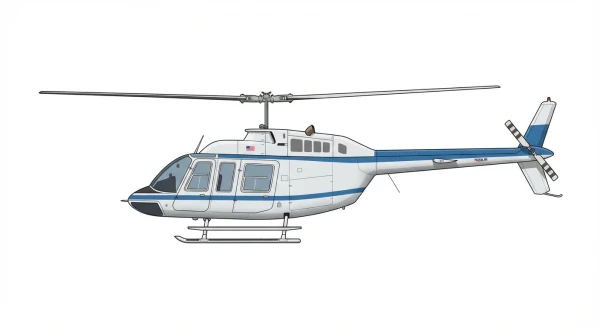
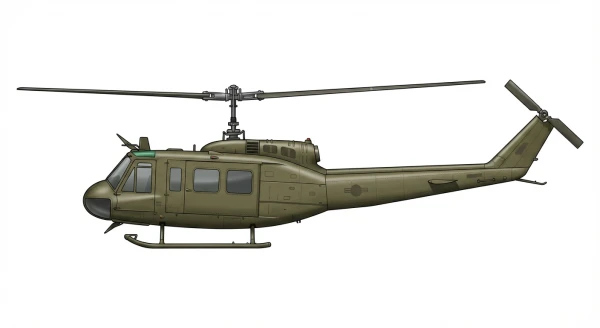
| 206 JetRanger | UH-1 Iroquois "Huey" | |
|---|---|---|
| Origin country | 🇺🇸 United States | 🇺🇸 United States |
| Category | Military Helicopters | Military Helicopters |
| Manufacturer | Bell | Bell |
| First flight | 10 January 1966 | 22 October 1956 |
| Year introduced | 1967 | 1959 |
| Number produced | 7300 units | 16000 units |
| Average unit price | $1.3 million | $1.3 million |
| Wingspan | 10.2 m | 14.6 m |
| Height | 3.9 m | 4.5 m |
| Length | 12.9 m | 12.7 m |
| Maximum speed | 226 km/h | 222 km/h |
| Operational range | 624 km | 510 km |
| Service ceiling | 4,572 m | 5,910 m |
| Max. takeoff weight | 2,495 kg | 4,309 kg |
| Empty weight | 1,737 kg | 2,087 kg |
| Total thrust | 1 x 485 kW | 1 x 820 kW |
Detailed Comparison
The Bell 206 JetRanger and the UH-1 Iroquois fulfill fundamentally different requirements within military aviation, despite sharing a manufacturer and widespread global adoption. While the UH-1 was designed as a robust, medium-lift utility platform instrumental in defining air mobility, the 206 was developed as a light observation helicopter (LOH) focused on agility and lower operational costs. Both airframes leverage turboshaft technology to deliver reliable performance in diverse environments.
Development and Design
The UH-1 Iroquois, developed in the late 1950s to meet US Army medical evacuation and utility requirements, was the first turbine-powered helicopter produced for the US military. Its design philosophy prioritized modularity and ruggedness, featuring a spacious cabin capable of rapid reconfiguration for troops, cargo, or medical litters. It popularized the iconic two-bladed teetering rotor system.
Conversely, the 206 JetRanger evolved from the YHO-4, a prototype initially rejected by the Army in favor of the Hughes OH-6. Bell redesigned the fuselage to be more streamlined and aesthetically pleasing, creating a commercial success that was subsequently re-adopted by the military as the OH-58 Kiowa. While the 206 also utilizes a two-bladed rotor, its design emphasizes compact dimensions and aerodynamic efficiency over the sheer internal volume and lifting capacity found in the Huey.
Specifications and Performances
The performance disparity reflects their distinct classifications. The UH-1 Iroquois possesses a significantly higher Maximum Takeoff Weight (MTOW) of 4,309 kg compared to the 206’s 2,495 kg, necessitating a much more powerful powerplant (Lycoming T53 generating 820 kW vs. the Allison 250’s 485 kW). This power allows the UH-1 to operate with substantial external loads and a higher service ceiling of 5,910 m, crucial for operations in mountainous terrain.
However, the lighter 206 JetRanger offers superior kinematic efficiency. It achieves a higher maximum speed of 240 km/h against the Huey's 222 km/h and boasts a longer range of 624 km versus 510 km. This speed and endurance profile makes the 206 ideal for reconnaissance and liaison duties where range is prioritized over payload capacity.
Deployment and usage
The UH-1 defined the concept of air mobility during the Vietnam War, serving as a troop transport, Medevac platform, and gunship armed with M60 machine guns, 70mm rockets, and miniguns. Its primary function is the insertion and extraction of personnel and providing direct fire support (variants UH-1B/C/M).
The 206 found its niche in precision roles. As the OH-58 Kiowa, it served in light observation and reconnaissance. Specialized variants, such as the Swedish Hkp 6A/B, demonstrated the airframe's adaptability by acting as anti-tank and anti-submarine platforms equipped with guided missiles and depth charges. The 206 is also the primary platform for pilot training (TH-57 Sea Ranger), whereas the Huey is deployed for mass maneuver and heavy utility tasks.
Conclusion
Ultimately, the distinction between these aircraft lies in payload versus precision. The UH-1 Iroquois remains the archetype of the battlefield utility helicopter, capable of delivering troops and firepower under duress. The 206 JetRanger complements this by offering a cost-effective, agile platform suited for reconnaissance, training, and specific light-attack duties. While the Huey provides the mass and volume required for infantry operations, the JetRanger delivers the visibility and endurance necessary for command and control.