Yak-36 Freehand vs Yak-38 Forger
Yak-36 Freehand vs Yak-38 Forger at a glance — top speed 900 vs 1,210 km/h, range 370 vs 1,300 km, max takeoff weight 8,900 vs 11,200 kg, built 4 vs 231 units.
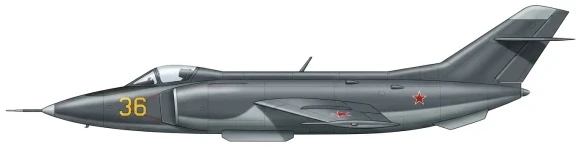
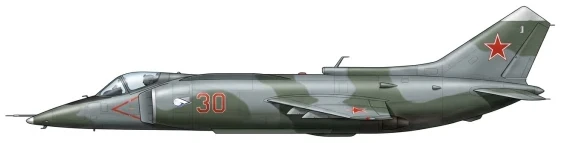
| Yak-36 Freehand | Yak-38 Forger | |
|---|---|---|
| Origin country | 🇷🇺 Ex-USSR | 🇷🇺 Ex-USSR |
| Category | Combat Aircraft | Combat Aircraft |
| Manufacturer | Yakovlev | Yakovlev |
| First flight | 9 January 1963 | 27 September 1970 |
| Year introduced | -- | 1976 |
| Number produced | 4 units | 231 units |
| Average unit price | $2 million | $12 million |
| Wing area | 17.0 m² | 18.5 m² |
| Wingspan | 10.0 m | 7.3 m |
| Height | 4.5 m | 4.4 m |
| Length | 17.0 m | 15.5 m |
| Maximum speed | 900 km/h | 1210 km/h |
| Operational range | 370 km | 1,300 km |
| Service ceiling | 12,000 m | 11,300 m |
| Max. takeoff weight | 8,900 kg | 11,200 kg |
| Empty weight | 5,300 kg | 7,020 kg |
| Total thrust | 2 x 5,303 kgf | 1 x 6,801 kgf |
Detailed Comparison
The Yakovlev Yak-36 Freehand was a proof-of-concept V/STOL technology demonstrator, while the Yak-38 Forger was the operational combat aircraft derived from its lessons. The most significant divergence between them lies in their propulsion systems: the Yak-36 used two swiveling jet engines for both lift and forward thrust, whereas the Yak-38 adopted a more complex lift-plus-lift/cruise configuration. This fundamental design change dictated the capabilities and limitations of the subsequent operational aircraft. The Yak-36 was purely experimental, with only four units built, while the Yak-38 was produced in significant numbers (231 units) and saw two decades of service with the Soviet Navy.
Development and Design
The Yak-36 was a direct exploration of V/STOL flight, utilizing two Tumansky R-27-300 turbojets mounted in the nose, whose nozzles could be rotated from horizontal to vertical. This configuration, while simple in concept, proved impractical for a viable combat aircraft due to engine-out instability and limitations on engine size. In developing the Yak-38, Yakovlev abandoned this approach for a system combining one large, thrust-vectoring Tumansky R-27V-300 engine in the rear for lift and cruise, and two smaller, vertically-mounted Rybinsk RD-36 lift jets just behind the cockpit. This distributed the weight but added complexity and dedicated "dead weight" during conventional flight. Unlike its contemporary, the British Harrier, which used a single engine with four rotating nozzles, the Yak-38's design was less efficient. Furthermore, the Forger was developed without an integrated radar, relying on very basic avionics and ground/ship-based control for guidance, severely limiting its combat autonomy.
Specifications and Performances
A comparison of specifications reveals the Yak-38's transition to an operational, carrier-based role. Its wingspan was significantly reduced (7.32 m vs. 10.0 m for the Yak-36) for shipboard storage, and its maximum takeoff weight was higher (11200 kg vs. 8900 kg) to accommodate fuel and a modest weapons load. While the Yak-38 was faster (1210 km/h vs. 900 km/h), its performance was severely constrained. The lift-jet system was highly fuel-intensive and performed poorly in hot and humid conditions, drastically reducing payload and its effective combat range, which was a nominal 1000 km. Critically, the aircraft could only land vertically, preventing the use of a rolling landing to bring back unused ordnance or extra fuel. This "vertical landing only" constraint meant any short takeoff had to account for a much lighter landing weight, fundamentally limiting its mission profile from the outset.
Deployment and usage
The Yak-36 never entered service and its flight program was purely for research. In contrast, the Yak-38 was the primary fixed-wing aircraft deployed on the four Kiev-class aircraft-carrying cruisers from 1976 until its retirement in 1991. It was intended to provide fleet air defense, reconnaissance, and light attack capabilities. In practice, its utility was minimal. Without a radar, it was ineffective in an air-to-air role against anything but the slowest targets and was vulnerable to contemporary Western fighters like the F-14 Tomcat. Its small payload, consisting of short-range missiles or small bombs, and limited range relegated it to a sea-control support asset of questionable value. The aircraft was essentially a political and technological statement rather than a truly effective combat system.
Conclusion
The Yak-36 Freehand was a necessary first step, demonstrating the basic feasibility of jet-borne V/STOL flight for the Soviet Union. However, the Yak-38 Forger, the operational result, stands as a significant compromise. Its complex and inefficient propulsion system, coupled with a complete lack of radar and sophisticated avionics, made it an aircraft with extremely limited combat potential. While it provided the Soviet Navy with valuable experience in carrier-based V/STOL operations, the Forger was technologically inferior to its Western counterparts and failed to provide a credible power projection capability. It represents an evolutionary dead-end in military aviation, a placeholder asset that was retired without a successful replacement.