Yak-36 Freehand
Soviet vertical/short takeoff and landing jet, operational in the mid-to-late cold war, not widely deployed but significant for future designs. Key figures: top speed 900 km/h, range 370 km, service ceiling 12,000 m, max takeoff weight 8,900 kg, unit price $2M, built 4.
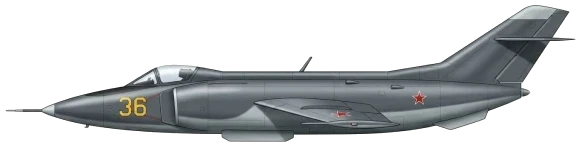
| Crew | 1 |
| Length | 17 m (55.8 ft) |
| Wingspan | 10 m (32.8 ft) |
| Height | 4.5 m (14.8 ft) |
| Wing area | 17 m² (183.0 sqft) |
| Empty weight | 5,300 kg (11,684 lbs) |
| Max. takeoff weight | 8,900 kg (19,621 lbs) |
| Powerplant | 2 × turbojets Tumansky R-27-300 5,303 kgf each |
| Maximum speed | 900 km/h (559 mph) |
| Operational range | 370 km (230 mi) |
| Service ceiling | 12,000 m (39,370 ft) |
| Climb rate | 140.0 m/s (459.3 ft/s) |
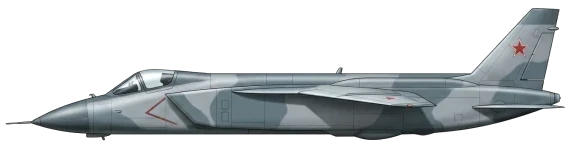
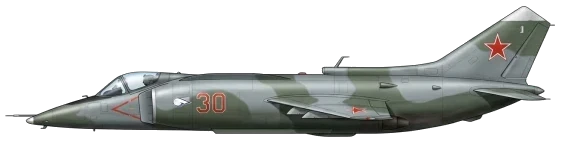
Description
The Yakovlev Yak-36, known inside the design bureau as Izdeliye V and given the NATO reporting name Freehand, was a Soviet technology demonstrator built to explore vertical take-off and landing for a future combat aircraft. Four airframes were completed, one of them for static testing only, and the type never entered production or squadron service. Its value was experimental: the Yak-36 gave the Soviet Union its first practical experience of jet-borne hovering flight and of the transition between vertical and wing-borne flight, and it led directly to the Yak-38, the only V/STOL combat aircraft the Soviet Navy ever deployed.
Development
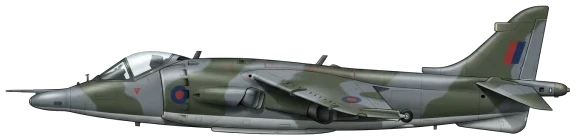
Yakovlev began studying vertical take-off in 1960 around the small Tumansky RU-19-300 turbojet, first proposing the Yak-104, a converted Yak-30 trainer carrying two lift engines mounted vertically between the intake ducts of its standard powerplant. That work was dropped in favour of a configuration using a single lift/cruise engine with rotating nozzles, on the pattern of the Hawker Siddeley P.1127 then nearing completion in Britain. No suitable Soviet engine existed and the bureau could not persuade the government to fund the development of one, so Yakovlev changed course again.
Answering a 1961 contract for a single-seat V/STOL fighter, the bureau proposed a twin-engine aircraft with a large nose intake, both engines in the forward fuselage, and a swivelling exhaust nozzle on each side of the lower fuselage close to the centre of gravity. The fighter itself was never built, but four technology demonstrators derived from those studies were ordered.
Design
The Yak-36 had a semi-monocoque fuselage, bicycle landing gear, and cropped delta wings with 37° of leading-edge sweep and 5° of anhedral mounted in the mid position. The forward fuselage was bulky because engines, cockpit, fuel tanks and equipment bays all had to sit as close to the centre of gravity as possible; aft of the wing it tapered sharply to swept tail surfaces with a high-set tailplane.
In wing-borne flight the aircraft was controlled conventionally by rudder, ailerons and elevators. In the hover, where those surfaces do nothing, control came from compressed engine bleed air blown through reaction nozzles at the wingtips, at the rear fuselage tip, and at the end of a long boom projecting forward from the top lip of the intake — the feature that gives the Yak-36 its unmistakable silhouette. Two underwing hardpoints could take bombs, gun pods or rocket pods, but the aircraft had neither the excess thrust nor the range to be useful as a combat type.
Operational History
The first tethered hover took place on 9 January 1963. Early testing was dominated by hot gas reingestion, in which exhaust gases were drawn back into the intakes and destroyed engine thrust, compounded by the suction effect of the exhaust close to the ground and by control system problems. After modification, the first untethered vertical flight followed on 23 June 1963 and the first full transition to horizontal flight on 16 September 1963. One test pilot described the first conventional take-off as reminiscent of a circus act, the aircraft leaping some 15 metres into the air before shaking violently in all three axes as forward flight continued.
A complete profile — vertical take-off, transition, deceleration and vertical landing — was flown for the first time on 24 March 1966. The Yak-36 made its public debut on 9 July 1967 at the Domodedovo air display outside Moscow. Of the flying prototypes, one crashed and was rebuilt; a second crashed in February 1971 and was not repaired. The second airframe survives on display at the Central Air Force Museum at Monino.
Legacy
The programme's output was knowledge rather than a usable aircraft. What the Yak-36 taught about reaction control, hot gas reingestion and transition handling fed directly into the Yak-36M, first flown on 27 September 1970, which entered service as the Yak-38 Forger aboard the Soviet Navy's Kiev-class carriers.
Frequently Asked Questions
What type of aircraft is the Yak-36 Freehand?
What is the maximum speed of the Yak-36 Freehand?
What is the range of the Yak-36 Freehand?
When did the Yak-36 Freehand first fly?
How many Yak-36 Freehand have been built?
Which countries operate the Yak-36 Freehand?
How much does a Yak-36 Freehand cost?
What is the service ceiling of the Yak-36 Freehand?
- AUG 52026 Updated Description and thrust updated
- JUL 232026 Updated Sources and cross-references refreshed
- APR 72026 Updated Sources and cross-references refreshed
- JAN 242026 Updated Thrust updated
- JAN 122026 Updated Range updated in a site-wide editorial pass