Virginia vs Yasen
Virginia vs Yasen at a glance — displacement 6,930 vs 8,600 tons, length 115 vs 139 m, speed 15 vs 20 knots, crew 135 vs 85.
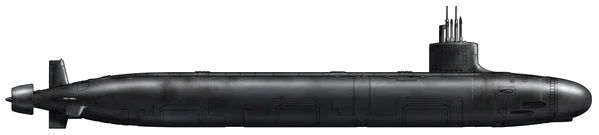

| Virginia | Yasen | |
|---|---|---|
| Origin | 🇺🇸 United States | 🇷🇺 Russia |
| Category | Submarine | Submarine |
| Type | Nuclear-powered attack submarine | Nuclear-powered attack submarine |
| Manufacturer | General Dynamics Electric Boat | Sevmash |
| Year introduced | 2004 | 2014 |
| Number built | 26 units | 6 units |
| Estimated unit price | $2,800 million | $1,600 million |
| Displacement | 6,930 tons | 8,600 tons |
| Maximum speed | 15.0 knots | 20.0 knots |
| Range | Unlimited | Unlimited |
| Length | 115.0 m | 139.2 m |
| Beam | 10.0 m | 13.0 m |
| Crew | 135 | 85 |
| Max depth | 240 m | 658 m |
| Virginia | Yasen | |
|---|---|---|
| Armament |
|
|
| Propulsion | 1 × S9G nuclear reactor 280,000 hp (210 MW); 2 × steam turbines 40,000 shp (30 MW); 1 × single shaft pump-jet propulsor; 1 × secondary propulsion motor | OK-650KPM pressurized water reactor, 200 MWt turbines of 43,000 shp |
Detailed Comparison
The United States Navy's Virginia class and the Russian Navy's Yasen class are the primary nuclear attack platforms of their respective fleets. The Virginia program emerged from the post-Cold War demand for a mass-producible alternative to the Seawolf class, focusing on acoustic stealth and land attack. The Yasen project combines the dedicated cruise missile carrier role of the Oscar class with the hunter-killer profile of the Akula class into a single 13,800-ton platform.
Development and Design
The Virginia class utilizes a continuous production line divided between Electric Boat and Newport News Shipbuilding, yielding 26 active hulls since 2004. Its design relies on open-system architecture, allowing rapid software integration and hardware upgrades. The Yasen class, built entirely at Sevmash, suffered a 20-year gestation for its lead boat due to 1990s funding shortfalls. It employs a highly automated interior, reducing its crew to 85 personnel compared to the Virginia's 135, despite displacing nearly 6,000 tons more. The Russian design incorporates low-magnetic steel and a spherical bow sonar array—forcing the relocation of its torpedo tubes to a slanted mid-ship position.
Weapons and Sensors
Yasen is heavily armed for anti-surface and strategic strike, carrying a mixed payload of Zircon hypersonic missiles, Oniks anti-ship missiles, and Kalibr land-attack variants. Its 10 torpedo tubes provide high volume-of-fire for close engagements. The Virginia class relies on the UGM-109 Tomahawk. Earlier blocks carry 12 missiles, but Block V variants integrate the Virginia Payload Module, increasing capacity to 40 Tomahawks per submarine.
- The Yasen relies on the Irtysh-Amfora spherical sonar complex for primary acoustic detection.
- The Virginia employs the BQQ-10 bow array and replaces optical periscopes with non-hull-penetrating photonic masts.
Propulsion and Performance
Yasen operates an OK-650KPM pressurized water reactor, achieving 35 knots submerged. The reactor's natural circulation cooling loop minimizes pump noise at low speeds, and the hull design permits operations at depths up to 658 meters. The Virginia utilizes the S9G reactor and a single pump-jet propulsor, yielding 34 knots. While its unclassified maximum depth is stated at 240 meters, the pump-jet configuration delays cavitation, keeping the Virginia acoustically quieter at higher sustained speeds.
Deployment and Combat Record
Virginia-class submarines execute persistent global deployments, routinely shadowing Russian and Chinese assets. They serve as the operational testbed for UUV integration and will form the basis of the Royal Australian Navy's undersea fleet under the AUKUS pact. The Yasen class operates in the Northern and Pacific Fleets. Severodvinsk has conducted Atlantic deployments and executed test launches of the Zircon hypersonic missile from surfaced and submerged positions, functioning as a localized standoff asset.
Conclusion
The Virginia class holds the advantage in sea control and sustained undersea operations. Its acoustic stealth at higher speeds, open architecture, and absolute numerical superiority (26 units to 6) allow the US Navy to dictate sub-surface operational tempos globally. The Yasen class possesses the edge in anti-surface warfare. Its integration of hypersonic anti-ship missiles and 658-meter dive depth make it a deadlier immediate threat to carrier strike groups in contested waters. For strategic land attack, the Virginia Block V overtakes the Yasen through sheer magazine volume, solidifying its role as a power-projection platform over the Russian design's area-denial focus.