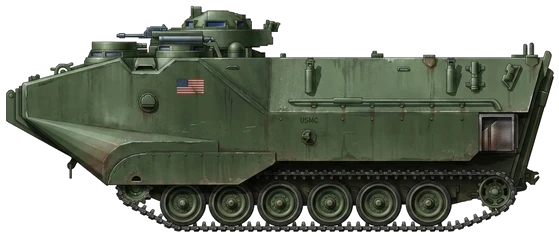
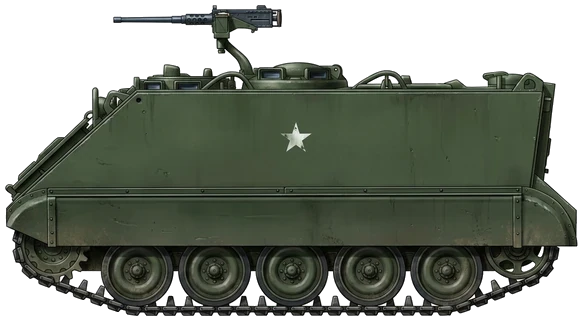
Designed for different infantry delivery requirements, the 24-ton AAV-7A1 provides ship-to-shore amphibious assault capability for a 21-man Marine platoon, while the 11.3-ton M113 operates as a baseline battlefield taxi. Both platforms rely on aluminum hulls that require heavy, weight-adding armor upgrades against modern anti-armor threats, altering their original mobility parameters.
Development and Design
FMC Corporation developed both vehicles using 5083 aluminum alloy to save base weight. The M113 emerged in 1960 as an air-transportable tracked box meant to shield a squad from artillery fragments and 7.62mm fire before dismounting. The AAV-7A1, entering service in 1972, was engineered around a boat-shaped hull and waterjets to achieve 13 km/h water speeds for contested beach landings. The M113's simple chassis spawned dozens of variants (M106 mortars, M577 command posts), whereas the AAV-7A1 remained highly specialized around its massive internal volume.
Protection and Firepower
Base aluminum armor on both platforms is easily defeated by modern heavy machine guns and RPGs.
AAV-7A1: The USMC integrated Enhanced Applique Armor Kits (EAAK) to defeat 14.5mm rounds and 155mm fragments, pushing combat weight to 24 tons. Firepower includes a Mk 19 40mm grenade launcher and M2HB 12.7mm machine gun, modernizing fire control with the thermal-equipped M153 CROWS.
M113: Operators applied slat armor and spall liners in the M113A3 package, providing limited protection against IEDs. The vehicle mounts an exposed M2HB, forcing the commander to operate unprotected unless fitted with ACAV gun shields.
Mobility and Logistics
The AAV-7A1 utilizes a 525 hp Cummins engine and Bradley-derived RAM/RS suspension to reach 72 km/h. Its 7.94-meter length and 3.26-meter height severely restrict maneuverability in narrow urban terrain. The M113 trades raw horsepower (212 hp GM 6V53) for a low 11.3-ton weight. This low ground pressure gives the M113 specific advantages in mud, while keeping procurement costs low ($0.6 million vs the AAV-7A1’s $2.5 million). The M113 also avoids the high maintenance burden associated with the AAV-7A1's complex waterjets and hull seals.
Deployment and Combat Record
The M113’s combat record spans Vietnam, Lebanon, and Iraq. In these theaters, IEDs and RPGs routinely penetrated its hull, forcing its relegation to rear-echelon roles. However, its heavy current use by Ukrainian forces validates its baseline mobility in rasputitsa conditions away from direct fire. The AAV-7A1 suffered catastrophic losses in urban combat; RPGs and artillery destroyed multiple vehicles during the 2003 Battle of Nasiriyah. Furthermore, a 2020 sinking off San Clemente Island killed nine personnel, resulting in a permanent USMC ban on AAV-7A1 water operations.
Conclusion
The M113 is the more pragmatic platform for sustained ground operations. At a quarter of the cost and half the weight, its scalable chassis functions reliably for support and transport roles in environments where heavy armor is unavailable. The AAV-7A1 operates as a compromised asset: it is too large and poorly armored for terrestrial urban combat, and unresolvable water ingress vulnerabilities have entirely negated its amphibious mandate.