BMPT Terminator vs T-72
BMPT Terminator vs T-72 at a glance — weight 48,000 vs 44,500 kg, top speed 60 vs 60 km/h, range 550 vs 500 km, crew 5 vs —.
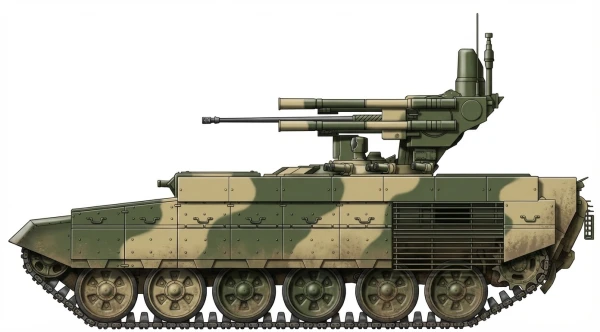
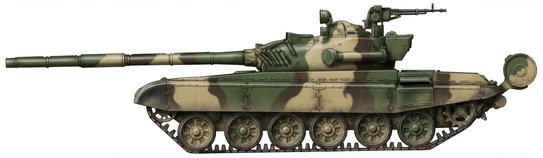
| BMPT Terminator | T-72 | |
|---|---|---|
| Origin country | 🇷🇺 Russia | 🇷🇺 Ex-USSR |
| Category | Light Armoured Vehicle | Main Battle Tank |
| Type | Heavy Armored Combat Support Vehicle | Medium Main Battle Tank |
| Manufacturer | Uralvagonzavod | Malyshev HMB Plant |
| Number produced | 33 units | 25,000 units |
| Estimated unit price | $-- million | $2 million |
| Combat weight | 48.0 tons | 44.5 tons |
| Maximum speed | 60 km/h | 60 km/h |
| Operational range | 550 km | 500 km |
| Length | 7.20 m | 9.73 m |
| Width | 3.60 m | 3.59 m |
| Height | 3.33 m | 2.23 m |
| Crew | 5 | 3 (commander, gunner, driver) |
| BMPT Terminator | T-72 | |
|---|---|---|
| Main armament | 4× 130 mm Ataka-T GWS launchers | 125 mm 2A46M-5 smoothbore gun |
| Secondary weapon | 2× 30 mm 2A42 autocannons (850 rounds) | 7.62 mm PKT coax. machine gun |
| Engine | Diesel Engine with 1000 hp | V-92S2F (T-72B3 & T-72B3M) 1,130 hp (840 kW) |
Detailed Comparison
The T-72 and the BMPT Terminator, despite sharing a baseline Uralvagonzavod chassis, execute entirely separate combat functions. The T-72 operates as a mass-produced, 125 mm-armed main battle tank built for large-scale armored warfare. The BMPT acts as a low-density, 48-ton armored escort armed with autocannons and ATGMs, specifically engineered to screen tank formations from infantry in constrained environments.
Development and Design
The T-72 originated in 1973 as Object 172, conceived as a reliable, cost-effective alternative to the complex T-64. It instituted a three-crew layout by integrating a mechanical carousel autoloader, a standard that dominated Soviet tank design for decades. The BMPT concept materialized after Russian armor took heavy losses in urban spaces like Grozny. Finalized in 2002 and entering service in 2011, the Terminator mounts a bespoke weapon station on a modified T-72 or T-90 hull. It reverses the crew-reduction trend, requiring a five-operator team to manage its disparate weapon systems simultaneously. Production reflects their distinct roles: over 25,000 T-72s exist globally, whereas BMPT production is capped at roughly 33 units.
Protection and Firepower
Firepower diverges sharply. The T-72 relies on a 125 mm 2A46M smoothbore gun for kinetic energy and high-explosive delivery against hardened targets, though its 22-round hull-floor autoloader configuration remains a fatal vulnerability to top-attack munitions and spalling. The BMPT sacrifices main gun caliber for volume of fire, mounting twin 30 mm 2A42 autocannons, four 130 mm Ataka-T anti-tank guided missiles, and dual automatic grenade launchers. This allows the BMPT to suppress infantry across high elevation angles—a blind spot for standard MBTs. Both platforms utilize composite materials and explosive reactive armor (ERA). The 48-ton BMPT carries heavier base protection and slat armor compared to the 44.5-ton T-72, compensating for the exposed nature of its missile tubes and external optics.
Mobility and Logistics
Because the BMPT shares the T-72 base architecture, mobility metrics align closely:
- 60 km/h maximum road speed
- 500 to 550 km operational range
- Tracked suspension engineered for deep wading
The T-72B3 variants utilize the 1,130 hp V-92S2F diesel, providing a 25.3 hp/ton power-to-weight ratio. Logistically, the T-72 has a global supply chain spanning over 40 countries. The BMPT, restricted to Russia, Algeria, and Kazakhstan, requires specialized maintenance for its multi-axis weapon mounts and varied ammunition types, creating a heavier sustainment burden per vehicle.
Deployment and Combat Record
The T-72 has functioned as the primary armored platform for both Russian and Ukrainian forces. The BMPT saw initial testing in Syria before formal combat deployment in the 2022 invasion of Ukraine, specifically around Sievierodonetsk and Kreminna. Field reports indicate the BMPT suppresses treelines effectively, but open-source intelligence confirms multiple destroyed units. It proved exactly as vulnerable to FPV drones and mines as the MBTs it escorts.
Conclusion
The T-72 retains the edge as the foundation of mechanized forces. While flawed by its ammunition storage, its 125 mm gun provides necessary direct-fire heavy support, and its mass availability makes it attrition-tolerant. The BMPT fails to justify its logistical footprint. Combat data from Ukraine demonstrates that a dedicated urban support vehicle does not solve the survivability issues facing armored columns against modern anti-tank networks. An upgraded MBT supported by dismounted infantry remains tactically superior to deploying a low-density, overly complex escort platform.