T-72 vs T-90
T-72 vs T-90 at a glance — weight 44,500 vs 48,000 kg, top speed 60 vs 60 km/h, range 500 vs 550 km, crew — vs 3.
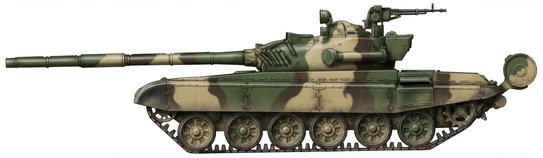
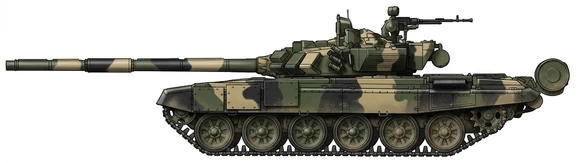
| T-72 | T-90 | |
|---|---|---|
| Origin country | 🇷🇺 Ex-USSR | 🇷🇺 Russia |
| Category | Main Battle Tank | Main Battle Tank |
| Type | Medium Main Battle Tank | Medium Main Battle Tank |
| Manufacturer | Malyshev HMB Plant | Malyshev HMB Plant |
| Number produced | 25,000 units | 4,000 units |
| Estimated unit price | $2 million | $4.5 million |
| Combat weight | 44.5 tons | 48.0 tons |
| Maximum speed | 60 km/h | 60 km/h |
| Operational range | 500 km | 550 km |
| Length | 9.73 m | 9.63 m |
| Width | 3.59 m | 3.78 m |
| Height | 2.23 m | 2.22 m |
| Crew | 3 (commander, gunner, driver) | 3 |
Detailed Comparison
The T-72 and T-90 share a direct technological lineage, with the T-90 functioning as a modernized evolution of the T-72 platform rather than a wholly new design. While the T-72 entered service in 1973 as a cost-effective mobilization model intended for mass production across the Warsaw Pact, the T-90 was introduced in 1992 to integrate advanced fire control and protection systems comparable to the T-80U into the more reliable T-72 hull. Consequently, the T-90 represents the high-end capability of Russian armor, while the T-72 remains the ubiquitous, lower-cost backbone of the force.
Development and Design
Conceived at Uralvagonzavod, the T-72 (Object 172) combined elements of the T-64A and Object 167 to resolve mechanical reliability issues found in early Soviet MBTs. It prioritized manufacturing scalability, resulting in 25,000 units built. The T-90 (Object 188) emerged from the late-Soviet need to consolidate MBT designs. Developed by the Kartsev-Venediktov Design Bureau, it utilized the T-72B hull but incorporated advanced systems rejected for the experimental Object 187. Both vehicles utilize a three-man crew layout with a carousel autoloader, maintaining a low profile—2.23 m for the T-72 and 2.22 m for the T-90.
Protection and Firepower
Both tanks mount a 125 mm smoothbore gun. The T-72 typically fields the 2A46 series, while the T-90 utilizes the upgraded 2A46M-5 and advanced fire control systems, including thermal imaging and the AT-11 Sniper ATGM system capable of engaging low-flying helicopters. Protection distinguishes the platforms significantly. The T-72 relies on cast steel and composite armor, often retrofitted with standard Explosive Reactive Armor (ERA). The T-90 integrates multi-layered steel and composite armor with heavy ERA (Kontakt-5 or Relikt) and the Shtora active protection system designed to disrupt laser-guided missiles. However, both designs share a critical vulnerability: ammunition storage in the hull carousel, which risks catastrophic secondary detonation upon armor penetration.
Mobility and Logistics
Modernized variants of both tanks, specifically the T-72B3 and T-90 series, share the V-92S2F engine, producing 1,130 hp (840 kW). Despite the T-90's increased combat weight of 48.0 tons compared to the T-72's 44.5 tons, both maintain a maximum road speed of 60.0 km/h. Operational ranges are comparable, with the T-90 achieving 550 km against the T-72's 500 km. Logistics are simplified by high component commonality, including deep wading snorkels and track systems.
Deployment and Combat Record
The T-72 has seen global use, from Syrian engagements in 1982 to the Gulf War and Chechen Wars. It serves as the primary armor for numerous nations due to wide export. The T-90 saw initial deployment in Dagestan (1999) and later in Syria. In the Russo-Ukrainian War, both platforms have been deployed in high-intensity combat. Documentation indicates heavy losses for both types, attributed to modern anti-tank weapons and drone strikes.
Conclusion
The T-72 remains a viable solution for nations requiring large armored formations at lower acquisition costs ($1.2 million), provided modern upgrades are applied. The T-90 ($4.5 million) offers higher survivability and superior target acquisition for frontline assault roles. While the T-90 represents a clear technological advancement, the shared architectural legacy limits the survivability of both platforms against top-attack munitions and modern anti-tank guided missiles.