BTR-82A vs M113
BTR-82A vs M113 at a glance — weight 15,400 vs 11,343 kg, top speed 90 vs 61 km/h, range 600 vs 480 km, crew — vs 2.
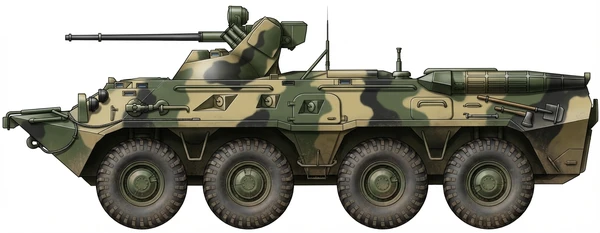
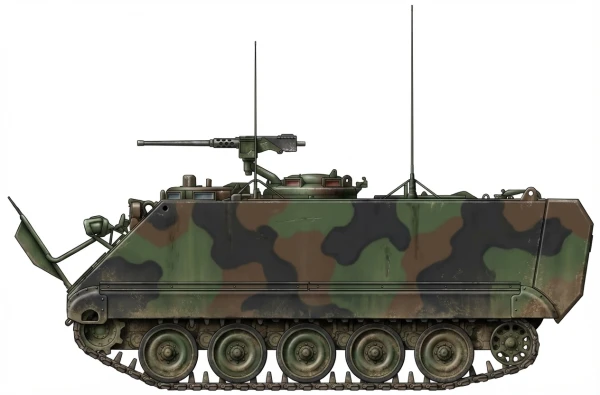
| BTR-82A | M113 | |
|---|---|---|
| Origin country | 🇷🇺 Russia | 🇺🇸 United States |
| Category | Armored Personnel Carrier | Armored Personnel Carrier |
| Type | Amphibious armored personnel carrier | Armored Personnel Carrier |
| Manufacturer | Arzamas Machine-Building Plant | FMC |
| Number produced | 5,000 units | 80,000 units |
| Estimated unit price | $-- million | $0.6 million |
| Combat weight | 15.4 tons | 11.3 tons |
| Maximum speed | 90 km/h | 61 km/h |
| Operational range | 600 km | 480 km |
| Length | 7.70 m | 2.52 m |
| Width | 2.90 m | 2.70 m |
| Height | 2.41 m | 1.85 m |
| Crew | 3 (+7 passengers) | 2 |
Detailed Comparison
The United States M113 and the Russian BTR-82A utilize fundamentally different chassis architectures—tracked and 8x8 wheeled, respectively—to fulfill the armored personnel carrier (APC) role. While the M113 utilizes a 1960s-era aluminum box design prioritizing air mobility and passenger capacity, the BTR-82A represents a modern iteration of the Soviet BTR-80 lineage, emphasizing firepower and operational mobility on paved surfaces.
Development and Design
Developed by FMC, the M113 replaced the M59 and M75, utilizing 5083 aircraft-quality aluminum alloy to match the protection of steel predecessors at a reduced weight. This material choice facilitated air transport via C-130 and C-141 aircraft. With over 80,000 units built, the chassis has been adapted for roles ranging from mortar carriers (M106) to command posts (M577). In contrast, the BTR-82A, manufactured by the Arzamas Machine-Building Plant, is a modernization of the BTR-80 series adopted in 2013. It retains the BTR-80 hull but integrates updated electronics, including GLONASS navigation and spall liners. While the M113 accommodates a crew of two and up to 15 passengers, the BTR-82A carries a crew of three plus seven passengers.
Protection and Firepower
The M113 provides baseline protection against 7.62mm small arms fire and shell splinters. Its standard armament is a single .50-caliber M2 Browning machine gun, though variants like the ACAV added gun shields and M60 machine guns. The BTR-82A offers superior firepower with a 30 mm 2A72 autocannon and a 7.62 mm PKT machine gun housed in a BPPU turret. Fire control on the Russian vehicle includes TKN-4GA-02 night vision and, in later production lots, thermal imagers. The BTR-82AT variant further integrates Kornet anti-tank guided missiles and SLAT armor, capabilities not standard on base M113s.
Mobility and Logistics
The M113 relies on a 212 hp General Motors diesel engine, achieving speeds of 61 km/h. Its lighter 11.3-ton combat weight and tracked design favor cross-country mobility in soft terrain, such as the jungles encountered during the Vietnam War. The BTR-82A utilizes a KamAZ diesel engine (260–300 hp) on an 8x8 wheeled platform, reaching 90 km/h on roads with an operational range of 600 km, surpassing the M113's 480 km range. Both vehicles are amphibious; the BTR-82A employs a rear-mounted hydrojet, while the M113 uses its tracks for propulsion.
Deployment and Combat Record
Since entering service in 1962, the M113 has seen extensive combat, notably in Vietnam with US forces and the Yom Kippur War with the IDF. Vulnerabilities to RPGs and IEDs led to the U.S. Army initiating replacement with the Armored Multi-Purpose Vehicle. The BTR-82A debuted in combat in Syria in 2015 and is currently deployed by Russian forces in the invasion of Ukraine.
Conclusion
The M113 remains a high-capacity logistics and transport platform, valued for its adaptability despite ballistic obsolescence. The BTR-82A functions as a heavily armed APC that bridges the gap between transport and infantry fighting vehicle, prioritizing road speed and direct fire support over the payload capacity and off-road versatility of the M113.