C-141 Starlifter
American military transport aircraft, pivotal during the Vietnam War, chiefly used for strategic airlift missions. Key figures: top speed 805 km/h, range 4,723 km, service ceiling 12,497 m, max takeoff weight 146,556 kg, unit price $40M, built 285.
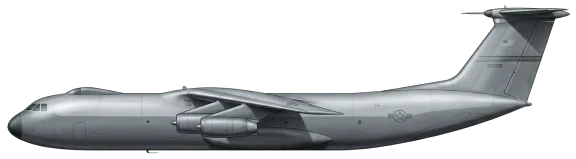
| Crew | 4 |
| Length | 51.3 m (168.4 ft) |
| Wingspan | 49 m (160.8 ft) |
| Height | 12.0 m (39.3 ft) |
| Wing area | 300 m² (3229.2 sqft) |
| Empty weight | 65,540 kg (144,491 lbs) |
| Max. takeoff weight | 146,556 kg (323,100 lbs) |
| Powerplant | 4 × turbofans Pratt & Whitney TF33-P-7 9,185 kgf each |
| Maximum speed | 805 km/h (500 mph) |
| Operational range | 4,723 km (2,935 mi) |
| Service ceiling | 12,497 m (41,001 ft) |
| Climb rate | 13.2 m/s (43.3 ft/s) |
Description
The Lockheed C-141 Starlifter is an American military strategic transport aircraft, produced by Lockheed-Georgia and retired from service in 2006. It served with the Military Air Transport Service (MATS), then the Military Airlift Command (MAC) and the Air Mobility Command (AMC) of the US Air Force, as well as with the Air Force Reserve, the Air National Guard and the Air Education and Training Command. The first jet-powered heavy airlifter designed from the outset for cargo, it entered service in April 1965 and formed the backbone of American strategic airlift for more than three decades.
Development
In the spring of 1960 the USAF issued Specific Operational Requirement (SOR) 182, calling for an aircraft capable of a range of 3,500 nautical miles (6,500 km) with a 27,000 kg payload, as well as low-altitude airdrops and paratroop drops. Requests for proposals were sent to Boeing, Douglas, Convair and Lockheed-Georgia. Lockheed proposed the Model 300, with a T-tail, high swept wing and four podded TF33 engines, and won the contract in March 1961. On 13 March 1961, President Kennedy ordered the development of the Model 300, with an initial contract for five test aircraft designated C-141. The prototype 61-2775 rolled out of the Marietta, Georgia, plant on 22 August 1963 and made its first flight on 17 December 1963. The first production delivery took place in April 1965; 284 aircraft were built for the USAF, plus one civil L-300 demonstrator transferred to NASA. Production ended in February 1968. Derivative projects — the L-300B/L-301 SuperstarLifter for Slick Airways and Flying Tiger Line, and the Anglo-American SC.5/40, SC.5/41 and SC.5/45 proposals with Shorts — resulted in no orders.
Design
The C-141 is powered by four Pratt & Whitney TF33-P-7 turbofans of 20,250 lbf (90.1 kN). The retractable tricycle landing gear comprises a twin-wheel nose unit and two four-wheel main bogies retracting forward into side fairings. The cargo hold is 21 m long, 3.0 m wide and 2.7 m high, with a floor 130 cm above the ground and a one-piece hydraulically operated rear ramp. It accommodates ten 463L pallets, 154 equipped troops, 123 paratroopers or 80 litter patients, and can carry a complete Minuteman missile in its container (up to 42,000 kg in this configuration). The rear side doors allow paratroop drops — the first from a jet aircraft in August 1965 — and in-flight cargo airdrops.
Operational History
The first aircraft was delivered to the 1707th Air Transport Wing at Tinker AFB on 19 October 1964, and the first operational example to the 44th Air Transport Squadron, 1501st Air Transport Wing, Travis AFB, on 23 April 1965. The type was committed to Vietnam, where it notably flew the repatriation flights of prisoners of war during Operation Homecoming in 1973. In October 1973, C-141s flew 422 missions and carried 10,754 tonnes of cargo to Israel during Operation Nickel Grass. During Desert Shield and Desert Storm, the fleet flew 8,536 missions, 144,661 tonnes of cargo and 93,126 passengers; the first Desert Shield flight was made on 7 August 1990 by an aircraft of the 437th Military Airlift Wing from Charleston AFB. Wing cracks and corrosion of the wing boxes required their complete replacement in the 1980s. Between 1996 and 1998, a C-141A served as the tow aircraft in Project Eclipse with a QF-106. Withdrawn from active units on 16 September 2004, it ended its career on MEDEVAC missions to Iraq and Afghanistan with the 445th Airlift Wing, and in the evacuation of Hurricane Katrina victims in 2005. The last aircraft, the "Hanoi Taxi" (66-0177), landed on 6 May 2006. Twenty-one C-141s were lost in accidents.
Variants
- C-141A: Initial model, 284 built, carrying 154 passengers, 123 paratroopers or 80 litters and 28,400 kg of cargo.
- NC-141A / L-300: Civil demonstrator transferred to NASA, modified to house the Kuiper Airborne Observatory telescope, grounded in October 1995.
- C-141B: 270 airframes stretched by 7.11 m between 1977 and 1982 and fitted with an in-flight refuelling receptacle, raising capacity to 205 troops, 168 paratroopers or 13 pallets.
- C-141B SOLL II: 13 aircraft modified in 1994 for low-level night flying, with enhanced navigation and improved countermeasures, operated with AFSOC.
- C-141C: 63 aircraft modernised in the 1990s with TCAS, GPS and digital cockpit elements, the last examples delivered in late 2001.
Frequently Asked Questions
What type of aircraft is the C-141 Starlifter?
What is the maximum speed of the C-141 Starlifter?
What is the range of the C-141 Starlifter?
When did the C-141 Starlifter first fly?
How many C-141 Starlifter have been built?
Which countries operate the C-141 Starlifter?
How much does a C-141 Starlifter cost?
What is the service ceiling of the C-141 Starlifter?
- AUG 302026 Updated Description updated
- AUG 52026 Updated Powerplant updated in a site-wide editorial pass
- APR 72026 Updated Sources and cross-references refreshed
- JAN 122026 Updated Range updated in a site-wide editorial pass