M26 Pershing vs M4 Sherman
M26 Pershing vs M4 Sherman at a glance — weight 41,900 vs 32,300 kg, top speed 40 vs 39 km/h, range 161 vs 160 km, crew 5 vs 5.
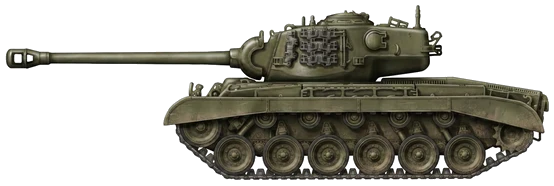
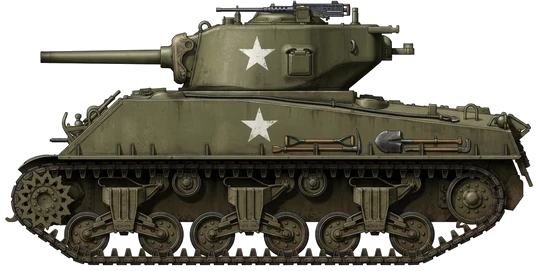
| M26 Pershing | M4 Sherman | |
|---|---|---|
| Origin country | 🇺🇸 United States | 🇺🇸 United States |
| Category | Main Battle Tank | Main Battle Tank |
| Type | Heavy Main Battle Tank | Medium Main Battle Tank |
| Manufacturer | U.S. Army Ordnance | U.S Army Ordnance |
| Number produced | 2,000 units | 58,000 units |
| Estimated unit price | $0.1 million | $0.1 million |
| Combat weight | 41.9 tons | 32.3 tons |
| Maximum speed | 40 km/h | 39 km/h |
| Operational range | 161 km | 160 km |
| Length | 8.65 m | 5.88 m |
| Width | 3.51 m | 2.68 m |
| Height | 2.78 m | 2.74 m |
| Crew | 5 | 5 |
| M26 Pershing | M4 Sherman | |
|---|---|---|
| Main armament | 1 M3 90mm gun | 1 M3 L/40 75mm gun |
| Secondary weapon | 1 M2 HB 12.7mm machine gun | 1 M2 12.7mm machine gun |
| Engine | Ford GAF V8 Diesel Engine with 500 hp | Continental/Wright Diesel Engine with 400 hp |
Detailed Comparison
The U.S. Army's shift from the M4 Sherman to the M26 Pershing marks the transition from mass-produced medium armor to the foundations of the modern main battle tank. The 32.3-ton M4 prioritized logistical standardization, yielding 58,000 units at $55,000 each. The 41.9-ton M26, costing $83,000, sacrificed mechanical reliability to field a 90mm gun and heavier armor capable of engaging late-war German tanks.
Development and Design
The M4 Sherman, standardized in 1942, was engineered for cross-oceanic shipping and rapid manufacturing. Its design mandated interchangeable parts and a physical footprint compatible with standard merchant marine cranes. The M26 Pershing evolved from the T20 series to counter heavy anti-tank fire. Delayed until late 1944 by tank destroyer doctrine and logistical resistance to a heavier chassis, the M26 introduced a rear-mounted engine and torsion bar suspension. This lowered the vehicle silhouette compared to the M4's tall profile dictated by its front-drive layout.
Protection and Firepower
The M26 defeats the baseline M4 in direct armored engagements. It mounts a 90mm M3 gun and 102mm upper hull armor, answering the 88mm guns of German Tiger and Panther tanks. The baseline M4 relies on a 75mm M3 L/40 gun, which struggled against heavy frontal armor, though its gyroscopic stabilizer permitted rough tracking on the move. Standard M4 models were vulnerable to 75mm high-velocity fire. The Sherman's later transition to wet ammunition stowage reduced post-penetration fires, anticipating modern ammunition compartmentalization. Both vehicles utilized standard .50 and .30 caliber machine guns.
Mobility and Logistics
Logistics dictate the M4's advantage. At 32.3 tons, the Sherman crossed standard military bridges and operated on a 400 hp engine with a 160 km range. The M26 matched the M4's 40 km/h top speed on paper but failed in field endurance. Its Ford GAF V8 produced 500 hp to move 41.9 tons, resulting in a low power-to-weight ratio. In Korea's mountainous terrain, the M26 suffered persistent engine and transmission overheating, forcing operators to replace it with the M46 Patton.
Deployment and Combat Record
The M26 arrived in Europe in January 1945 with the Zebra Mission, seeing limited engagements including a victory over a Panther in Cologne. In Korea, M26s destroyed T-34-85s at the Battle of the Bowling Alley, but mechanical failure rates led to their withdrawal while HVSS-equipped M4s remained active. The M4 operated in every theater of World War II and was exported widely. Upgraded variants remained combat viable for decades, seeing deployment in conflicts including:
- The 1948 Arab-Israeli War
- The Suez Crisis
- The Indo-Pakistani War of 1965
- The Six-Day War
Conclusion
The M4 Sherman holds the edge in sustained, theater-level campaigns where operational mobility, rapid transport, and fleet availability outweigh individual vehicle firepower. Its mechanical reliability and modularity allowed upgrades that kept it viable into the 1970s. The M26 Pershing is superior in static, defensive operations or direct armored engagements where its 90mm gun and 102mm armor dictate the outcome, but its compromised powertrain renders it a strategic liability for mobile warfare.