Type 10 vs Mitsubishi Type 90
Type 10 vs Mitsubishi Type 90 at a glance — weight 48,000 vs 50,000 kg, top speed 70 vs 70 km/h, range 500 vs 300 km, crew 3 (commander, gunner and driver) vs 4.
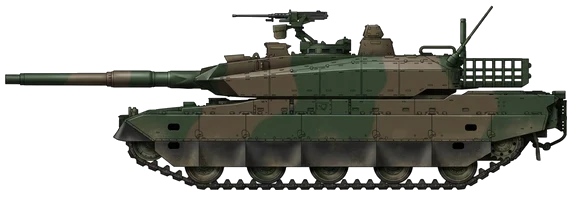
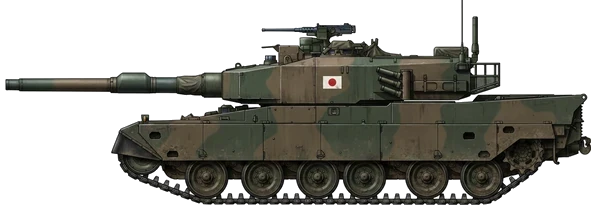
| Type 10 | Mitsubishi Type 90 | |
|---|---|---|
| Origin country | 🇯🇵 Japan | 🇯🇵 Japan |
| Category | Main Battle Tank | Main Battle Tank |
| Type | Main battle tank | Heavy Main Battle Tank |
| Manufacturer | Mitsubishi Heavy Industries | Mitsubishi Heavy Industries |
| Number produced | 117 units | 120 units |
| Estimated unit price | $11.3 million | $8.6 million |
| Combat weight | 48.0 tons | 50.0 tons |
| Maximum speed | 70 km/h | 70 km/h |
| Operational range | 500 km | 300 km |
| Length | 9.49 m | 9.90 m |
| Width | 3.24 m | 3.70 m |
| Height | 2.30 m | 2.55 m |
| Crew | 3 (commander, gunner and driver) | 4 |
| Type 10 | Mitsubishi Type 90 | |
|---|---|---|
| Main armament | Japan Steel Works 120 mm L/44 calibers-long smoothbore cannon with automatic loader | 1 Rheinmetall 120mm smoothbore barrel (40 shells) gun |
| Secondary weapon | Type 90 12.7 mm machine gun | 1 M-2HB 12.7mm machine gun (660 rounds) |
| Engine | 4-stroke 22.6-litre diesel V8 MHI 8VA34WTK 1,200 hp/2,300 rpm | Mitsubishi Diesel Engine with 1500 hp |
Detailed Comparison
Japan operates the Type 90 and Type 10 main battle tanks to fulfill two diverging doctrinal requirements. The 50-ton Type 90 was engineered in the late Cold War to intercept Soviet armor in the open terrain of Hokkaido. The lighter, 48-ton Type 10 was developed to enable rapid deployment across Japan’s constrained civilian infrastructure and execute data-linked battlefield coordination.
Development and Design
The Type 90 emerged from a 1980s requirement to defeat T-72s, entering service in 1990. Its mass concentrated its deployment to the northern island of Hokkaido due to infrastructure limits. By the 1990s, the Ministry of Defense initiated the TK-X project after determining the Type 90 lacked the internal volume required for modern C4I integration. The resulting Type 10, fielded in 2012, centers on a network-centric architecture. It utilizes the 10NW system to link with the Regiment Command Control System, automating target synchronization at the platoon level.
Protection and Firepower
Both platforms employ 120mm L/44 smoothbore guns, mechanical autoloaders, and three-man crews. The Type 90 uses a licensed Rheinmetall gun with a 4–6 second load cycle and fixed ceramic/steel composite armor. The Type 10 integrates a domestic Japan Steel Works cannon designed for higher chamber pressures, required to fire the proprietary Type 10 APFSDS penetrator. Its autoloader reduces the firing interval to 3.5 seconds.
Protection on the Type 10 relies on modular ceramic composites, allowing armor packages to be altered based on bridge weight limits or threat profiles. The Type 10 also incorporates specific top-armor protection against explosively formed penetrators—a design requirement drawn directly from armor casualties in Iraq and Syria.
Mobility and Logistics
Mobility dictates Japanese armored doctrine. The Type 90's 1,500 hp engine yields a 300 km operational range but restricts the tank to approximately 65% of Japan's bridges. The Type 10 reduces combat weight to 48 tons, expanding bridge compatibility to over 80%. While its 1,200 hp V8 diesel produces lower raw output, the Type 10 integrates a continuously variable transmission (CVT). This enables identical 70 km/h top speeds in forward and reverse. High-speed reverse mobility heavily increases survivability during shoot-and-scoot engagements, a tactic validated by Ukrainian mechanized units against Russian armor.
Deployment and Combat Record
Neither tank has seen combat, limiting real-world damage assessments. JGSDF deployments reflect their physical constraints:
- The Type 90 remains geographically locked to Hokkaido's 7th Armored Division and northern brigades, constrained by transport logistics.
- The Type 10 is distributed widely across the archipelago, sized for rapid maritime transport to Japan's southwestern island chains.
Export attempts have failed. Japan negotiated to leverage the Type 10's engine for Turkey’s Altay tank in 2014, but talks collapsed over Tokyo's strict export laws and technology transfer disputes.
Conclusion
The Type 10 is the strictly superior platform for contemporary operations. While the Type 90 possesses raw engine power and adequate kinetic protection for static frontal engagements, its lack of C4I integration and heavy logistical footprint render it tactically rigid. The Type 10's ability to share target data in real-time, combined with modular armor, EFP protection, and a CVT that enables rapid reverse maneuvers, makes it a far more survivable and deployable platform in current threat environments.