Type 99 vs VT-4
Type 99 vs VT-4 at a glance — weight 52,000 vs 52,000 kg, top speed 65 vs 70 km/h, range 450 vs 500 km, crew 3 vs 3 (commander, driver, gunner).
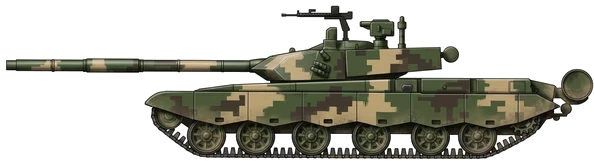
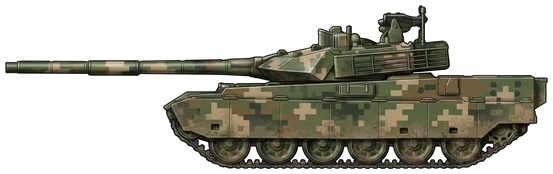
| Type 99 | VT-4 | |
|---|---|---|
| Origin country | 🇨🇳 China | 🇨🇳 China |
| Category | Main Battle Tank | Main Battle Tank |
| Type | Medium Main Battle Tank | Main battle tank |
| Manufacturer | Norinco | Norinco |
| Number produced | 1,300 units | 120 units |
| Estimated unit price | $2.5 million | $4.9 million |
| Combat weight | 52.0 tons | 52.0 tons |
| Maximum speed | 65 km/h | 70 km/h |
| Operational range | 450 km | 500 km |
| Length | 9.99 m | 10.10 m |
| Width | 3.45 m | 3.44 m |
| Height | 2.30 m | 2.40 m |
| Crew | 3 | 3 (commander, driver, gunner) |
Detailed Comparison
China's Type 99 (1,300 units produced, $2.5 million each) forms the heavy armor core of the People's Liberation Army, while the VT-4 (120 units, $4.9 million each) is Norinco's export-oriented platform aimed at states locked out of Western markets. Both vehicles share a Soviet-legacy T-72 chassis architecture and a 125mm main gun, but they diverge sharply in procurement logic, subsystem maturity, and operational history.
Development and Design
The Type 99 program began in 1989 to replace the Type 88, evolving from reverse-engineered T-72s into a domestic third-generation platform. It entered service in 2001, culminating in the digitized Type 99A (2011) and the high-altitude Type 99B (2025). The VT-4, originating as the MBT-3000 in 2009, was engineered specifically to remove foreign dependencies—such as Ukrainian engines—that constrained earlier Chinese export tanks. It repackages subsystems from the Type 96B and Type 99A into an exportable chassis, charging foreign buyers double the unit cost of the PLA's domestic tank.
Protection and Firepower
Both tanks rely on a 125mm smoothbore gun (ZPT-98 and ZPT-98A) fed by a carousel autoloader. Combat data from Ukraine confirms this layout inherently compromises crew survivability, as hull penetrations routinely trigger catastrophic ammunition detonation. Differences emerge in secondary defensive systems:
- The Type 99 mounts modular composite armor, third-generation Relikt-type ERA, and the JD-3 active laser blinder, designed to permanently blind enemy optics or ATGM operators.
- The VT-4 utilizes FY-4 ERA (rated at 700mm RHA equivalent) and integrates the GL5 hard-kill APS on the VT-4A1 variant, alongside a small drone launcher, reflecting post-Nagorno-Karabakh battlefield adaptations.
Mobility and Logistics
At 52 tons, both vehicles share similar weight profiles but differ in power generation. The Type 99 utilizes a 1,500 hp V12 liquid-cooled diesel, yielding a superior power-to-weight ratio. The VT-4 relies on a 1,200 hp VT/E1 diesel paired with a Ch1000B automatic transmission. The VT-4 drivetrain has demonstrated reliability issues; during the 2024 Zhuhai Airshow, a VT-4 stalled mechanically while traversing a prepared incline.
Deployment and Combat Record
The Type 99 is restricted to domestic PLA use, deployed primarily in heavy combined arms brigades in the Beijing and Shenyang Military Regions, and remains untested in combat. The VT-4 has a documented, problematic combat record. Deployed by Nigeria against Boko Haram, one VT-4 was destroyed by an RPG, while another suffered a main gun failure during a military display. In December 2025, a Royal Thai Army VT-4 suffered a ruptured gun barrel during a border clash with Cambodia. Pakistan remains the largest user, producing a local variant designated Haider.
Conclusion
The Type 99 holds a decisive operational edge. Its 1,500 hp powerplant provides better tactical mobility, and its integration into a mature, domestic PLA supply chain ensures mechanical reliability. The VT-4's documented track record of mechanical stalls and metallurgical failures—specifically ruptured 125mm barrels in Thailand and Nigeria—indicates compromised manufacturing standards for the export market. The VT-4 fulfills a political procurement niche for developing states, but the Type 99 is the fundamentally sounder combat vehicle.