Tunisia Military Forces
Open-source order of battle for 2026: 35,800 active troops, 174 aircraft, 66 warships, 2,603 ground vehicles.
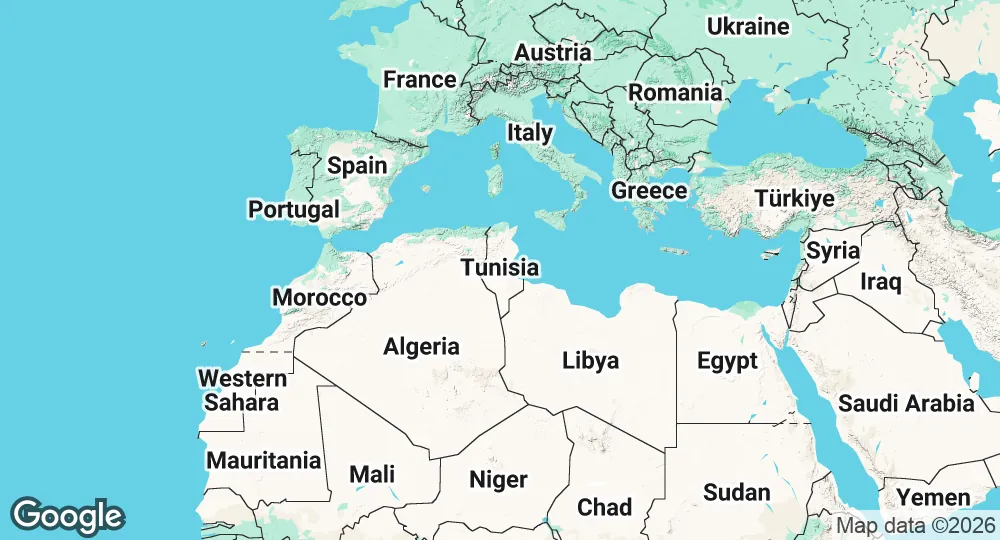
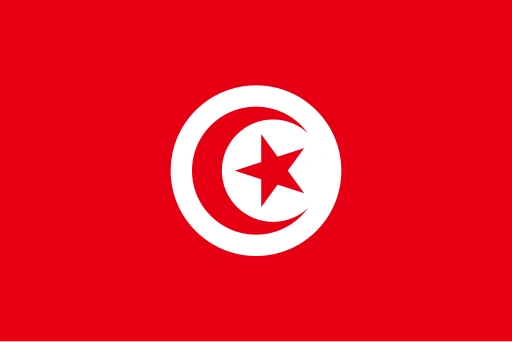
Armed Forces in 2026
| Domain | Strength | Composition |
|---|---|---|
| Air Force | 174 aircraft | 13 combat 116 helicopters 2 air bases +9 on order |
| Tunisian National Navy | 66 warships | |
| Ground Forces | 2,603 vehicles | 90 main battle tanks |
| Personnel | 35,800 active | 12,000 paramilitary |
ARMS Index (Aggregate Rating of Military Strength)
Full ranking →| Pillar | Weight | Score | Basis |
|---|---|---|---|
| Manpower | 15% | 57.6 | Active, reserve & paramilitary personnel |
| Ground forces | 20% | 53.1 | Tanks, armor & artillery weighted by type |
| Naval power | 20% | 24.8 | Weighted by hull type: carrier tiers, nuclear vs conventional submarines |
| Air power | 25% | 36.7 | Weighted by aircraft type and fleet age |
| Nuclear deterrent | 10% | 0.0 | No declared nuclear capability |
| Defense budget | 10% | 35.3 | Annual spending, purchasing-power adjusted |
| Readiness | modifier | ×1.00 | Budget per soldier: proxy for training, maintenance & technology |
Country File
| Population | 12.3M (2024) |
| GDP | $51.3 billion (2024) |
| GDP per capita | $4,181 |
| Military budget | $1.3B (2024) |
| Share of GDP | 2.5% (2024) |
| Military spending per capita | $105 (2024) |
| Inflation rate | 7.21% (2024) |
| Capital | Tunis |
| Region | Africa |
| Land area | 155,360 km² |
| Coastline | 1,148 km |
| Land borders | 1,469 km |
| Bordering countries | 2 |
| Currency | TND |
Strategic Overview in 2026
Strategic Position
Tunisia’s defense posture is primarily defined by the requirement to secure its land and maritime borders against regional instability. The country’s southeastern frontier remains a focal point due to the persistent security vacuum in western Libya. In 2025, the Tunisian government extended the military buffer zone along the Libyan and Algerian borders through August 2026 to counter arms trafficking, militant infiltration, and irregular migration.
The military maintains a defensive doctrine centered on territorial integrity and internal security. Tunisia holds Major Non-NATO Ally (MNNA) status, a designation that facilitates access to United States military training, intelligence sharing, and excess defense articles. Regional security cooperation is characterized by a trilateral framework with Algeria and Libya focused on border management. Additionally, Tunisia participates in the NATO Mediterranean Dialogue and hosts various international exercises, such as Phoenix Express, to improve maritime interoperability.
Primary security concerns include the presence of extremist cells in the western highlands, specifically the Chaambi and Sammama mountains, and the risk of spillover from militia rivalries in Tripoli. The military is also tasked with managing migration flows across the Mediterranean, coordinating with European Union partners on maritime surveillance.
Military Forces
The Tunisian Armed Forces (TAF) are organized into the Army, Air Force, and Navy, with an active-duty strength of approximately 36,000 personnel. This is supplemented by a 12,000-member National Guard under the Ministry of Interior, which performs gendarmerie and border security functions.
Army
The Army is the largest branch and is structured into three mechanized brigades and specialized Saharan territory forces. Armor units operate M60A1 and M60A3 Patton main battle tanks, alongside SK-105 Kürassier light tanks. Mechanized units utilize M113 armored personnel carriers and Turkish-made BMC Kirpi and Ejder Yalçın Mine-Resistant Ambush Protected (MRAP) vehicles. Specialized capabilities include the Groupement des Forces Spéciales (GFS), which focuses on counter-terrorism and mountain warfare.
Air Force
The Air Force provides light attack, transport, and intelligence, surveillance, and reconnaissance (ISR) capabilities. The fighter fleet consists of F-5 Tiger II aircraft, supplemented by AT-6 Wolverine light attack aircraft delivered through 2026. For ISR missions, the Air Force operates C-208B Grand Caravan EX aircraft and Anka-S unmanned aerial vehicles (UAVs). Transport is handled by a fleet of C-130H and C-130J-30 Hercules. The rotary wing includes UH-60M Black Hawk and Bell 412 helicopters.
Navy
The Navy focuses on coastal defense and search and rescue. Its fleet includes Syphax-class offshore patrol vessels (OPVs) and MSOPV 1400 vessels. In 2025, the Navy commissioned two refurbished Island-class patrol boats from the United States to enhance its 1,148-kilometer coastline surveillance. The fleet also operates Archangel and SAFE response boats for near-shore interdiction.
Defense Industry
Tunisia possesses a modest domestic defense industry primarily concentrated on naval construction. The Société de Constructions Industrielles et Navales (SCIN) has locally manufactured coastal patrol craft in cooperation with foreign partners. However, the country remains largely dependent on foreign imports for advanced platforms and heavy equipment. Procurement has increasingly diversified beyond traditional partners like the United States and France to include Turkey for armored vehicles and UAVs.
Strategic Trends
The Ministry of National Defense is currently implementing its 2020-2030 strategic plan, which prioritizes the modernization of ISR capabilities and border surveillance infrastructure. The 2026 state budget allocates approximately 6.32 billion Tunisian dinars to the ministry, a 13% increase over 2025. This rise is largely driven by a 47% increase in investment spending for new equipment and infrastructure upgrades.
Modernization efforts are focused on improving the military's ability to conduct proactive counter-terrorism operations and detect cross-border movements. This includes the deployment of electronic sensor fences and ground-based radars along the southeastern border. A shift toward more mobile and lighter forces reflects the transition from conventional territorial defense to asymmetrical warfare requirements. Constraints on the defense posture include significant public debt and high inflation, which limit the acquisition of high-cost platforms such as modern multirole fighter aircraft.
Military Expenditure: CIA World Factbook. Last updated on 11 August 2026. Suggest a change
Frequently Asked Questions
How large is Tunisia's military?
What is Tunisia's defense budget?
How does Tunisia rank militarily in the world?
Does Tunisia have nuclear weapons?
How many aircraft does Tunisia's air force have?
How large is Tunisia's navy?
How many tanks does Tunisia have?
What percentage of GDP does Tunisia spend on defense?
What is Tunisia's military personnel per capita?
Does Tunisia have paramilitary forces?
- AUG 112026 Updated Global Military Index updated
- AUG 42026 Updated Global Military Index updated in a site-wide editorial pass
- AUG 32026 Updated Global Military Index updated
- JUL 162026 Updated Global Military Index updated in a site-wide editorial pass
- JUN 162026 Updated Yearly statistics, military spending and 2 more fields updated
- JAN 172026 Updated Main battle tank count and Global Military Index updated
- JAN 132026 Updated Description updated