UH-1N Twin Huey
American medium military utility helicopter, introduced in the late 20th century, widely used for tactical transport, search and rescue, and close air support. Key figures: top speed 240 km/h, range 459 km, service ceiling 5,300 m, max takeoff weight 4,763 kg. In service with 28 air forces as of 2026 — United States (63), Thailand (56), Italy (47) and 25 others.
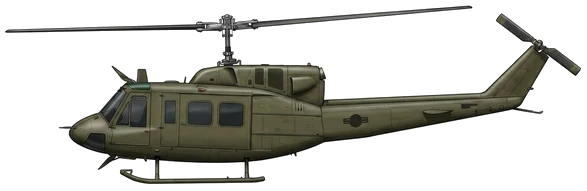
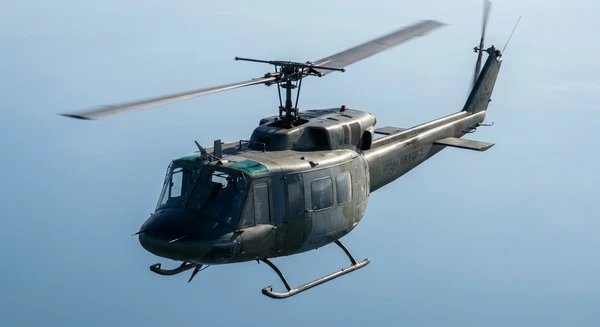
| Crew | 4 (pilot, co-pilot, crew chief, gunner) |
| Length | 17.6 m (57.7 ft) |
| Wingspan | 14.6 m (48.0 ft) |
| Height | 4.4 m (14.4 ft) |
| Wing area | 168 m² (1808.3 sqft) |
| Max. takeoff weight | 4,763 kg (10,501 lbs) |
| Powerplant | 2 × Pratt & Whitney Canada T400-CP-400 930 kW each |
| Maximum speed | 240 km/h (149 mph) |
| Operational range | 459 km (285 mi) |
| Service ceiling | 5,300 m (17,388 ft) |
| Climb rate | 8.92 m/s (29.3 ft/s) |
-
 United States
63
United States
63
-
 Thailand
56
Thailand
56
-
 Italy
47
Italy
47
-
 Colombia
23
Colombia
23
-
 Austria
22
Austria
22
-
 Saudi Arabia
22
Saudi Arabia
22
-
 Bahrain
21
Bahrain
21
-
 Philippines
15 +6
Philippines
15 +6
-
 Bangladesh
14
Bangladesh
14
-
 Argentina
13
Argentina
13
-
 Sri Lanka
12
Sri Lanka
12
-
 Turkey
12
Turkey
12
-
 Angola
9
Angola
9
-
 Iran
9
Iran
9
-
 Venezuela
9
Venezuela
9
-
 Greece
8
Greece
8
-
 Peru
8
Peru
8
-
 Morocco
7
Morocco
7
-
 Panama
7
Panama
7
-
 Zambia
7
Zambia
7
-
 Spain
6
Spain
6
-
 Guatemala
5
Guatemala
5
-
 Uruguay
5
Uruguay
5
-
 El Salvador
4
El Salvador
4
-
 Yemen
4
Yemen
4
-
 Sudan
3
Sudan
3
-
 Lebanon
2
Lebanon
2
-
 Myanmar
1
Myanmar
1
- Air-to-Surface AS.12
- Rocket Pod 2.75-inch (70 mm) rocket pods
Recent Events — UH-1N Twin Huey
8 events →-
SEP 152026
 Philippines
×2
Two Bell 412EPX formally accepted at Villamor AB; second batch of an eight-helicopter order.
Delivered
Philippines
×2
Two Bell 412EPX formally accepted at Villamor AB; second batch of an eight-helicopter order.
Delivered
-
DEC 222025
 Thailand
Bell 212 lost stability on a border mission and hard-landed at Surin airport; fire put out, four crew injured, the Army said.
Damaged
Thailand
Bell 212 lost stability on a border mission and hard-landed at Surin airport; fire put out, four crew injured, the Army said.
Damaged
-
NOV 302025
 Sri Lanka
Bell 212 crashed during Cyclone Ditwah relief operations at Wennappuwa; the pilot was killed and four injured.
Crash
Sri Lanka
Bell 212 crashed during Cyclone Ditwah relief operations at Wennappuwa; the pilot was killed and four injured.
Crash
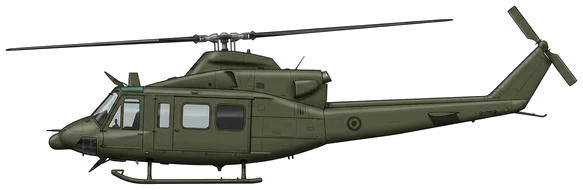
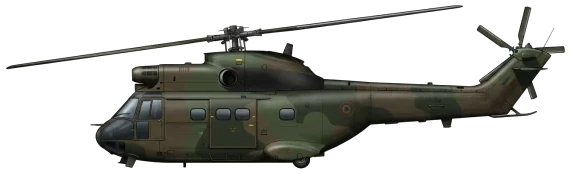
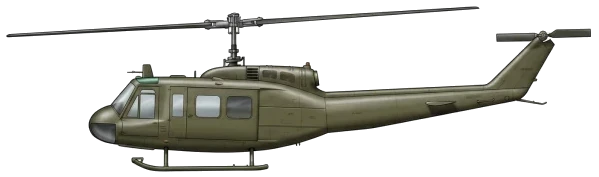
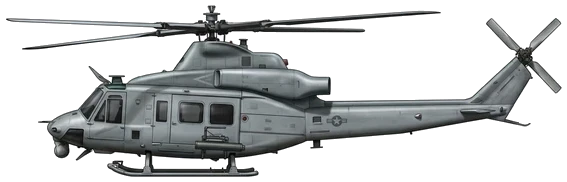
Description
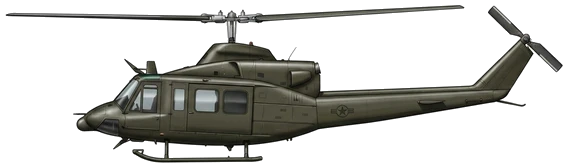
The Bell UH-1N Twin Huey is a twin-engine medium military helicopter developed from the stretched-fuselage Bell 205. Designed by Bell Helicopter following 1968 negotiations with the Canadian Forces, the aircraft performed its maiden flight in April 1969. The US military subsequently ordered 294 aircraft under the UH-1N designation, with deliveries starting in 1970, while Canada procured 50 under the CUH-1N (later CH-135) designation starting in 1971. Agusta also produced the helicopter under license in Italy as the AB-212.
Design
Power is provided by a PT6T-3/T400 Turbo Twin Pac, producing up to 1,342 kW (1,800 shp). If one engine section fails, the remaining section can deliver 671 kW (900 shp) for 30 minutes to maintain cruise performance. The UH-1N is IFR and night-flight capable, featuring duplicate hydraulic, electrical, and fuel systems alongside fire suppression systems. The helicopter has a maximum takeoff weight of 10,500 lb (4,763 kg), an internal cargo capacity of 4,400 lb (1,996 kg), and an external load capacity of up to 5,000 lb (2,268 kg). The cabin can be configured for up to 14 passengers or six medical evacuation litters. USMC variants integrated a stability control augmentation system that replaced the mechanical rotor stabilization bar.
Armament
Standard armament consists of a .50 caliber GAU-16 machine gun mounted on the left side and a 7.62 mm GAU-17 minigun or M240 lightweight machine gun on the right side. The helicopter can also carry 2.75-inch (70 mm) rocket pods.
Operational History
The USAF deployed the UH-1N to Vietnam in October 1970 to support Special Forces reconnaissance missions. USMC and USN operations began in 1971. USMC UH-1Ns provided close air support, reconnaissance, and communications during the 2003 invasion of Iraq and deployed to Afghanistan before their retirement in August 2014. The USAF utilizes the UH-1N to support ICBM launch sites. Internationally, Canada operated the CH-135 in UN peacekeeping missions in Central America, Somalia, and Haiti. Argentina deployed two Bell 212s during the 1982 Falklands War, and Colombia operated the type during its internal armed conflict. Export and licensed operators include Italy, Greece, Iran, Peru, Spain, Turkey, and Venezuela.
Variants
- CH-135 Twin Huey: The Canadian Forces version of the UH-1N, of which 50 were procured starting in 1971.
- UH-1N Iroquois: The initial production model utilized by the United States Air Force, Navy, and Marine Corps.
- VH-1N: A specialized VIP transport variant configured for carrying high-ranking officials and the US president.
- HH-1N: A dedicated search and rescue variant.
- Agusta-Bell AB 212ASW: An Italian license-built maritime variant configured for anti-submarine warfare and anti-shipping operations.
Frequently Asked Questions
What type of aircraft is the UH-1N Twin Huey?
What is the maximum speed of the UH-1N Twin Huey?
What is the range of the UH-1N Twin Huey?
When did the UH-1N Twin Huey first fly?
Which countries operate the UH-1N Twin Huey?
What is the service ceiling of the UH-1N Twin Huey?
- JUN 302026 Created Page created: UH-1N Twin Huey