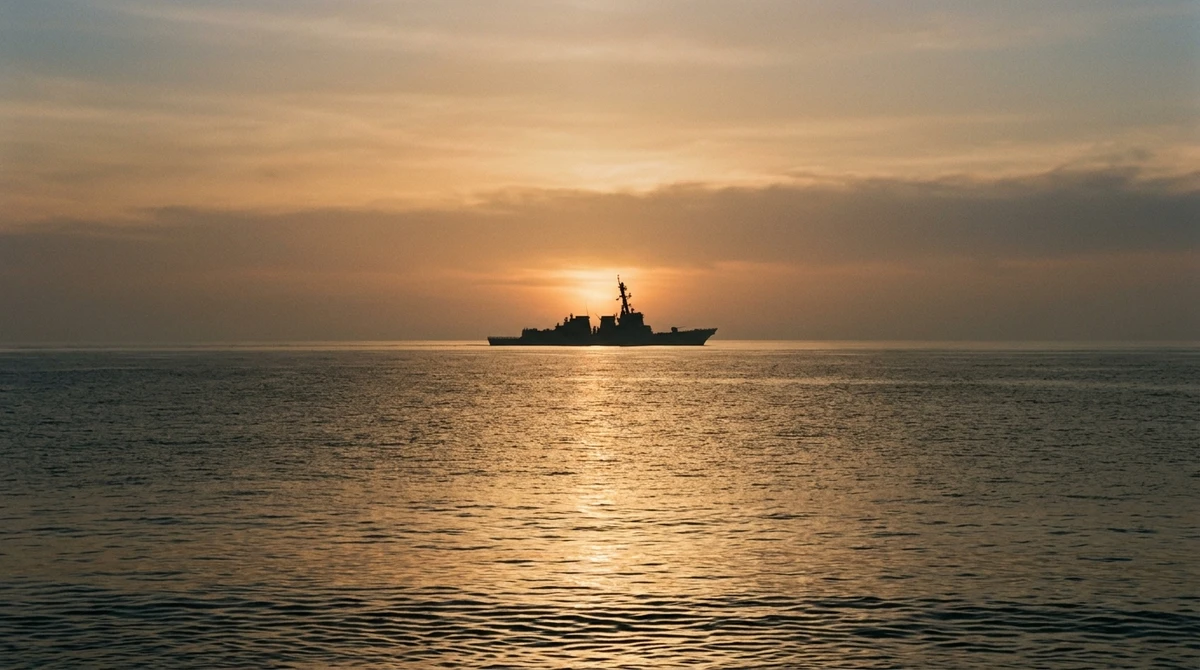
Giuseppe Garibaldi was the first through-deck aviation ship built for the Italian Navy and the first designed to operate fixed-wing aircraft. Constructed by Fincantieri at the Monfalcone shipyard, the vessel was laid down in 1981 and commissioned in 1985. Although functioning as an aircraft carrier, it was officially designated as an aircraft-carrying cruiser (Incrociatore portaeromobili) due to a 1937 law that restricted fixed-wing aircraft operation to the Italian Air Force. This legal restriction remained in place until 1989, when the Italian Navy was permitted to acquire Harrier II fighters.
The ship features an off-axis flight deck equipped with a 6.5-degree ski-jump to support short take-off and vertical landing (STOVL) operations. The propulsion system utilizes gas turbines driving two shafts. For defensive and offensive operations, the vessel was originally equipped with surface-to-surface missiles, though these were removed during a 2003 modernization to expand the flight deck and communication systems. Remaining defensive equipment includes surface-to-air missiles, Close-In Weapon Systems (CIWS), and torpedo tubes. Electronic warfare capabilities consist of jamming systems, decoy launchers, and towed torpedo decoys. The ship’s aviation complement consists of a mix of AV-8B Harrier II fighter-bombers and helicopters, such as the Agusta SH-3D or AgustaWestland AW101, configured for anti-submarine warfare, search and rescue, and electronic early warning.
Throughout its service history, Giuseppe Garibaldi was based in Taranto and primarily functioned as an anti-submarine warfare carrier. In 1999, the vessel deployed Harrier fighters for combat sorties during the Kosovo War. Following the 2001 terrorist attacks, it served as the command ship for Italian naval forces in the Indian Ocean during Operation Enduring Freedom, conducting interception and air support missions in Afghanistan. In 2009, the carrier was succeeded as the Italian flagship by Cavour. During the 2011 military intervention in Libya, the ship's aircraft participated in strike operations under NATO command. Giuseppe Garibaldi was decommissioned on October 1, 2024, and replaced by the landing helicopter dock Trieste. Following its retirement, the ship was transferred free of charge to Indonesia, a transfer approved by the Italian Parliament in April 2026. It left Taranto in August 2026 and was commissioned into the Indonesian Navy as KRI Sriwijaya (100) at Tanjung Priok, Jakarta, on 24 September 2026, becoming Indonesia's first aircraft carrier.