AV-8B Harrier II
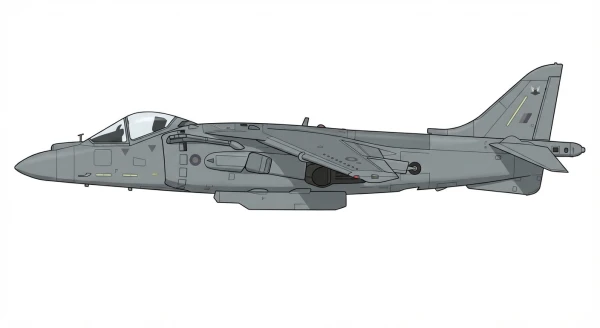
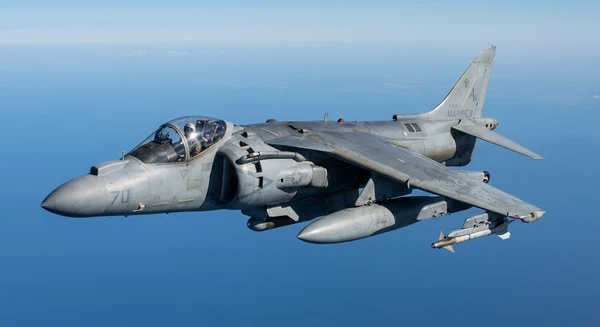
British-American ground-attack aircraft, infamously deployed in numerous conflicts including the Gulf War with unique vertical takeoff/landing capabilities. Key figures: top speed 1,070 km/h, range 3,300 km, service ceiling 15,240 m, max takeoff weight 14,100 kg, unit price $26M, built 337. In service with 3 air forces as of 2026 — United States (87), Italy (12), Spain (10).
| Crew | 1 |
| Length | 14.1 m (46.3 ft) |
| Wingspan | 9.3 m (30.3 ft) |
| Height | 3.6 m (11.6 ft) |
| Wing area | 22.6 m² (243.4 sqft) |
| Empty weight | 6,340 kg (13,977 lbs) |
| Max. takeoff weight | 14,100 kg (31,085 lbs) |
| Powerplant | 1 × turbojet Rolls-Royce Pegasus F402-RR-408 10,500 kgf each |
| Ejection seat | UPC Stencel SJU-4/7A |
| Maximum speed | 1070 km/h (Mach 1.07) |
| Operational range | 3,300 km (2,051 mi) |
| Service ceiling | 15,240 m (50,000 ft) |
| Climb rate | 75.0 m/s (246.1 ft/s) |


- Air-to-Surface AGM-65 Maverick
- Air-to-Surface AGM-84 Harpoon
- Anti-Radiation AGM-88 HARM
- Air-to-Air Medium-Range AIM-120 AMRAAM
- Air-to-Air Short-Range Raytheon AIM-9 Sidewinder
Recent Events — AV-8B Harrier II
2 events →-
JUN 32026
 United States
×10
TAV-8B two-seat trainers retired alongside the single-seat fleet as USMC Harrier operations ended at MCAS Cherry Point.
Retired
United States
×10
TAV-8B two-seat trainers retired alongside the single-seat fleet as USMC Harrier operations ended at MCAS Cherry Point.
Retired
-
JUN 32026
United States
×77
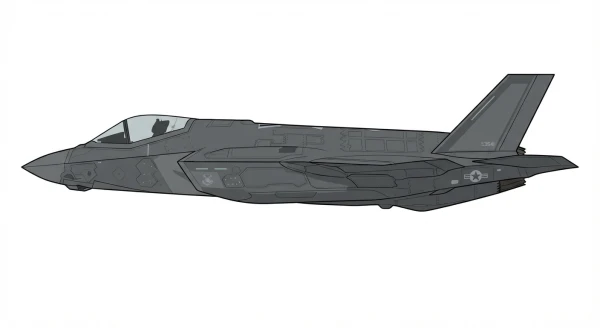
VMA-223 flew the final Harrier sortie at MCAS Cherry Point; AV-8B officially retired after four decades of USMC service, replaced by the F-35B.
Retired
Description
The McDonnell Douglas (now Boeing) AV-8B Harrier II is a single-engine ground-attack aircraft developed jointly by the United States and the United Kingdom. Designed for light attack and multi-role missions including close air support and armed reconnaissance, the aircraft entered service with the United States Marine Corps in January 1985. It is known for its vertical or short takeoff and landing (V/STOL) capabilities.
Development
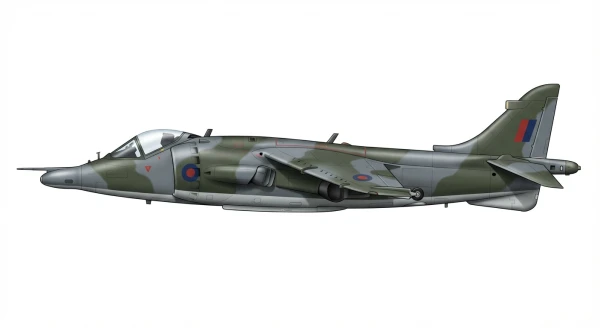
Development began in the early 1970s as a joint U.S.–UK effort to address payload and range limitations in the first-generation Hawker Siddeley Harrier. The United Kingdom withdrew from the project in 1975 due to budget constraints, leading McDonnell Douglas to redesign the AV-8A independently. Rebuilt prototypes designated YAV-8B first flew in November 1978, and the first full-scale development AV-8B made its initial flight in November 1981. British Aerospace rejoined the program as a subcontractor in 1981, taking a 40 percent airframe work-share. Production ended in 2003 after approximately 340 aircraft were built over a 22-year manufacturing run.
Design
The AV-8B features a composite supercritical wing with a sweep of 37 degrees, an elevated cockpit for improved visibility, and mid-span outrigger landing gear. Power is supplied by a single Rolls-Royce Pegasus turbofan engine with four synchronized vectorable thrust nozzles and under-fuselage lift-improvement devices. Cockpit avionics include an angle-rate bombing system, a cathode-ray multi-purpose display, and hands-on-throttle-and-stick controls. The AV-8B(NA) variant introduced a forward-looking infrared sensor, while the AV-8B Plus added an APG-65 pulse-Doppler radar.
Armament
The aircraft has six under-wing pylons and one centerline station providing a total payload capacity of 9,200 lb (4,200 kg). It carries an under-fuselage pod-mounted General Dynamics GAU-12 Equalizer 25 mm five-barreled rotary cannon with 300 rounds. Munition options include AIM-9 Sidewinder and AIM-120 AMRAAM air-to-air missiles, AGM-65 Maverick air-to-surface missiles, Hydra 70 and Zuni rocket pods, and GBU-12 laser-guided or JDAM guided bombs.
Operational History
The AV-8B has served with the United States Marine Corps, the Spanish Navy, and the Italian Navy. During Operation Desert Storm in 1991, 86 USMC AV-8Bs flew 3,380 sorties with five combat losses. The type subsequently flew combat missions during Operation Allied Force in Kosovo, Operation Enduring Freedom in Afghanistan, the Iraq War, and Operation Odyssey Dawn in Libya. Italian and Spanish Harriers operated in coalition deployments over Kosovo and Libya, flying from carriers such as Giuseppe Garibaldi and Príncipe de Asturias. The USMC retired its AV-8B fleet in June 2026 during its transition to the F-35B Lightning II.
Variants
- AV-8B Harrier II: The initial day-attack production variant equipped with an angle-rate bombing system.
- AV-8B Harrier II Night Attack: An upgraded version incorporating a forward-looking infrared camera, night-vision goggle compatibility, and an F402-RR-408 engine.
- AV-8B Harrier II Plus: A radar-equipped variant featuring an APG-65 radar for beyond-visual-range missile capability.
- TAV-8B Harrier II: A dedicated two-seat trainer featuring an extended forward fuselage and a heightened vertical stabilizer.
- EAV-8B Matador II: The designation applied to AV-8B variants operated by the Spanish Navy.
Frequently Asked Questions
What type of aircraft is the AV-8B Harrier II?
What is the maximum speed of the AV-8B Harrier II?
What is the range of the AV-8B Harrier II?
When did the AV-8B Harrier II first fly?
How many AV-8B Harrier II have been built?
Which countries operate the AV-8B Harrier II?
How much does a AV-8B Harrier II cost?
What is the service ceiling of the AV-8B Harrier II?
- AUG 122026 Updated Range corrected to the ferry range
- AUG 62026 Updated Description updated
- AUG 12026 Updated Manufacturer updated
- JUN 262026 Updated Bombs updated
- APR 72026 Updated Sources and cross-references refreshed
- JAN 122026 Updated Range updated in a site-wide editorial pass