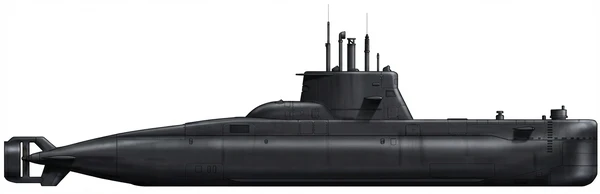
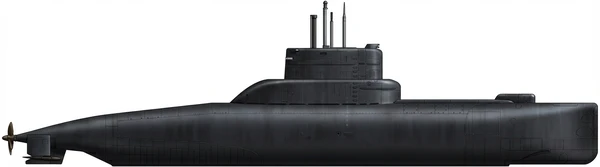
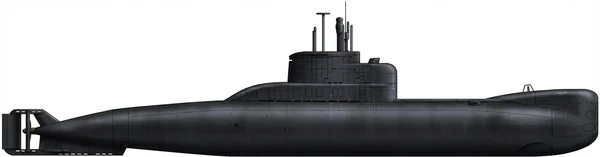
The Ghadir class is a series of midget submarines manufactured by the Marine Industries Organization for the Islamic Republic of Iran Navy. Development followed Iranian interest in midget submarine technology during the 1980s, which included an unsuccessful assembly attempt in 1987 and the reported acquisition of North Korean vessels in 1988 and 1993. The existence of the Ghadir class was first identified in February 2004. In May 2005, Iranian officials announced the commencement of mass production, with the first unit participating in the Ettehad 84 military exercise. While design origins are subject to varying analyses—with some observers noting similarities to the North Korean Yugo and Sang-O classes—unclassified intelligence reports indicate the design is based on the Yono class.
The class is designed for operations in the shallow waters of the Persian Gulf. Propulsion is provided by a diesel-electric system featuring a secondary retractable propeller. Each vessel is equipped with sonar of an unknown type and carries a crew of seven. Beyond torpedoes such as the Valfajr and Hoot, the class is capable of deploying Nasr-1 and Jask-2 anti-ship cruise missiles; the latter was developed specifically for submarine launch. Secondary mission capabilities include naval mine laying and the transport and retrieval of personnel for special operations. The design emphasizes maneuverability and the ability to remain stationary on the seabed to avoid detection.
The Ghadir class entered active service in 2007. All units are assigned to the Iranian Navy’s Southern Fleet, with no vessels active in the Caspian Sea. Estimates of the total number of vessels produced vary by source, with reports ranging from 10 to 21 active units around 2020. Service history includes participation in regional exercises and international deployments. In May 2014, the Ghadir 953 conducted a port call in Karachi, Pakistan, to participate in joint naval drills with the Pakistan Navy. One vessel was reportedly lost in April 2014, with causes attributed to either an exercise accident or a collision during patrol. The fleet has undergone periodic expansion, with a new unit commissioned as recently as September 2022. Maintenance programs have also been documented, with overhauls of existing vessels occurring through 2020.
The class saw combat during the 2026 Iran war. A Ghadir boat was shown being struck in a US Central Command strike video released on 10 March 2026, and a second was hit pier-side at Bandar Abbas naval base on 12 July 2026 by Saronic Corsair unmanned surface vessels, the first US combat employment of armed sea drones against a submarine. Claims about the wider toll diverge sharply: US Secretary of War Pete Hegseth stated in March that Iran's submarines — "they once had 11" — were gone, and the White House said in April that Iran retained zero submarines, yet only two Ghadir losses have been confirmed by imagery and the July strike itself contradicts the "zero" assessment. Iranian officials, for their part, said in May 2026 that light submarines remained deployed in the Strait of Hormuz. The International Institute for Strategic Studies counted about 16 boats in service in its February 2026 edition of The Military Balance, immediately before the war.