James Madison-class (SSBN-627)
American submarine, introduced in 1964, displaces 7,443 tons. Key figures: displacement 7,443 tons, length 130 m, top speed 16 knots, crew 140, built 10. No longer in service; operated by 1 navy over its career.

| Subtype | Nuclear-powered ballistic missile submarine |
| Displacement | 7443 tons |
| Displacement submerged | 8383 tons |
| Crew | 140 members |
| Width | 10.0 m (32.8 ft) |
| Length | 130.0 m (426.5 ft) |
| Max. depth | 400 m (1312.3 ft) |
| Propulsion | 1 × S5W PWR, 2 geared steam turbines (15,000 shp (11,000 kW)), 1 shaft |
| Units | James Madison, Tecumseh, Daniel Boone, John C. Calhoun, Ulysses S. Grant, Von Steuben, Casimir Pulaski, Stonewall Jackson, Sam Rayburn, Nathanael Greene |
| Range | Unlimited, except by food supplies |
| Maximum speed | 16 knots |
| Max. speed submerged | 21 knots |
- 16 Polaris A3 or Poseidon C3 or Trident I C4 missiles
- 4 × 21-inch (533 mm) torpedo tubes
- 12 torpedoes
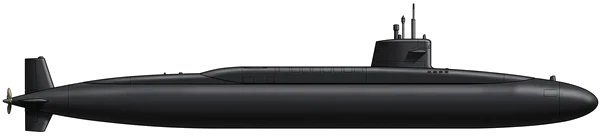
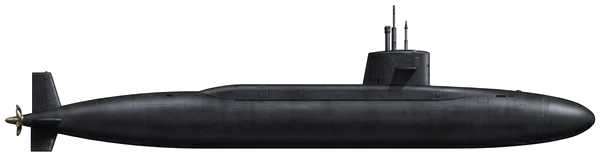
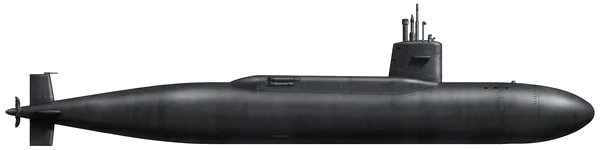

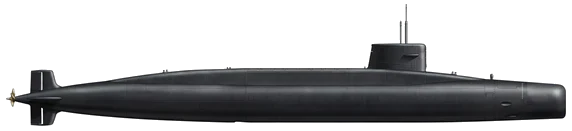
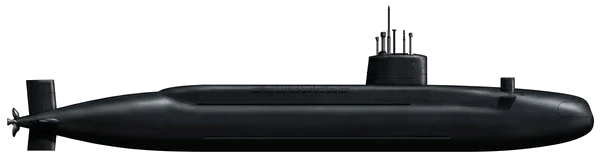
Description
The James Madison class was a series of ten nuclear-powered fleet ballistic missile submarines operated by the United States Navy. Built between 1962 and 1964, the class was an evolutionary development of the Lafayette class. The vessels were constructed by Newport News Shipbuilding and Drydock Company, General Dynamics Electric Boat, Mare Island Naval Shipyard, and Portsmouth Naval Shipyard. Along with the George Washington, Ethan Allen, Lafayette, and Benjamin Franklin classes, these submarines formed the "41 for Freedom" nuclear deterrent force.
The design was identical to the preceding Lafayette class but was initially configured to carry the Polaris A-3 missile. During the early 1970s, the Navy modified all ten boats to carry Poseidon C-3 missiles. A subsequent modification in the late 1970s and early 1980s enabled six boats to carry the Trident I C-4 missile: James Madison, Daniel Boone, John C. Calhoun, Von Steuben, Casimir Pulaski, and Stonewall Jackson. Due to design similarities, some references group the James Madison class with the Lafayette and Benjamin Franklin classes.
The class remained in commission from 1964 to 1995. In May 1972, USS John C. Calhoun completed the fleet's thousandth Polaris nuclear deterrent patrol upon entering Holy Loch, Scotland. Decommissioning occurred between 1986 and 1995. The removal of the class from service was directed by the entry of Ohio-class submarines into the fleet, the requirements of the SALT II treaty, vessel age, and the dissolution of the Soviet Union. Following decommissioning, the submarines were processed through the Ship-Submarine Recycling Program. One unit, USS Sam Rayburn, was retained in a non-operational status before being designated for recycling.
Frequently Asked Questions
What type of ship is the James Madison-class?
What is the displacement of the James Madison-class?
What is the maximum speed of the James Madison-class?
What is the range of the James Madison-class?
How many crew members serve on the James Madison-class?
How many James Madison-class ships have been built?
Which countries operate the James Madison-class?
- APR 72026 Updated Description updated in a site-wide editorial pass
- JAN 242026 Updated Range added
- JAN 182026 Updated Type, manufacturer and 8 more fields updated