Reis-class (Type 214TN)
Turkish submarine, 1,860 tons displacement, powered by Siemens fuel cells. Key figures: displacement 1,860 tons, length 68 m, top speed 10 knots, crew 27, unit cost $370M, built 2. In service with 1 navy — Turkey (2).
| Subtype | Diesel-electric submarine |
| Displacement | 1860 tons |
| Displacement submerged | 2013 tons |
| Crew | 27 members |
| Width | 6.3 m (20.7 ft) |
| Length | 68.35 m (224.2 ft) |
| Propulsion | 3,900 kW (5,200 hp) Siemens Permasyn main engine, 2× MTU 16V 396SE 64L diesel generators, 2× batteries (324 Type 30PS15B), 2× 120 kW (160 hp) Siemens fuel cells |
| Range | 12,000 nm |
| Maximum speed | 10 knots |
| Max. speed submerged | 20 knots |
- 8 x 533 mm torpedo tubes
- Roketsan Akya torpedoes
- Mk48 Mod6T torpedoes
- DM2A4 torpedoes
- Atmaca anti-ship missiles
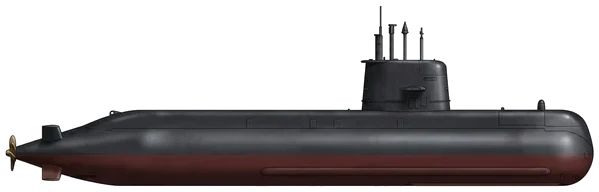
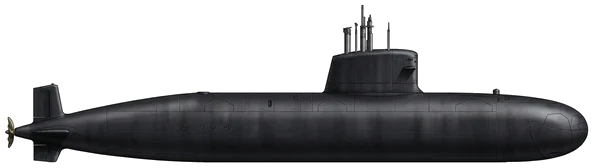
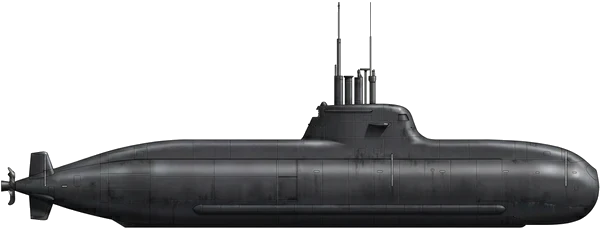
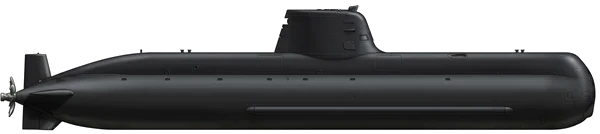
Description
The Reis class, formerly designated the Cerbe class, is a series of six air-independent propulsion (AIP) submarines built for the Turkish Navy. The program began on 28 December 2006 when the Undersecretariat for Defence Industries of the Turkish Ministry of National Defense issued a request for proposal. Following bids from DCNS, Navantia, and a German-British consortium of Howaldtswerke-Deutsche Werft (HDW) and Marine Force International (MFI), Turkey selected the ThyssenKrupp Type 214 design in July 2008. A contract worth €2.06 billion was signed on 2 July 2009, entering into force on 22 June 2011. Under the agreement, the submarines are license-built at Gölcük Naval Shipyard in Turkey using material packages supplied by HDW/MFI. Turkish companies, including ASELSAN, HAVELSAN, MilSOFT, STM, Koç Information and Defense, TÜBİTAK Defense Industries Research and Development Institute, and Meteksan Defense, serve as subcontractors.
The Reis-class design is based on the Type 214 submarine, modified with Turkish subsystems and armaments. Propulsion is provided by a 3,900 kW Siemens Permasyn main engine, two MTU 16V 396SE 64L diesel generators, 324 Type 30PS15B batteries, and two 120 kW Siemens fuel cells that support the AIP system. Sensors and combat systems include the ISUS 90-72 sonar and weapon control system. For armament, the submarines feature eight 533 mm torpedo tubes capable of deploying Roketsan Akya, Mk48 Mod6T, and DM2A4 heavyweight torpedoes, Atmaca anti-ship missiles, and mines.
Construction of the vessels takes place at the Gölcük Naval Shipyard's Submarine Production Plant, utilizing Block A for hull welding and assembly and Block B for outfitting. The Turkish Navy named the six planned submarines after 16th-century Ottoman Navy admirals: TCG Pirireis, TCG Hızırreis, TCG Muratreis, TCG Aydınreis, TCG Seydialireis, and TCG Selmanreis. The lead boat, TCG Pirireis (S-330), was laid down on 28 September 2015, launched, and began sea trials in December 2022 before commissioning on 24 August 2024. The second submarine, TCG Hızırreis (S-331), was laid down in 2017, launched on 25 May 2023, and commenced sea trials in August 2024, was handed over on 27 November 2025 and was commissioned at Istanbul Naval Shipyard on 21 December 2025. TCG Muratreis (S-332) was laid down in 2018, launched on 29 May 2025, and docked for fitting. The final three submarines—TCG Aydınreis (S-333), TCG Seydialireis (S-334), and TCG Selmanreis (S-335)—are currently under construction.
Frequently Asked Questions
What type of ship is the Reis-class?
What is the displacement of the Reis-class?
What is the maximum speed of the Reis-class?
What is the range of the Reis-class?
How many crew members serve on the Reis-class?
How many Reis-class ships have been built?
Which countries operate the Reis-class?
How much does a Reis-class cost?
- SEP 252026 Updated Commissioning date of the second boat corrected; handover date added
- JUL 292026 Updated Description updated
- JUL 242026 Updated Type updated; cost updated
- JAN 182026 Created Page created: Reis