Chang Bogo-class (Type 209/1200)
South Korean submarine, introduced in 1993, uses four MTU diesel engines for propulsion. Key figures: displacement 1,200 tons, length 56 m, top speed 11 knots, crew 33, unit cost $373M, built 12. In service with 1 navy — South Korea (8).
| Subtype | Diesel-electric attack submarine |
| Displacement | 1200 tons |
| Displacement submerged | 1400 tons |
| Crew | 33 members |
| Width | 6.3 m (20.7 ft) |
| Length | 56.0 m (183.7 ft) |
| Max. depth | 500 m (1640.4 ft) |
| Propulsion | 4 MTU Type 8V396 SE diesel engines, 1 Siemens electric motor, 1 shaft, 5,000 shp (3,700 kW) |
| Range | 11,000 nm at 10 knots |
| Endurance | 50 days |
| Maximum speed | 11 knots |
| Max. speed submerged | 21 knots |
- 8 x 21 in (533 mm) torpedo tubes
- 14 SUT torpedoes
- UGM-84 Harpoon anti-ship missiles
- 28 mines
- White Shark heavy torpedo
- Hae Sung anti-ship missiles
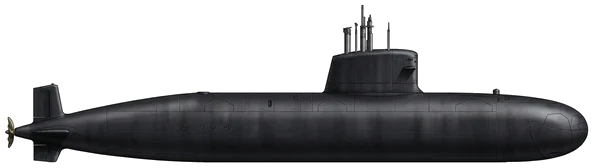
Description
The Chang Bogo class, also designated as KSS-I, is a variant of the Type 209 diesel-electric attack submarine. Named after an ancient maritime figure, the class was developed to serve the requirements of the Republic of Korea Navy and was later adopted by the Indonesian Navy. Since its initial commissioning, the platform has undergone various modifications and has been succeeded by the Type 214. It has also been evaluated for potential acquisition by other regional powers.
This class of attack submarine utilizes a diesel-electric propulsion system. The design features bow-mounted torpedo tubes capable of deploying heavy torpedoes, mines, and integrated anti-ship missiles. Modernization efforts have introduced Torpedo Acoustic Counter Measures and advanced sonar suites, including hull-mounted passive and active search-and-attack arrays. Structural upgrades have involved hull stretching to increase displacement and the development of lithium-ion battery technology to extend submerged endurance. Maintenance protocols require a complete disassembly and re-welding of the hull periodically to replace internal machinery and navigational systems.
The Chang Bogo class is actively operated by South Korea and Indonesia, where it is also known as the Nagapasa class. The platform has been extensively utilized in international maritime exercises, including RIMPAC and Tandem Thrust. Operational records from these simulations indicate high lethality; units have successfully engaged surface vessels and nuclear-powered submarines while remaining undetected. Reported incidents include the sinking of a decommissioned cruiser during a live-fire exercise and a collision with a commercial merchant vessel. The class remains a primary component of regional underwater strike capabilities. Retirement of the South Korean boats began on 31 December 2025, when the lead boat, ROKS Jang Bogo (SS-061), was decommissioned after 34 years of service.
Frequently Asked Questions
What type of ship is the Chang Bogo-class?
What is the displacement of the Chang Bogo-class?
What is the maximum speed of the Chang Bogo-class?
What is the range of the Chang Bogo-class?
How many crew members serve on the Chang Bogo-class?
How many Chang Bogo-class ships have been built?
Which countries operate the Chang Bogo-class?
How much does a Chang Bogo-class cost?
- SEP 252026 Updated First South Korean retirement, the lead boat in December 2025, recorded
- JAN 182026 Created Page created: Chang Bogo