Son Won-il-class (Type 214 / KSS-II)
German submarine, introduced in 2007, has a displacement of 1,690 tons and diesel-electric propulsion. Key figures: displacement 1,690 tons, length 65 m, top speed 12 knots, crew 27, unit cost $330M, built 16. In service with 1 navy — South Korea (9).
| Subtype | Diesel-electric submarine |
| Displacement | 1690 tons |
| Displacement submerged | 1860 tons |
| Crew | 27 members |
| Width | 6.3 m (20.7 ft) |
| Length | 65.0 m (213.3 ft) |
| Max. depth | 400 m (1312.3 ft) |
| Propulsion | Diesel–electric, fuel cell AIP, low-noise skew back propeller; 2 × MTU 16V-396 (3.96 MW) diesel engines; 1 × Siemens Permasyn (2.85 MW) electric motor |
| Range | 12,000 nm |
| Endurance | 84 days |
| Maximum speed | 12 knots |
| Max. speed submerged | 20 knots |
- 8 × 533 mm torpedo tubes
- 4 Sub-Harpoon missile-capable
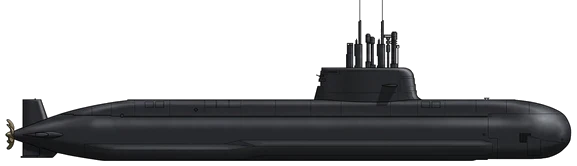
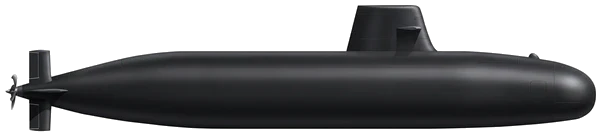
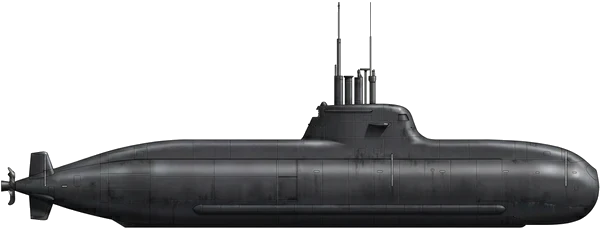
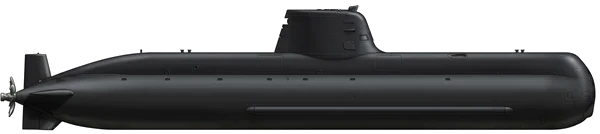
Description
The Son Won-il-class submarines were developed for the Republic of Korea Navy based on the German Type 214 design by Howaldtswerke-Deutsche Werft (HDW). The South Korean Ministry of Defence initiated the program under an October 2000 agreement with HDW, which included the transfer of submarine construction technology. A total of nine Son Won-il-class submarines were ordered. The first batch of three vessels was assembled by Hyundai Heavy Industries and began entering service in 2007. The second batch of six submarines was ordered under a subsequent August 2008 contract to be built by Daewoo Shipbuilding & Marine Engineering, entering service starting in 2012.
The design of the Son Won-il class combines the principles of the Type 209 submarine family with features of the Type 212A submarine. The pressure hull is constructed of HY-100 steel, enabling an estimated diving depth of 400 meters. Unlike the Type 212A, the export design lacks a non-magnetic steel hull, leaving it susceptible to magnetic anomaly detectors. Propulsion is provided by two MTU 16V-396 diesel engines, two Piller Ntb56.40-10 charging generators, a Siemens Permasyn electric motor, and a low-noise skew back propeller. The air-independent propulsion (AIP) system utilizes two HDW polymer electrolyte membrane (PEM) hydrogen fuel cell BZM120 modules from Siemens Energy. For armament, the submarines feature eight 533 mm torpedo tubes, four of which are capable of launching Sub-Harpoon missiles. The primary sensor is the SPHINX-D Radar System from Thales Defence Deutschland GmbH, which integrates a high-power pulse transmitter with a low-power tactical Low Probability of Intercept (LPI) transmitter to allow covert surface navigation.
Active service for the Son Won-il class began with the commissioning of the lead ship, ROKS Sohn Won-yil (SS-072), on 27 December 2007. This was followed by ROKS Jeong Ji (SS-073) in December 2008 and ROKS An Jung-geun (SS-075) in December 2009. In March 2008, media reports alleging defects related to excessive screw noise on the first vessel were denied by the Republic of Korea Navy.
The second batch of submarines includes ROKS Kim Jwa-jin (SS-076), ROKS Yun Bong-gil (SS-077), ROKS Yu Gwan-sun (SS-078), ROKS Hong Beom-do (SS-079), ROKS Lee Beom-seok (SS-081), and ROKS Shin Dol-seok (SS-082). Among these, the guided-missile submarine ROKS Hong Beom-do was launched on 5 April 2016. Of the nine planned vessels, eight are currently in active duty with the Republic of Korea Navy.
Frequently Asked Questions
What type of ship is the Son Won-il-class?
What is the displacement of the Son Won-il-class?
What is the maximum speed of the Son Won-il-class?
What is the range of the Son Won-il-class?
How many crew members serve on the Son Won-il-class?
How many Son Won-il-class ships have been built?
Which countries operate the Son Won-il-class?
How much does a Son Won-il-class cost?
- JUL 292026 Updated Description updated
- JUL 242026 Updated Type updated
- JAN 182026 Created Page created: Son Won-il