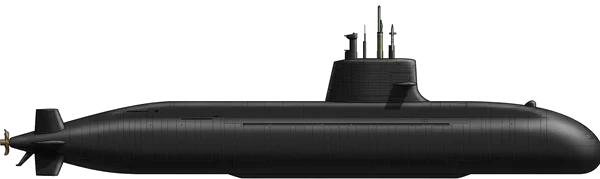
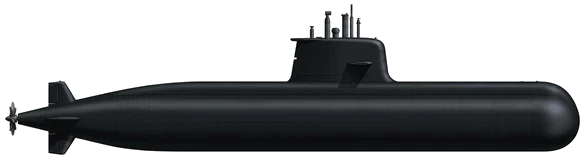
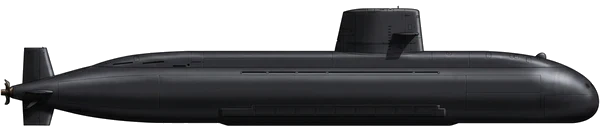
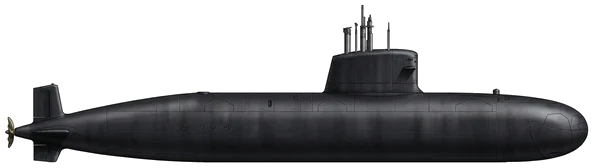
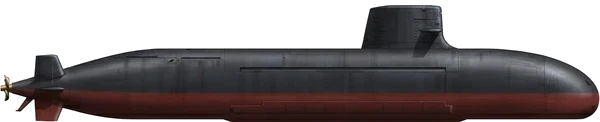
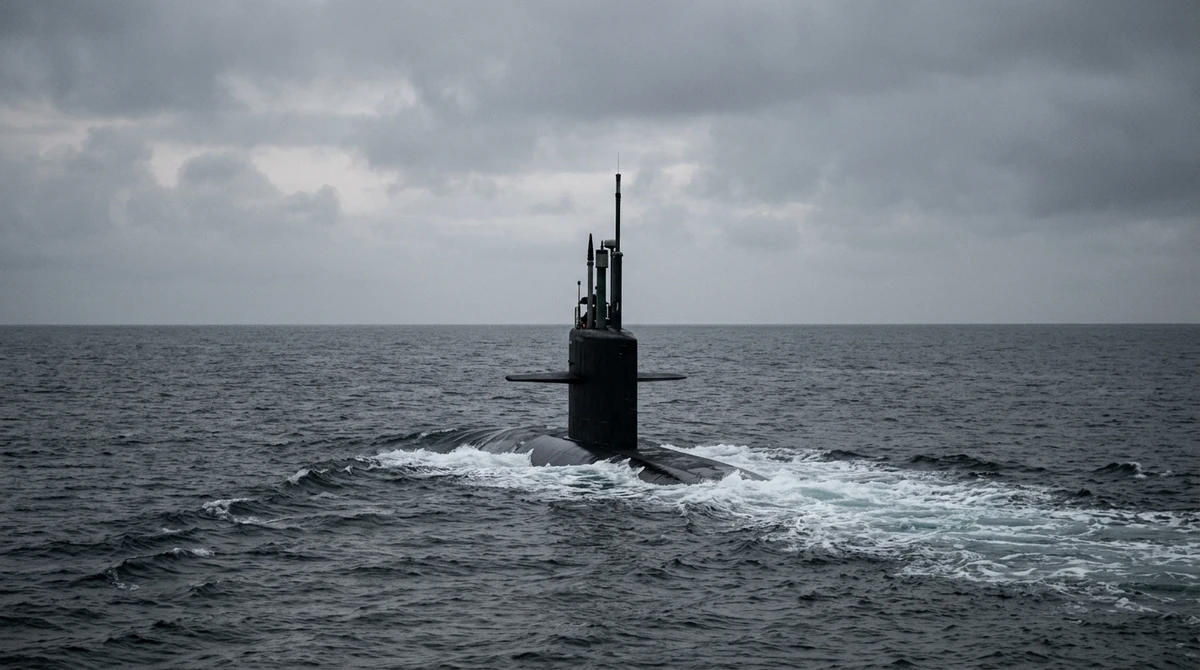
The Taigei-class submarines (29SS) are a class of diesel-electric attack submarines built for the Japan Maritime Self-Defense Force of Japan as the successor to the Sōryū class.
Development of the Taigei class began with preliminary studies in 2004 to optimize cost-effectiveness and design efficiency. In 2005, research commenced on next-generation sonar and air-independent propulsion systems. Structural evaluations in 2006 focused on noise reduction and impact resistance, utilizing a floating floor structure to dampen internal vibrations and mitigate external shocks. In 2009, studies began on a new snorkel power generation system after MTU 16V396SE and SEMT Pielstick PA4V200SM engines were evaluated and deemed insufficiently powerful. Subsequent research addressed pressure shell structures in 2012 to optimize compartment space, fluid noise reduction and advanced sonar systems in 2016, silent drive technologies in 2017, and high-efficiency power storage and supply systems in 2018.
The hull design of the Taigei class is similar to the Sōryū class but is 100 tons heavier. Propulsion is provided by an electric motor driving a single shaft and propeller, powered by Kawasaki 25/25SB diesel engines on the first two hulls and Kawasaki 12V 25/31 engines on subsequent vessels. The boats employ lithium-ion batteries to enable extended underwater endurance and higher submerged speeds than conventional diesel-electric vessels. The sensor suite comprises an OYX-1 processing system, a ZQX-12 tactical display system, a Mitsubishi Electric non-penetrating optical periscope, NZLR-2 ESM, and a ZPS-6H surface radar. Acoustic detection relies on an Oki ZQQ-8 sonar suite, which integrates bow-mounted, flank-array, and fibre-optic towed-array sonars. Armament consists of six HU-606 533 mm torpedo tubes configured to launch Type 89 and Type 18 heavyweight torpedoes, alongside UGM-84L Harpoon Block II missiles. Plans exist to integrate Type 12 anti-ship missiles and potentially the Hyper Velocity Gliding Projectile.
The vessels are constructed by Mitsubishi Heavy Industries and Kawasaki Heavy Industries at their respective shipyards in Kobe. The lead vessel, JS Taigei, was laid down in 2018, launched in 2020, and commissioned in 2022. In 2024, JS Taigei was reclassified as a dedicated test submarine to conduct trials, allowing commissioned frontline submarines to focus on active monitoring operations. Subsequent vessels in the class include JS Hakugei, JS Jingei, JS Raigei, and JS Chōgei, with JS Sōgei launched in October 2025. In December 2023, the Ministry of Defense awarded Kawasaki Heavy Industries an R&D contract to design a successor class of diesel-electric submarines.