Nuclear vs Air-Independent Propulsion: How a Submarine Runs Without Air, and What Japan Is Weighing
After Japan's defense minister declined on September 11, 2026 to rule out nuclear-powered submarines, a technical explainer on how a reactor, a Stirling engine, a fuel cell and a lithium-ion battery each keep a boat under water, and what each one buys.
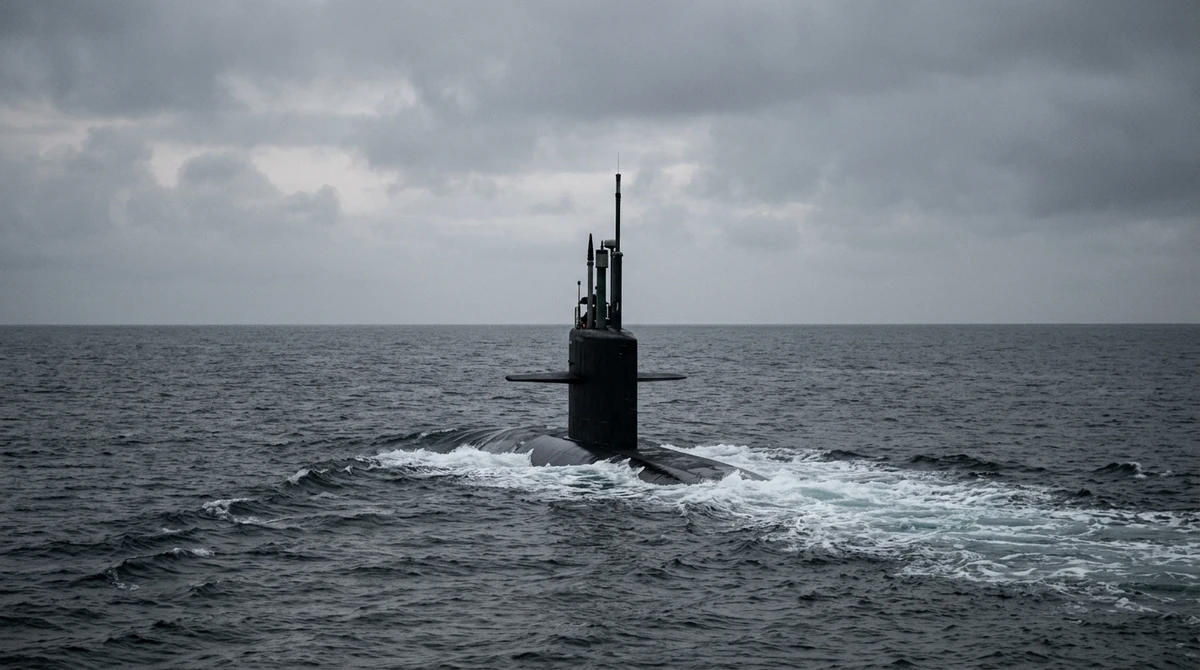
When Japan's defense minister said on September 11, 2026 that the option of nuclear-powered submarines "will not be ruled out", the remark set two very different machines side by side. The Japan Maritime Self-Defense Force operates 23 conventionally powered boats, the second-largest such fleet in the world, and its newest class runs on lithium-ion batteries with no reactor and no auxiliary engine at all. The six navies it would be joining field 140 nuclear-powered hulls between them in GlobalMilitary.net data. Both kinds of submarine dive and hide; the difference is what happens to the air.
A diesel engine needs oxygen, and a submerged submarine has none to spare. A conventional boat therefore runs on its diesels only on the surface or at snorkel depth, with a mast raised to breathe, and uses that time to charge a battery that then drives an electric motor in silence. The share of a patrol spent with a mast up is the "indiscretion rate," and it is the number every conventional-submarine designer is trying to push down: a snorkelling boat is noisy, leaves a wake and a radar return, and is at its most vulnerable. On lead-acid batteries, a submarine can stay down for a few days at a crawl, or for a few hours at high speed. Everything below is a different answer to that constraint.
The nuclear answer is to carry the oxygen problem out of the equation. A pressurized-water reactor heats a sealed primary loop of water kept liquid under pressure; that loop boils a secondary loop in a steam generator, and the steam drives turbines that turn the shaft through reduction gears, or turn generators that feed electric motors. France's Suffren class uses the second layout in hybrid form: two propulsion turbines for speed, two turbo-generators and two electric motors for low and tactical speeds, all fed by a K15 reactor, according to Naval News. Nothing in the chain consumes air. The boat's endurance is set by its crew and its food, not its fuel: Naval News puts Suffren's at a minimum of 70 days with 65 sailors, at speeds beyond 25 knots. A submarine that can cross an ocean submerged at that pace and stay on station for two months is a different tactical object from one that must come up to breathe every few days.
The price of that freedom comes in three forms. The first is the reactor itself and the fuel inside it. The United States fuels its naval reactors with uranium enriched to 93 percent, originally produced for warheads, and the Virginia class was the first with a core designed to last the ship's 33-year life without refueling, the Arms Control Association notes; the Columbia-class cores are designed for 42 years. France took the opposite path, running its boats on fuel enriched to less than 6 percent, close to civilian grade, at the cost of refueling every ten years during a major overhaul. The second is money: the Congressional Research Service puts a Virginia-class boat at about $5.0 billion when bought at two a year, and 41 had been procured through fiscal year 2025. The third is everything around the boat. Coverage of the Japanese debate in Naval News listed the obstacles in order: cost, an entirely new infrastructure for reactor maintenance, fuel handling and trained personnel, and the Atomic Energy Basic Act, which restricts nuclear energy to peaceful purposes.
Air-independent propulsion is the conventional submarine's counter-offer: a small power plant that runs under water on oxygen the boat brings with it, usually as liquid oxygen in cryogenic tanks, so that the battery is topped up without a mast. Three families exist, and they share one limit. Their output is measured in hundreds of kilowatts against the megawatts of a main motor, so an AIP boat creeps on its auxiliary plant and still sprints on its battery.
The oldest in service is the Stirling engine, developed by Kockums, now part of Saab. Diesel fuel and liquid oxygen burn in a pressurized chamber; the heat drives a closed helium cycle in which the gas is alternately heated and cooled against seawater to move a piston, and the piston turns a generator. Because combustion is external and continuous, Saab describes the engine as quiet and vibration-free, with no vibration spreading to the hull. Each unit produces about 75 kW, according to European Security & Defence, and the Swedish boats manage over two weeks of AIP operation at 5 knots. The first ten Sōryū-class boats carry four Kawasaki-built Kockums engines each, China's Type 039A uses a Stirling plant of its own, and the Hangor class commissioned for Pakistan in April 2026 is assumed to as well, though Pakistani officials have not confirmed its propulsion, Naval News reported.
The fuel cell is the German answer. In a proton-exchange membrane cell, hydrogen and oxygen combine across a membrane to produce electricity directly, with water as the only exhaust, collected on board; on the Type 212A the hydrogen sits in metal-hydride cylinders and the liquid oxygen in tanks outside the pressure hull, feeding a Permasyn motor of about two megawatts, The War Zone notes. The first boat carried nine 34 kW cells, later ones two of 120 kW; the current thyssenkrupp plant delivers 320 kW from four stacks, and nine navies operate its fuel-cell boats, from Germany and Italy to South Korea and Singapore. Spain's S-80 Plus solves the hydrogen storage problem differently: a reformer makes hydrogen on demand from bioethanol, so no hydrogen is stored on board, Navantia says, for a rated 300 kW and up to three weeks submerged; the third boat, Cosme García, was the first fitted, the first two being retrofitted at their first overhaul. India's DRDO has developed a phosphoric-acid fuel-cell module for the Kalvari class, to be inserted at refit. France's own MESMA, a closed-cycle steam turbine burning ethanol with oxygen, equips Pakistan's Agosta 90B boats and has found no other customer.
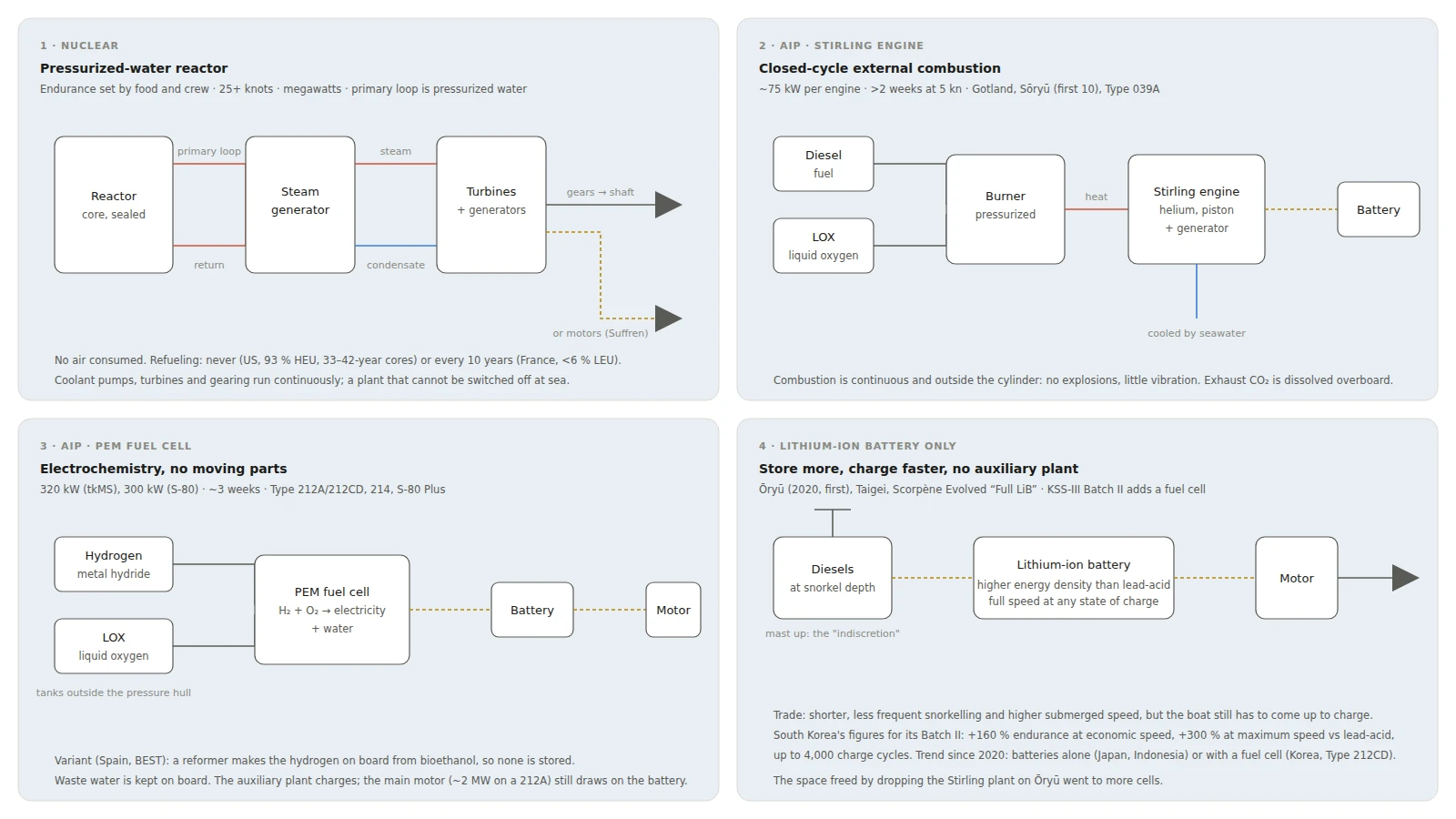
The newest answer is not an engine at all. On March 5, 2020 the JMSDF commissioned Ōryū, the eleventh Sōryū-class boat and the first submarine in the world to run on lithium-ion batteries; the Stirling plant was removed and the space given over to more cells. Lithium-ion stores more energy per tonne and per cubic metre than lead-acid, charges faster, which shortens each snorkelling exposure, and delivers full speed regardless of its state of charge, European Security & Defence notes in its review of the technology. Japan then built the Taigei class, five of which are in service, around lithium-ion batteries alone, with no AIP module at all. South Korea went the other way and kept both: the first KSS-III Batch II boat, launched on October 22, 2025 for service at the end of 2027, pairs Samsung SDI lithium-ion cells with a fuel-cell plant, and the Republic of Korea Navy claims 160 percent more endurance at economic speed and 300 percent more at maximum speed than the lead-acid Batch I, with up to 4,000 charge cycles. Naval Group's Scorpène Evolved for Indonesia is a "Full LiB" boat, batteries with no AIP, and Germany and Norway's Type 212CD, twelve boats from 2029, combines two diesels, a fuel-cell plant and provision for lithium-ion cells, according to Naval Technology.
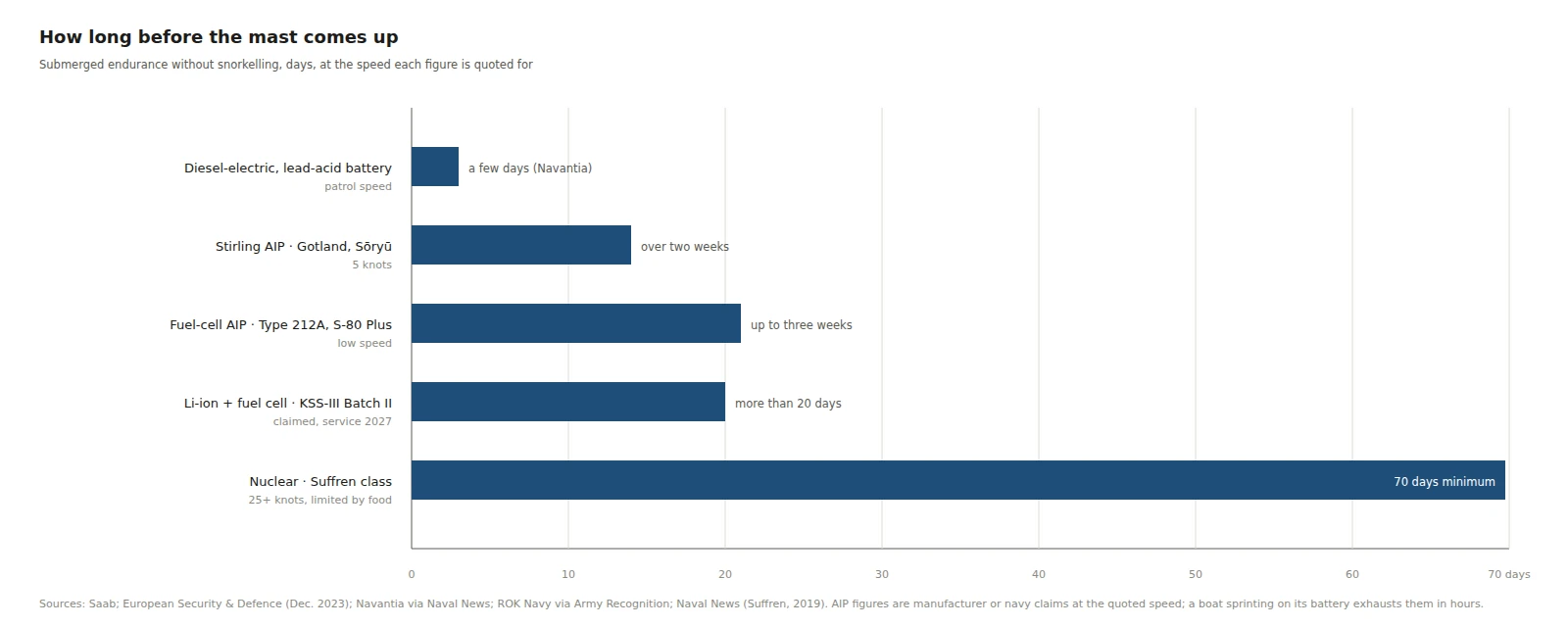
What the chart does not show is the second axis. An AIP boat holds its two or three weeks only at a walking pace; a nuclear boat holds its 70 days at 25 knots. That is the capability the JMSDF chief of staff had in mind in January 2026 when he acknowledged, according to Naval News, that the long submerged endurance and high speed of nuclear attack submarines "could provide a significant improvement in tactical capability." Against it stands the one advantage a battery boat never gives up: at low speed, with the auxiliary plant off, it has almost nothing turning. A reactor cannot be shut down at sea; its coolant must circulate, and its turbines and gearing run whether the boat is hunting or hiding, which is why Suffren's designers gave it electric motors for tactical speeds and why navies with short sea lanes to defend have stayed conventional. Crew size follows the plant: Suffren sails with 65, the Gotland class with under 30.
Japan's geography is the case for both. Its patrol areas in the East China Sea and the straits of the Ryukyu chain are close to home, where a quiet battery boat that leaves port charged can sit for weeks; a nuclear boat would add the ability to reach the Philippine Sea or the Bashi Channel fast and stay, and to sail with the Virginia-class boats the US Navy operates from Japan, and that Australia is acquiring through AUKUS. The choice, if one is made, will appear in the three security documents due by the end of 2026 rather than in a press conference. Until then the JMSDF's answer to the air problem remains the one it chose in 2020: no reactor, no Stirling engine, and as many lithium-ion cells as the hull will take.
More News
All news →
Latvia Picks Czech Morana Howitzers Over Sweden's Archer
Latvia's Cabinet of Ministers decided on September 15, 2026 to procure Excalibur Army's Morana 155 mm wheeled howitzers, setting aside a June 2025 letter of intent with Sweden for 18 BAE Systems Bofors Archer systems, the Ministry of Defence said.
US Air Force to Extend B-1 and B-2 Service Lives With Only Three B-21s in the Fleet
Air Force Global Strike Command said on 17 September 2026 that the B-1 Lancer and B-2 Spirit will fly beyond their planned retirements, keeping a US bomber force built on 1955, 1986 and 1993 designs in service while the B-21 Raider arrives at three aircraft.
Japan Will Not Rule Out Nuclear-Powered Submarines as Six Navies Field 140 Between Them
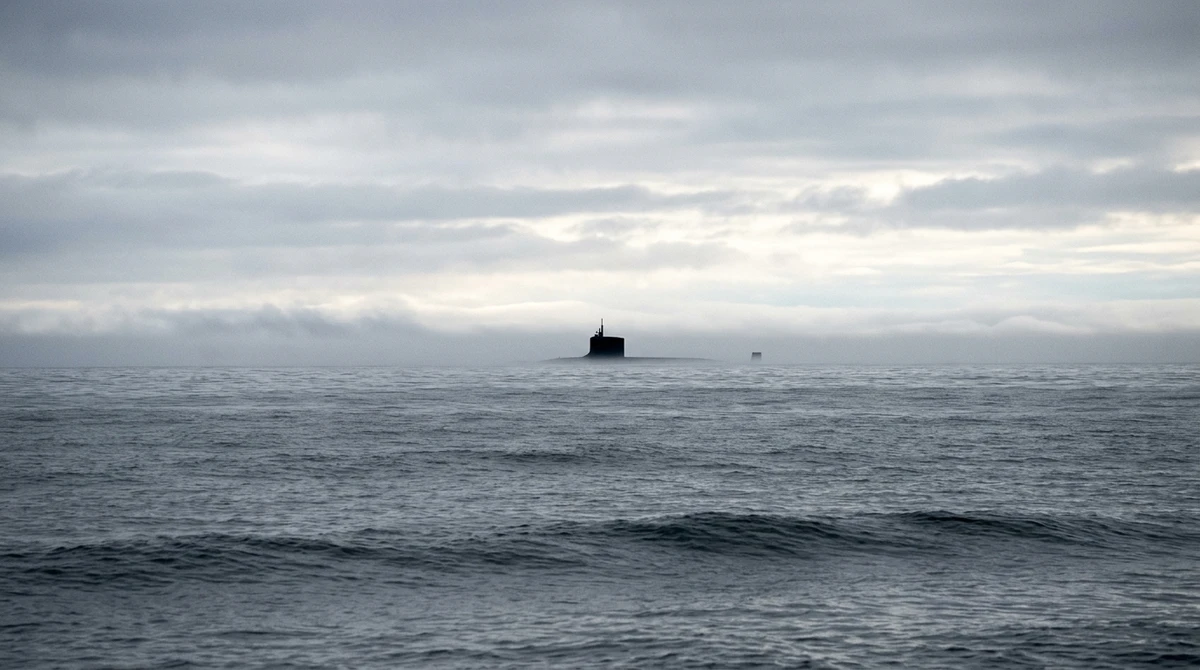
Japan's defense minister said on 11 September 2026 that nuclear-powered submarines "will not be ruled out" in the year-end revision of the country's security documents, an option that would put the JMSDF alongside the six navies operating 140 nuclear boats today.
Former Italian Carrier Giuseppe Garibaldi Enters Indonesian Waters Ahead of Handover to Jakarta
The Indonesian Navy said on 17 September 2026 that the former Italian carrier Giuseppe Garibaldi, to be renamed KRI Sriwijaya, had entered Indonesian waters and was due at Tanjung Priok in Jakarta on 18 September, ahead of a formal transfer whose date is reported differently by outlets.
Saudi Arabia Cleared to Buy 48 F-35 Fighters in $24.3 Billion State Department Approval
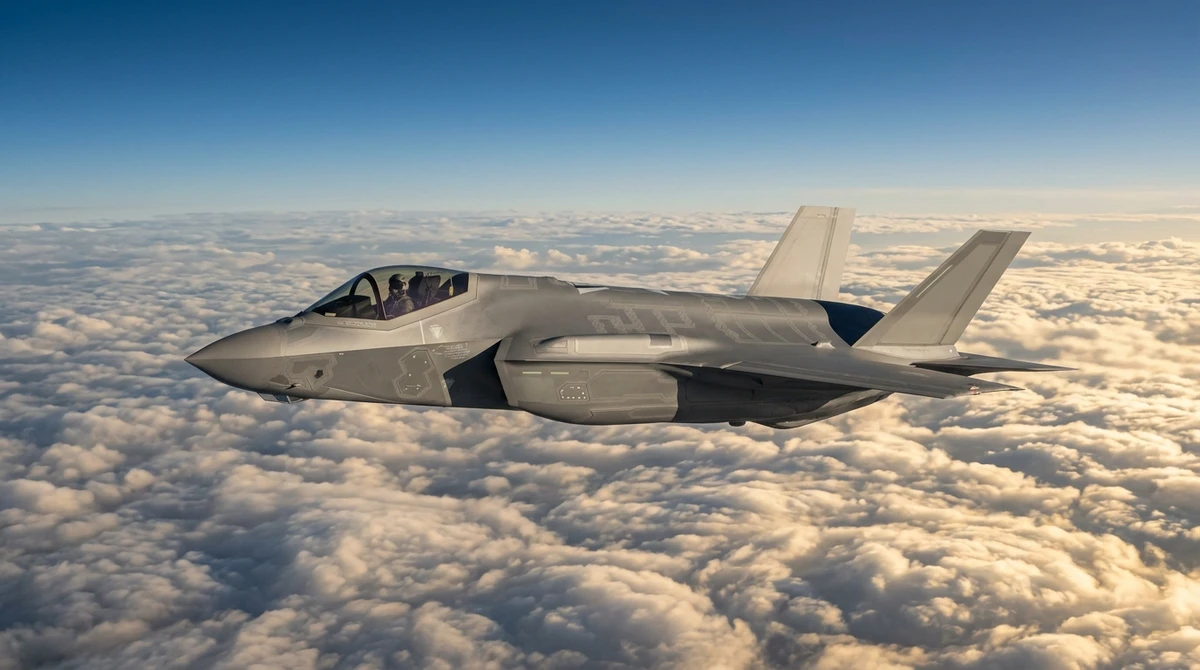
The U.S. State Department on 17 September 2026 approved a possible Foreign Military Sale of 48 F-35 Lightning II fighters and 49 F135 engines to Saudi Arabia, a package estimated at $24.3 billion that now goes to Congress for review.

Only Four Air Forces Fly High-Altitude Surveillance Drones, and Japan Has Just Lost One of Its Three
A Japan Air Self-Defense Force RQ-4B Global Hawk went down over international waters north of Tottori prefecture on 15 September 2026, the first loss of a Japanese Global Hawk and one of only 39 high-altitude surveillance drones GlobalMilitary.net records in service worldwide.